AI researchers often glibly – at times, gleefully – describe the potential that their creations might lead to human extinction.
Perhaps this helps the work feel as scientifically momentous as the early-twentieth-century discoveries in quantum mechanics and nuclear physics that led to the atomic bomb. With atomic weapons, humans nearly caused our own extinction. Given who currently has control over the deployment of these arsenals, we’re still teetering at the brink. Twentieth century advances in physics and engineering might do us in.

How grand, then, that computer scientists may have concocted a new way to do us in!
When AI researchers describe the potential for their creations to cause human extinction, though, they typically evoke the metaphor of how we humans have imperiled chimpanzees. Compared to chimpanzees, we humans have more cognitive flexibility. (By many metrics, at least. There are certainly also mental tasks that most chimpanzees can accomplish more readily than most humans, but for the sake of the metaphor, let’s lean into the anthropocentric chauvinism for now.)
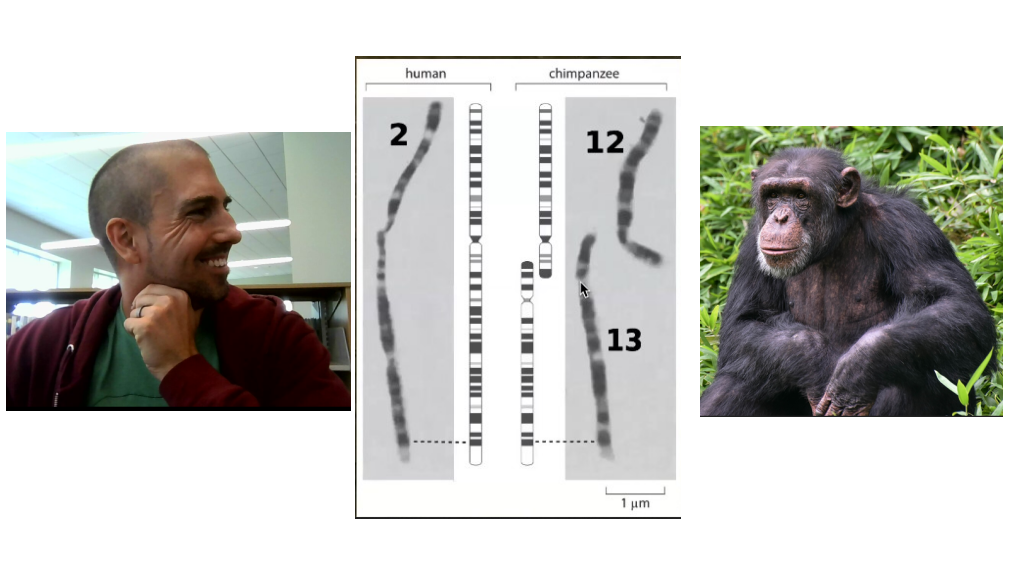
We are smarter. Wiser. More able to create new technologies. With our brilliant minds, we’ve conquered the world. We can coordinate collective action across vast distances, on a far larger scale and far more quickly than any troop of chimpanzees.
Humans and chimpanzees share an ancestry, but because we are more clever, we’ve taken over their world.
And the implication is that AI could do that to us.
Quite possibly, a hyper rational AI would make choices that would result in our extinction. As I’ve described, a transistor-based intelligence would prefer a very different atmosphere from the oxygen-rich air that we humans need in order to survive.
At the moment, though, there is no cognitively flexible AI. When people discuss AI, they are typically referring to LLMs (“large language models” rather than “artificial intelligence”), which can do something that looks quite similar to intelligent behavior, but only because our own minds have evolved to interpret conscious volition from the actions of others. We see faces when we look at electrical outlets. We read human emotions like anger or vindictiveness into the behavior of storms.
And so of course we see minds from text. Especially when that text is generated by randomizing plagiarism engines.
A large language model or an algorithmic image generator is built by inputting huge quantities of training data. Existing text (generated by humans) or images (generated by humans, and described by humans) is processed by the computer to generate a large matrix of probabilities. Consider the previous sentence: in all human writing to date, perhaps the word “of” was followed by a noun 70% of the time, an adjective 30% of the time. If an LLM were writing that sentence, after putting in the word “of,” the LLM would generate a random number between 0 and 1 – if the random number was below 0.7, it would put a noun into the next position of the sentence.
Except that an LLM doesn’t concoct probabilities based only on the previous word. It will perform a calculation using a vector the represents the full set of existing text, multiplied by a matrix that represents all the choices that all human writers in the past have made. The branch of mathematics that this type of calculation comes from is called “linear algebra,” and it’s often tricky for humans to visualize – useful matrices often represent N-dimensional space, where the number N might be very large, whereas our brains are best at imagining only three-dimensional worlds – but it’s conceptually simple, necessitating only that many numbers be multiplied and added together.
Coincidentally, this is also why computer chips that were originally designed for video game graphics are so good at running LLMs – game graphics are collections of vectors representing which color pixel appears at which position, and multiplying these vectors by simple matrices according to rules of linear algebra allows you to transform images. If you want to make an image twice as big, perhaps to represent your character flying toward something in a space ship, you multiply the starting image by the matrix [2 0 ; 0 2]. If you’d like to rotate an image ninety degrees to the left, perhaps to represent what you’d see while doing a barrel role in a space ship, you’d multiply the starting image by the matrix [0 -1 ; 1 0]. These are just two-dimensional matrices, because computer graphics appear on two dimensional screens, whereas LLMs use very large matrices to handle all the data that might affect the probability of what word might come next in a vector of text. But the underlying math is the same.

Each LLM is built to use these matrices to come close to plagiarizing text, but with sufficient randomization to skirt the legal definition of plagiarism. When generating text that hews closely to examples in the training set that can be plagiarized from, an LLM will do a good job. Many humans have written about Taylor Swift, so an LLM could generate a very convincing biography of Taylor Swift. If an LLM is used to generate text that isn’t similar to examples in the training set, though, it will fail. An LLM can generate biographies of relatively minor public figures, also, and the text will have a reasonable structure and well-written sentences. It will also be riddled with lies and inaccuracies.
Please note that none of this is meant to imply that it would be impossible to create a transistor-based intelligence. As I’ve described recently, no one yet understands how the connections between our neurons actually results in conscious intelligence, but as of yet, we’ve discovered no reasons why something similar couldn’t be built using computer chips. LLMs aren’t intelligent – that’s not the intent behind these algorithms – but other computer-chip-based creations might be.
But even LLMs could do great harm to humanity.
And the most relevant metaphor for how LLMs will hurt us is not the way that human cunning has nearly driven chimpanzees to extinction … but rather how human noise is pushing many species closer to extinction. Blithely, inadvertently, unthinkingly, we humans are loud. And all that blundering noise we make has the potential to doom birds, and frogs, and fish, and whales, and …
Many bird species use sound to find mates, and care for their young, and coordinate behavior. And because human cars, airplanes, construction equipment, etc. are so noisy, in many parts of the world, we’ve saturated the frequencies that birds once used.
In noisy water – and, because transoceanic shipping has increased, most water is now quite noisy – fish are less likely to evade predators, marine mammals are increasingly stressed and unable to communicate.
We’re not doing this to other animals out of malice. Unlike with chimpanzees, we’re not even intentionally taking their territories. We’re simply making a lot of sound, and that hurts the other creatures who share our world.
Similarly, a LLM would have no intent to actually hurt humans. These algorithms use matrix math and random numbers to generate text that looks similar to their training data – there’s no underlying concept of what the text actually means (and indeed, insofar as any text generated by an LLM has meaning, it’s because either because a human reader creates that meaning in their mind, or because the text has been plagiarized from executable programs and so has an effect when run on a (human-created) operating system.
An LLM could still cause devastating damage – issuing text-based commands to detonate atomic weapons, for instance, or to deactivate the coolant systems of a rival LLM datacenter.
But more broadly, the thing that these algorithms do, and do well, is generate large quantities of text quickly. And that, in and of itself, can be harmful for humans. Amid large quantities of randomly generated text, it becomes more difficult to find human writing. Like the birds who hear only the drone of automobiles on a nearby highway, our increased isolation will result from someone else’s machine simply functioning as designed.

.
.
.
lonely bird photograph, used as header & closing image, by Daude Helal Fahim on flickr.

