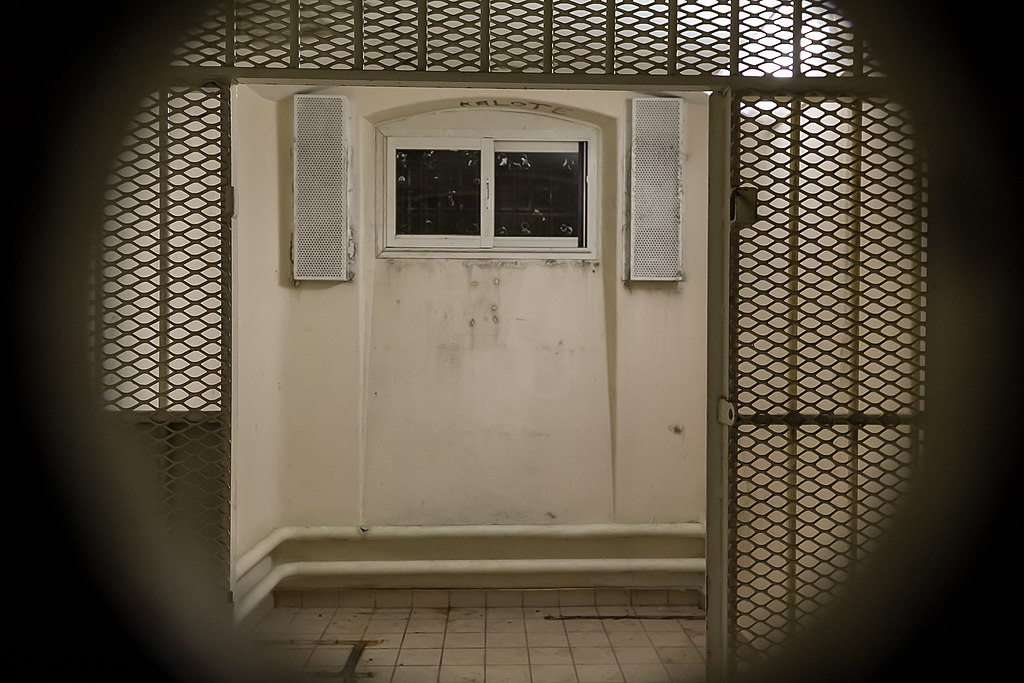
For the past few years – precipitated perhaps by the pandemic, perhaps because the ACLU has filed several lawsuits stating that the county jail here is often overcrowded, unsafe, unsanitary, and inhumane – anyone who volunteers inside the building has to be escorted by a correctional officer while walking through the halls.
So I was standing in a small foyer, waiting to be escorted into the building proper. To reach that foyer, I’d already been buzzed through two locked doors. To reach the space where I typically meet with people (to read & discuss poetry, or to handle archaeological artifacts, or to analyze NASA data on the search for habitable exoplanets, or what have you), I needed to be buzzed through yet another locked door, then escorted up an elevator, then let into the locked classroom.
At the far end of the foyer, the door has a panel of one-way reflective glass. This panel never quite fit, leaving it warped in ripples, contorting and compressing my reflection like a fun-house mirror. Depending on the angle, this mirror might grant me the impression of a slender giraffe neck, or unnaturally tall ovoid eyes, or a scrunched mouth full of little goblin teeth.
The mirror often makes me look monstrous. On some days, I’d prefer not to see myself like that.
So I stood there, closed my eyes, and tried to ignore all the sounds of the space. The various air compressors, what with three hundred some people breathing recycled indoor air (replete with vape pen exhaust, which the jail commissary sells to people at $14 apiece). The muffled buzz of distant locks. The clang of metal doors, sometimes punctate, when a door swings shut and locks somebody in, sometimes horrifically rhythmic, when a door is being kicked BANG BANG BANG by an angry person in crocs.
I’d often pictured them – these door kickers, who occasionally maintain their aggression for hours, every kick loud enough to rattle my skull and ablate my thoughts if I happen to be walking near – as kicking the doors with their toes, which had baffled me. With only crocs, and making such loud noises, how did their toes not break? That is the way that I would reflexively kick a door. But I’ve since been told that the typical procedure for making those klaxon-like sounds is to stand with your back to the door and slam the flat of your foot down into it. And also that sometimes the bones in people’s heels do break when they’re doing this.
In many ways – the isolation, the lack of sunshine, the constant ache from insufficiently padded feet on a concrete floor – the physical constraints of a jail are more than a human body can bear.
Still, I tried not to think about any of that for a bit. I closed my eyes and tried to meditate. Standing there, silent in the foyer. Waiting.
With every breath, I silently intoned the Sanskrit phrase “sat nam” inside my head. One syllable as I breathed in, one syllable as I breathed out. This apparently translates as “truth name,” but because I don’t speak Sanskrit, the phrase doesn’t mean terribly much to me. It’s how I was first taught to meditate, so it’s what I still do.
After some span of time – five minutes, perhaps, or ten? I often wear a watch when I volunteer in the jail these days, since I’m not allowed to take my phone inside and in the past I’ve accidentally hosted classes that lasted nearly three hours because we were having an interesting discussion, but I still rarely remember to actually look at my watch – the door in front of me emitted an angry buzz and its lock disengaged. A correctional officer swung the door open and eyed me quizzically. “Were you meditating, Frank?”
I smiled. “Trying,” I said. “Sometimes seems like my moments waiting here are the only times I remember to do it. I kind of envy the people who’re able to make space in their regular lives to, like, keep up with this at home.”
As I was answering, I’d stashed my phone and ID in a locker and followed him into an open elevator. The elevator doors closed, then nothing happened. We stood waiting for about twenty seconds, both of us staring at the panel of indicator lights, all dim. (The elevator doesn’t have buttons on the inside, but it still has lights to let you know which floor you’re going to.) The officer pressed a button on his walkie talkie, once, twice, and then finally the door panel lit up, showing that the elevator was taking us to the fourth floor. That’s where most people in this jail are held; I believe the intervening floors have walkways toward the court, although I don’t know for sure since none of my rides have ever stopped there.
The correctional officer resumed our conversation about meditation:
“Yeah, my problem is that I have a lot of trouble sitting still. My mind is always racing. Unless I’m messed up on something, but then I’m just like nnnnngggggh,” and he posed, arms splayed at his sides, gazing vacantly toward the ceiling.
And he’s right: it’s not the same. The stillness of meditation is different from the stillness of sleep, which is different from the stillness of inebriation. (The distinction between the latter two is why it’s so harmful over time to use alcohol to help yourself fall asleep at night – the unconscious state you’d reach isn’t quite the same as sleep, and your body and brain both need sleep to stay healthy.)
The correctional officer went on:
“But there’s this guy I know, he’s like … I don’t think he’s the main pastor, but he works over at Sherwood Oaks Church. And he’s been meditating, like, every day, and he says that there are all these benefits, all this stuff like you wouldn’t believe.”
It’s not a miracle cure, meditation. But also: yes, actually. Meditation does help us. In potentially unexpected ways.
The elevator door opened, and we were walking down the hallway.
Many people who volunteer at the jail are self-described “very liberal” types. After coming to volunteer with me, one of these people said, “It feels uncomfortable to me, the way you act like you’re friends with the guards. You’re asking about their weekends? And they are the jailers!”
I felt disappointed, honestly. The correctional officers are people, too. And, physically, they are in there – every day that they go to work, they are in the jail. It’s not a particularly fun or healthsome space.
And the correctional officers aren’t handing down sentences. Writing laws. Constructing vast systems of intergenerational trauma abetted by economic instability.
The particular correctional officer whom I was walking with that day: one time, a few years ago, when we had to wait in a hallway together because of an incident involving pepper spray, he told me, “I think about it sometimes, how I grew up like a lot of these guys. How very nearly that could have been me. And it breaks your heart. We’ve got a guy in seg, he has to be in seg, but you can see him losing it, and you can only do so much, right? Like he’ll tell me sometimes about the fights he’s getting in with people, and I have to say to him, ‘You know that you’re alone in there, right,’ and for a moment he’ll remember. But only for a moment.”
So, how well could I teach meditation while walking down a thirty meter hallway?
At the very least, I could try.
“I think the easiest version for people whose minds race a lot is called ‘mantra meditation,’ ” I said.
“Mantra meditation,” he repeated. “What’s that?”
“It’s like … a bit like the people who are saying ‘om’ a lot, over and over. You have a phrase and you keep repeating it, and that helps keep other thoughts from taking over your head.”
He nodded. Took his key ring in his hand. We were already almost at the classroom door.
“There’s a Christian version, actually. The same idea, but instead of the mantra being, like, a syllable or some noise, you pick a prayer, and then you repeat that exact same prayer, silently, over and over in your head for five, maybe ten or fifteen minutes as you sit somewhere. A common one is ‘The Jesus Prayer.’ Again and again, ‘Lord Jesus Christ, please have mercy on me.”
He nodded. The door was open. “And it helps?” he asked.
“For most people, their minds still wander some,” I said. “But while you’re repeating your phrase, silently in your head … for most people, their minds wander less. And when you notice, you just focus on your phrase again.”
He let me into the room and closed the door behind me. No need to lock it; the doors all lock automatically.
Maybe he’ll try it.
I learned about the Christian version of mantra meditation from the same source as a lot of precocious kids, J.D. Salinger’s Franny and Zooey. And every time I tell people, it’s hard not to think of a phrase from the book, the moment when Zooey cavalierly explains that the mantra I’m giving people is wrong.
Zooey’s sister Franny had taken up mantra meditation, and Zooey was regaling their mother with an explanation. Zooey said that his sister had learned about this form of meditation from a book – books within books! – about a Russian peasant who maintained a similar practice.
“So, anyway, [the Russian peasant] begins his pilgrimage to find a teacher,” [Zooey] said. “Someone who can teach him how to pray incessantly, and why. He walks and he walks and he walks, talking to this priest and that. Till finally he meets a simple old monk who apparently knows what it’s all about. The old monk tells him that the one prayer acceptable to God at all times, and ‘desired’ by God, is the Jesus Prayer – ‘Lord Jesus Christ, have mercy on me.’ Actually, the whole prayer is ‘Lord Jesus Christ, have mercy on me, a miserable sinner,’ but none of the adepts in either of the Pilgrim books put any emphasis – thank God – on the miserable sinner part.”
Meditation, repetition – these are words we set aside to carve into our minds. I think there’d be no benefit to that final phrase. To become a creature upon whom the world shows mercy: there is value in that. But to stress and identify with misery? Most of us don’t need further reminder that we too are flawed.
For me, “sat nam” still works well enough. The words have the comforting texture of a worry stone, worn smooth from years of use. Had I known more Hebrew at the time I began my practice, perhaps I’d have chosen something like “anachnu hamigdal” – אֲנַחְנוּ הַמִגְדָּל – we are, or we will collectively become, the tower.
But most any phrase will do. English or otherwise. “Make space.” “At peace.” “More love.” A bit trite, maybe, the sort of silly thing embroidered on a throw pillow manufactured at mass scale, but still: wouldn’t one of these be a helpful thought to ingrain within yourself? A breath in, a breath out, over and over as you sit. Time passes, and it will help.
With your mind more clear, you’ll more likely be of benefit to the world you’re in. Which I would certainly appreciate. After all, I share this world with you.
.
.
.
header image by Édouard Hue.
 Frank Brown Cloud