Stanford
-
Responses to “On testing.”
My spouse posted my previous essay on social media, and I’d like to address some of people’s comments. There were some excellent points! My apologies if I failed to address everything that people said, but I tried my best. Scroll to find my responses to: A shutdown could have prevented the Covid-19 epidemic. We know…
45, access to health care, air pollution, air quality, antibodies, antibody test, antibody testing, asymptomatic, CDC, corona virus, coronavirus, coronavirus immunity, Covid, Covid testing, Covid versus flu, Covid vs flu, Covid-19, Covid-19 antibodies, Covid-19 epidemic, Covid-19 immunity, Covid-19 in children, Covid-19 serum test, Covid-19 testing, cruise ship, demographics, Diamond Princess, domestic violence, Donald Trump, duration of coronavirus immunity, duration of covid immunity, Environmental Protection Agency, EPA, epidemiology, flu deaths, flu vaccination, flu vaccine, Harvard, health care, how many people were infected, immunity, infection, infection rate, influenza, influenza deaths, intubation, Ioannidis, isolation, Italy, John Ionnadis, lockdown, lung damage, modeling, New York Times, PCR, PCR testing, pollution, PotUS, Premier Biotech, quarantine, risk of social distancing, Robbio, sampling, sampling bias, Santa Clara, science, serum test, shutdown, smoking, smoking deaths, smoking rates, social distancing, Stanford, Stanford study, suicide, teaching in jail, Trump, vaccination, vaccination rates, ventilators, viral propagation, viral shedding
-
On testing.
With more data, many of us can stop being afraid and start helping our friends & neighbors who are most at risk.
2022, 45, access to health care, age, air pollution, air quality, Andrew Gelman, antibodies, antibody test, antibody testing, ass-hat in chief, asymptomatic, case fatality rate, CDC, CFR, cigarettes, coronavirus, coronavirus immunity, Covid testing, Covid versus flu, Covid-19, Covid-19 antibodies, Covid-19 epidemic, Covid-19 immunity, Covid-19 in children, Covid-19 serum test, Covid-19 testing, cruise ship, demographics, Diamond Princess, domestic violence, Donald Trump, duration of coronavirus immunity, duration of covid immunity, Environmental Protection Agency, EPA, epidemiology, flu deaths, flu vaccination, flu vaccine, Harvard, health care, how many people were infected, immunity, infection, infection rate, influenza, influenza deaths, intubation, Ioannidis, isolation, Italy, John Ioannidis, lockdown, lung damage, modeling, New York Times, PCR, PCR testing, pollution, PotUS, Premier Biotech, quarantine, risk of social distancing, Robbio, sampling, sampling bias, Santa Clara, science, sedentary behavior, serum test, shutdown, smoking, smoking deaths, smoking rates, social distancing, Stanford, Stanford epidemiologist, Stanford School of Medicine, Stanford study, Stanford University, suicide, teaching in jail, Trump, vaccination, vaccination rates, ventilators, viral propagation, viral shedding
-
On smuggling.
Prison admins must think it’s risky to accept books. But if prisons weren’t horrible, we wouldn’t have to send them.
abolition, abolitionism, biochemistry, biomedical research, book bans, book restrictions, books to prisoners, gang murder, gang violence, mailing plasmids, mass incarceration, Midwest Pages to Prisoners, Pages to Prisoners, poetry, prison abolition, prison abolitionism, prison book ban, prison book bans, prison book programs, prison gangs, prison mail policy, prison violence, research, research practices, scientific research, shipping plasmids, smuggling, smuggling DNA in magazines, Stanford, Stanford biochemistry, Sympathy for the Devil, violence in prison
-
On ethics and Luke Dittrich’s “Patient H.M.”
When scientists act unethically, it undermines trust in science … which breaks my heart, since the scientific method is awesome.
A Story of Memory Madness and Family Secrets, Arieh Warshel, biochemistry, brain surgery, cell biology, data, enzymology, epilepsy, ethics, fraud, GCC185, graduate school, human experimentation, immunofluorescence, ketosteroid isomerase, KSI, lobotomy, Luke Dittrich, medial temporal lobe, membrane trafficking, memory, MIT, MPR, Patient H.M., primary data, psychosurgery, publish or perish, reproducibility crisis, research, research ethics, RhoBTB3, science, scientific method, shredding files, Stanford, Suzanne Corkin
-
On Alvaro Enrigue’s ‘Sudden Death,’ translation, and the power of narrative control.
Translators control our experience of stories; those who control stories, control the world.
Alvaro Enrigue, Aztec, conquest, conquistadors, Cortes, fall of the Aztecs, Geronimo de Aguilar, Hernan Cortes, history of Mexico, history of tennis, Hungary, Malinali Tenepatl, Maya, Natasha Wimmer, octopus literature, Ralph Robinson, Robert Adams, Roma, Stanford, Sudden Death, teaching English, tennis, Thomas More, Translation, underage drinking, Utopia, violence, xingar
-
On perception and learning.
We adults can’t fix the world until we learn from children that it’s okay to be wrong.
analytical philosophy, animal cognition, automated image analysis, Brendan Wenzel, Bring me a slab, childhood development, children’s books, chimpanzee learning, computer learning to find cats, computer science, data clustering, David Lancy, falsifiable theories, Google, human development, identification, language acquisition, learning, Liu Cixin, Ludwig Wittgenstein, mental filters, neural networks, New York Times, parenting, perception, personhood, Philosophical Investigations, principal component analysis, Quoc Le, science, scientific method, Slab!, Stanford, teaching, The Anthropology of Childhood, The Three-Body Problem, They All Saw a Cat, unsupervised learning, Upshot, what is a cat, what is red, Youtube cat videos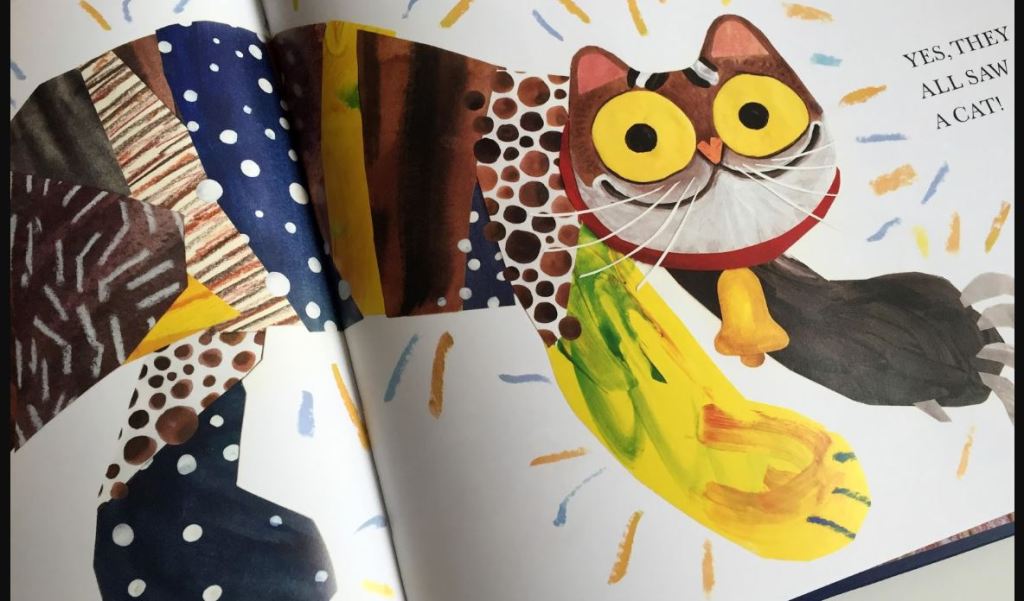
-
On Colson Whitehead’s ‘The Underground Railroad.’
In Colson Whitehead’s new speculative fiction, he condenses a century of racial injustice into a single fugitive’s journey. I hope readers realize the reality was even worse, that some of these crimes spanned the century and reverberate still.
alternate history, animal welfare, Blood at the Root, Carol Anderson, Colson Whitehead, curses, Douglas Blackmon, emancipation, evil, Forsyth County, fugitive slave act, graduate school, Harriet Washington, incarceration crisis, Lewis Hyde, Medical Apartheid, Michelle Alexander, oppression, Patrick Phillips, police brutality, review of The Underground Railroad, science fiction, slavery, Slavery By Another Name, speculative fiction, Stanford, The Gift, The New Jim Crow, The Underground Railroad, Thirteenth Amendment, trust, Tuskegee Syphilis Study, vegan, vegetarian, whose pain matters, witchcraft
-
On the question of whom to blame for the paucity of women in science.
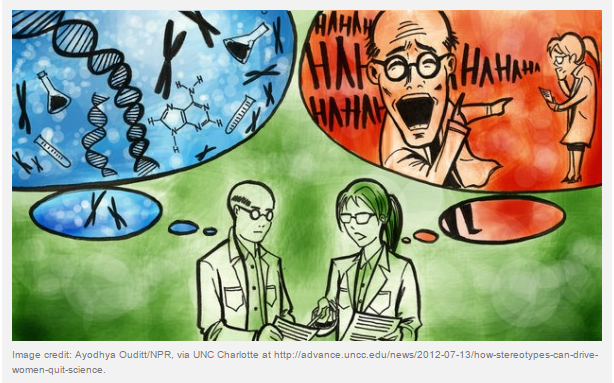
We castigate scientists for the number of women in STEM fields, but the behavior of non-scientists might be equally to blame.
 Frank Brown Cloud