evolution
-
On Charles Foster’s ‘Being a Beast’ and battling the empathy gap.
If Charles Foster can learn, & care, what it’s like to be a badger, all citizens should be able to empathize with the experience of Homo sapiens from other ethnic backgrounds.
agricultural revolution, all lives matter, Being a Beast, Black Lives Matter, brains, Charles Foster, civil forfieture, common ancestors, Donald Trump, empathy, empathy gap, evolution, family first, faulty roadside drug tests, Hungary, incarceration crisis, injustice, Jeneen Interlandi, jeremy betham, John Oliver, living as a badger, natural selection, Neil Gaiman, neurological basis of empathy, Peter Singer, power racing, psychology, reading fiction develops empathy, river otters, Roma, swift, The View from the Cheap Seats, tofu, utilitarianism, vegan, vegetarian
-
On octopus literature, a reprise: what would books be like if we didn’t love gossip?
Of all intelligent species I know of, only the octopus evolved its mind for purposes other than keeping track of gossip.

-
On my own attempt to understand what motivates people to join the terrorist organization Daesh.
Kent Russell’s essay on juggalos helped me think about Middle Eastern terrorism.

-
On Gerry Alanguilan’s “ELMER,” his author bio, and animal cognition.
In ELMER by Gary Alanguilan, chickens suddenly gain intelligence and have to fight against murder, oppression, and prejudice.
abortion rights, Andy Hartzell, animal cognition, chicken, David Duchovny, ELMER, empathy, ethics, evolution, Fox Bunny Funny, Frans de Waal, Gerry Alanguilan, graphic novel, Holy Cow, Homo naledi, live your ethics, Peter Singer, speciest, suffering, teleological misconception, teleology, vegan, vegetarian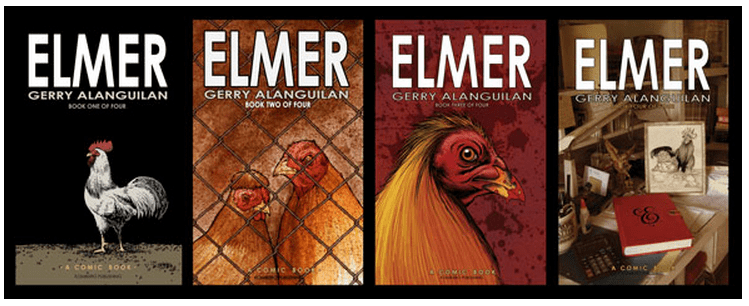
-
On mental architecture and octopus literature.
I might spend too much time thinking about how brains work. Less than some people, sure — everybody working on digital replication of human thought must devote more energy than I do to the topic, and they’re doing it in a more rigorous way — but for a dude with no professional connection to cognitive…
-
On how human different humans happen to be (hint: equivalently human).
I finally read some of the initial papers (circa 1981) describing an outbreak of opportunistic infections among previously-healthy homosexual men in the United States. The case studies are harrowing — a dispassionate litany of suffering, ending with death. And, yes, these are papers from before I was born. I should’ve read them already, or at least…
-
On fire myths and the origin of knowledge
EDIT 5/4/2018: a finished essay based on this research was published here. If you’re writing about conflicts between religious and scientific worldviews, there is absolutely no reason why you’d be forced to write about fire. But, c’mon… fire is cool. Eventually you probably would. While researching myths about the origin of fire, I realized that…
-
On evolution (and why there aren’t more black plants).
As I was reading Freeman Dyson‘s recent collection Dreams of Earth and Sky, specifically his essay on democratizing genetic manipulation, I came across the following passage: “For a plant growing in a hot climate, it is advantageous to reflect as much as possible of the sunlight that is not used for growth. There is plenty…
-
On violence against women (part three): rape, evolution, and the dangers of partial truths.
This is third in a series. Read Part 1 and Part 2. Were you sired by a jerk? Don’t worry! You can still be good! I’m mostly familiar with two theories addressing the question, “Why do men rape?” One comes from feminism, like the thesis put forward in Brownmiller’s Against Our Will: violence against women…

