For the audio version of this essay, click below!
I wrote about this topic fairly recently, but I’ve been making audio recordings for many of the new essays, and re-worked this material slightly while recording this.
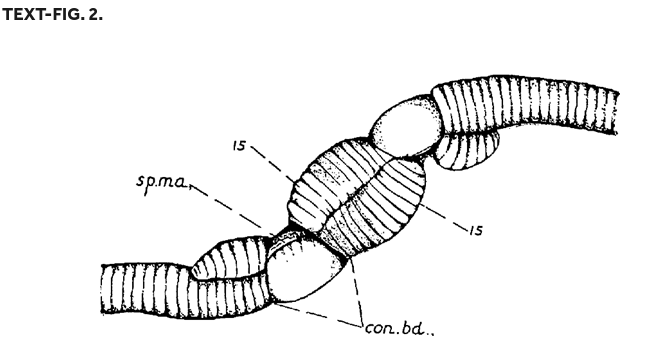
The earliest scientific reports that could double as earthworm erotica were published in the 1800s, but apparently some of that early voyeurism was inexcusably cavalier. For a 1926 study in which the researchers A.J. Grove and L.F. Cowley watched worms mate while the worms were confined between the glass slides of a microscope, Grove and Cowley wrote scathingly that their predecessors, and I quote, “mistook the constricting bands seen during coition for the ends of the cocoons, and further, failed to distinguish between the slime-tube formed during coition and the cocoon slime tube.”
Okay, I’m back. And I am going to pretend to be appalled here. I mean, appalled at the quality of Victorian scientific investigation, and not just generally appalled about the topic under consideration here. As though I might think, like, how could I ever again trust a researcher who had failed to distinguish between these various types of slime tubes?
Grove and Cowley believe that it is very important for these slime tubes to be distinguished. I’m going to read the first three sentences of their study.
“In a previous paper we described some observations on the sexual congress of worms. These observations led naturally to the consideration of other important reproductive processes, such as cocoon formation and deposition, regarding which our knowledge is scanty in respect of many essential details. Perhaps the most pressing point upon which light is desired is the exact relationship between coition and cocoon formation.”
Grove and Cowley then present a extremely detailed description of worm sex. Thirty-one long sentences that steadily progress from the worms’ “increased tumescence in the citellum” to their “caressing of the anterior segments,” eventually leading to little shivers that pass in waves over the surface of each worm during “the flow of seminal fluid,” until at last the two worms separate and each commences “backing out of the coition slime-tube, which is left behind.”
Why, yes, indeed, this research paper does include illustrations. Luckily, there were no embedded sound effects.
In many ways, I regret having read this paper. I did not need as much exactitude as Grove and Cowley provide regarding how slippery the worms became during arousal, nor did I need quite so many sentences describing exactly what the worms did next to their partner’s “tumid lips.” But I read the paper because I wanted a sense of timing.
How long does worm sex take?
In some animals, like gorillas or many types of birds, copulation lasts only for a few seconds. In other animals, like the antechinus, which is a small marsupial that is closely related to kangaroos but looks rather like a mouse, the week-long breeding season might include several extended pairings in which non-stop copulations lasts fourteen or more hours. This is apparently so physically taxing for each male antechinus that his metabolism churns into overdrive, his immune system fails, and every male dies by the end of the week. Shortly before death, the antechinus males have already begun to decompose, but they still shamble about, hoping to woo one final mate. By then, the antechinus females sensibly run away.
From Grove and Cowley, I learned that earthworm sex often takes an entire afternoon, with most of that time devoted to caressing and lubrication and other such activities that we humans sometimes mistakenly distinguish from sex by referring to them as “foreplay.” Among earthworms, the portion of their festivities that comprises penetration and orgasm might last for about thirty minutes to an hour.
It seems that earthworms like to take their time.
And I wanted to know about the duration of worm sex in order to better understand the findings of Alberto Velando, Julio Eiroa, and Jorge Dominguez, who conducted a 2008 study in which they investigated how earthworms respond to different erotic scenarios.
Are there some situations that earthworms find so sexy that they’re willing to pull out all the stops?
Well, I suppose that Velando and colleagues didn’t phrase their central question in quite those words, but that’s the gist of it.
Velando and colleagues confined a bevy of baby earthworms in separate Petri dishes and raised each worm in solitude. Then Velando and colleagues transferred pairs of these sexually inexperienced adult earthworms into shared dishes, and waited several days to determine whether the worms would learn to mate and choose to do so with each other.
This experimental design involved significantly less annelid voyeurism than Grove and Cowley’s study – instead of constantly watching the worms, they just checked each morning for signs that the worms had mated sometime during the previous day. So in the report of this experiment, I was not forced to read about the potentially fumbling efforts of first-time worm lovers … but this also means that I can’t comment on any contrast between those situations and the smooth, self-assured entwinings described at length by Grove and Cowley.
I suppose I should also mention that, among earthworms, there is far more sexual equality than among us human beings. When worms mate, each worm might become a father, or a mother, or both. Every adult worm has both biological sexes, and each worm will undertake both stereotypically male and stereotypically female behaviors when they mate.
In the typical orientation of their bodies, according to Grove and Cowley, each worm will slip inside their partner. Grove and Cowley wrote that “The tanks used permitted the observation of both sides of the worms, and it was possible to determine by direct observation that the flow of seminal fluid took place on both sides of each of the co-operating worms.”
When we discuss stereotypical male behaviors in earthworms, they aren’t discussing the behavior of distinct individuals. Each worm is both male and female.
So, Velando and colleagues had some worms. Some of these worms were still trapped in the dishes where they’d been isolated for their entire lives. Others had been given a chance to hook up.
The researchers then took some of the “sexually experienced” worms and placed them in Petri dishes with new partners. At which point they concluded that worms, when paired with an experienced partner, will typically try harder at sex.
Since we know that worm sex takes several hours – thanks, Grove and Cowley – we know that there was plenty of time for each worm to assess the likely level of recent experience of their current partner.
I should probably also mention that I am definitely not a fan of lethal animal experimentation. Unfortunately, all of these worm studies eventually swerved from lighthearted, albeit weird and squiggly, erotica … into the unpleasant snuff variety. The worms in Grove and Cowley’s 1926 study were killed either during or after sex so that their various sexy bits could be carefully examined under a microscope. And the worms in Velando and colleague’s 2008 study were killed so that the researchers could measure the total volume of semen that each worm received.
After all, that was the researchers’ proxy for how much effort a worm was putting into sex. They learned that worms ejaculate more when fooling around with an experienced partner.
And, yes, I should admit that the way I’ve described this lacks a bit of scientific precision. When I use the phrase “sexually experienced” to describe an earthworm, you might imagine a parallel to a human lover who knows all the moves, who perhaps keep their nightstand stocked with a wide variety of toys and supplies, whereas Velando and colleagues were investigating worms’ behavior only when the worms could detect that a sexual partner had enjoyed recent pairings with other worms, perhaps through their senses of scent or touch or the like. To the best of my knowledge, no one has yet conducted equivalent experiments to investigate whether sexual experience results in any long-lasting change in worm behavior, or how other worms might respond to a well-practiced individual.
And indeed, most evolutionary biologists would summarize this experimental finding by using the phrase “sperm competition.” There are probably genetic sequences that could cause a worm to ejaculate more after detecting the traces of another partner’s semen. A worm with that genetic sequence could sire more offspring, and so over many generations, that genetic sequence would spread. It would become more common for worms to behave that way.
If a worm mated with two partners, and each of those partners ejaculated the same amount, then we might expect for equal numbers of the offspring to inherit genetic sequences from either of those two partners. But if the second partner had a genetic sequence that induced that worm to ejaculate twice as much, then we might expect for twice as many offspring to inherit genetic sequences from the second partner. And so those offspring would also inherit the behavior.
But this raises a question about the first worm.
Like, why did that first worm not try harder?
Among animals, the act of mating probably needs to seem enticing or fun for one or both partners. After all, the only way for a sexually-reproducing organism to exist in the world currently is to be descended from a long line of ancestors who all felt inspired to mate. Some measure of pleasure probably sways them to create the next generation.
But in many species, one or more partners will stop helping their offspring after that. They mate, and then, well, that’s it. Afterward, they swim or crawl or fly or walk away. Hopefully the kids can fend for themselves.
In other species, a single parent can put in some effort and dramatically increase the odds of survival of their offspring. And there are often genetic sequences that sway individuals to be more likely to care for offspring. And so those offspring, who are more likely to survive, will also be likely to inherit the genetic sequences that swayed a parent to care for them. Over time, those genetic sequences become more common. Eventually, most surviving children will have genetic sequences that sway them to care for their own children someday.
Now, in sexual reproduction, some species are like worms, with sperm and egg cells that combine inside the body. Or I guess I could have mentioned human beings instead of worms, since that is how human reproduction works, too. But we’ve mostly been thinking about worms, right? In all their squirmy glory.
Biologists refer to this as “internal fertilization.” Sexual reproduction occuring inside a parent’s body. And in this case, if a single parent were going to care for the children, it would typically the parent in whose body the fertilization occurred. Because that parent is going to be around when the offspring emerge. The other parent might be long gone.
Other species use “external fertilization.” Both the sperm cells and the egg cells arejust released into the environment. And in species with external fertilization, any acts of caretaking are most likely to be performed by whichever parent is near the fertilized eggs last. Like, maybe a female fish leaves behind some egg cells and then swims away before a male fish fertilizes those eggs. Then, if a single parent is going to do some caretaking, it’s probably going to be the male parent, right?
This is the evolutionary biology equivalent of the game hot potato. The music stops, you look around, and you realize that the other parent is long gone. So, sure, you could just drop the potato, you could abandon your offspring too … but what if you just cared for them a little?
And this is actually what we see. Most frogs and fish are pretty crummy parents – about ninety percent of frog species just abandon their fertilized eggs and hope for the best. But among the ten percent of frog species that do care for their young, more often than not, it’s the male parent that does the caretaking. Because he’s there last, right? The other parent already hopped away!1
But even if you aren’t planning to take care of your offspring, mating is still costly. It takes energy to make all those sperm or egg cells. So even in species where one biological sex does more caretaking than the other, there is still parsimony in sexual activity.
Like, okay, let’s return to those worms. That study by Velando and colleagues. Theoretically, worms could ejaculate a whole bunch even if they were paired with inexperienced partners. But they don’t. Worms will put in a lot of effort – releasing a whole bunch of sperm cells that they had spent energy creating – only if they are mating with an experienced partner.
When biologists describe the behaviors of non-human animals, these sorts of responses are often described in a very detached, mathematical way. Like when biologists discuss the evolution of peacock tails, the choices of female peacocks – who for generations have chosen to mate with the males with the most spectacular tails out of all their potential partners, which is why current males have really fabulous tails, since they are descended from a long lineage of males who had genetic sequences inclining them to have fabulous tails – well, biologists will often say that the females make these choices because they calculate that a male must be really strong and fit to have survived despite the hindrance of a fabulous tail.
But that’s not how animals make choices. Not even human animals, despite all our affectations of rational behavior. Choices come from emotions. Medical patients who have a reduced emotional response to the world, even if all their other intellectual abilities are intact, even if they’re still great at mathematics and logic, people with reduced emotional responses often find themselves unable to make choices, in situations ranging from how many apples to buy at a grocery store to which restaurant to visit for dinner to whom they should marry. Charles Darwin attempted to make a rational list to guide his decision of whether or not to marry his cousin. This was silly. You could never calculate your way to the right person to marry. You can’t even calculate your way to knowing whether to make particular investments with your money. Even in highly numerical, simple situations, our choices come from our feelings.
So a female peacock won’t carefully calculate, like, that male survived despite his giant tail, which means that if we have children, our children will inherit the genes that helped him to survive, but they’ll also inherit the genes that might make them likely to have a giant, hindering tail, too, which might make them more likely to be captured and eaten by leopards… That is almost certainly not what is going on inside a female peacock’s brain. Instead, a female peacock has to experience a feeling that attracts her to the male with the big tail. It has to be pleasurable to look at him, and think about sidling up close.
In worms, there are probably genetic sequences that cause them to ejaculate more when they sense that a partner was recently paired with another worm. But those genetic sequences cause that effect by changing how the worm feels.
And the same is true of caretaking. For a frog to have a genetic sequence that makes it more likely that this frog will take care of the next generation, maybe carrying tadpoles on his back, or protecting them inside his mouth, then it must feel good to be helping.
But a neat thing about human brains, in particular, is how much neural plasticity our species has. Human behavior is very flexible. Just like other animals, we are swayed by our genetic sequences. All else being equal, certain genetic sequences will make it a little easier to make certain sorts of choices. But the influence of genes on our choices is not absolute.
Here’s an example. Lots of forms of exercise are kind of awful. Weight lifting, or riding an exercise bike, or running on a treadmill. You’re just wasting energy. When you exercise, you’re wasting many more calories’ worth of energy than it would cost an earthworm to produce a few extra sperm cells. Animals really should not want to do something so wasteful. But if you make a habit of going to the gym and doing those things, lifting weights or running on a treadmill, then your brain might correlate the sensation of exercise with the foreknowledge of how it will make you feel. Like, running is awful, but the sensation of having gone running is pretty great, and there’s no way to have gone running without actually doing it – and so then, weirdly, pointless exercise might begin to feel good. To evoke an emotional response of pleasure.
Caretaking is similar. Lots of the actual activities involved in raising children are legitimately terrible. I do not enjoy helping kids get ready for school in the morning. I’ve never enjoyed cooking macaroni. Persuading a grubby kid to take a shower. Or folding laundry. But those activities are correlated with the good moments of being with my kids.
We humans are animals. We have good reasons to be lazy – in the distant past, animals that frivolously wasted energy would not have survived. But even earthworms experience some feelings strong enough to overcome their laziness.
Isn’t it cool that we can intentionally cultivate that sort of feelings in ourselves?
- And the male parent is likely to be present last because sperm cells tend to be smaller and independently viable for a briefer period of time after release into the environment. If gamete release is staggered, the larger egg cells tend to be released first. ↩︎
 Frank Brown Cloud