For the audio version of this essay, click below!
In the beginning, there was a cloud of gas and dust swirling around our sun, but by about four and a half billion years ago, all that stuff was pulled together by its own gravitational mass. That’s when the Earth was born.
The early Earth was a nice enough planet, as far as planets go. I mean, most patches of ground were probably magma. Any solid ground would be bare rock, since dirt is made of dead things and nothing had ever lived there yet. There was liquid water on the early Earth, but the water didn’t have any dissolved oxygen, so contemporary fish would die if they tried to swim there. There was no oxygen in the air, either, so you or I wouldn’t last very long, what with our need for breathing.
Okay, maybe the early Earth wasn’t all that nice. I haven’t even mentioned the steady bombardment by meteors, include the likely impact with a nearly planet-sized space rock that cleaved so much from our planet’s surface that the residual debris ended up forming our moon.
But the early Earth was pretty nice compared to how inhospitable most other planets are – like Venus with its sulfuric acid raining from the sky, or Mars with its lack of atmosphere and its planet-engulfing dust storms. I’d pity anyone who dreams about living there. And the early Earth was apparently so nice and friendly that it only took, like, a billion years for the first living organisms to appear. Maybe less. Maybe only five hundred million years!
Or, I don’t know, maybe the whole unpleasantness was also essential? Because most stories about biogenesis – the initial creation of living things from inorganic molecules – involve repeated lightning strikes and gross mixtures of chemicals in shallow seaside ponds.
But still, relatively early on our planet, in ways that we still don’t quite understand, the first living things appeared. So we’re going to skip ahead a bit, to about three and a half billion years ago. Our planet had been around for about a billion years by then. Most of the major asteroids that were going to hit us already had.1 The world was a little calmer. And, floating in the water, some things were alive.
#
Living things use energy, and they make new living things.
Without energy, things devolve into chaos. If I fold a bunch of t-shirts and put them in a stack somewhere in my house, I’ve put energy into assembling that structure. A stack of neatly folded shirts. But unless I continue to put more energy into it, the stack will eventually slump over, or the shirts will get scattered because one of my kids will be looking for a favorite shirt and yank the bottom one out from my neat stack, just to check it, just in case.2
Our bodies are the same. Unless we keep eating, and keep using energy, we’ll die and decompose.
Or a bacterium. A bacterium is an orderly thing. Its insides are different from the world outside. But if the bacterium stops finding and using energy, then that distinction will disappear. It will fall apart, and eventually its insides will match the world outside, at which point you can’t really say that there’s a bacterium anymore. There would just be some liquid with old bacterial parts sloshing about. Which would not be alive. Just some gross, grimy water.
Using energy is unavoidable. But a thing could be perfectly well alive by just staying distinct from its surroundings and never creating anything new.
Since accidents happen, though, and sometimes living things do fall apart, despite all our best intentions, we’re more likely to see living things still out there in the world around us if their ancestors were good at making new copies of themselves. Technically, living things don’t have to make new living things. But their lineages would have disappeared if they didn’t.
#
The earliest living things on Earth, about three and a half billion years ago, probably got their energy from ocean vents or breaking apart various complicated chemicals.
But then a particular type of living thing – cyanobacteria – or, well, an organism that we think looked a lot like contemporary cyanobacteria, but they were probably at least a little different, since these were their ancient ancestors, several billion years ago – which is an important but also kind of pedantic distinction, so I’m just going to call them cyanobacteria – these cyanobacteria discovered a neat trick. They learned how to conjure sugar from thin air. Magical! Seriously, by using the energy from sunlight, they could combine carbon dioxide and water to build sugar. This was the precursor to modern photosynthesis.
And then they could eat the sugar. They could use that energy to grow. So cyanobacteria conquered the Earth. Other living things were just hanging around ocean vents, patiently waiting for the vents to erupt and provide them with enough energy to, like, do things, to throw a party or whatever, but cyanobacteria could make their own fuel every time the sun was shining. Which was almost every day.
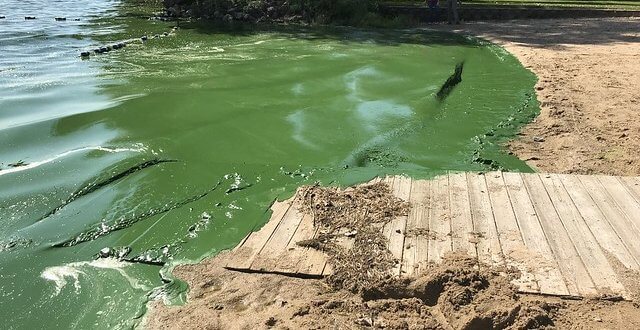
The surface of the oceans probably changed from blue to green.3 Cyanobacteria lived like kings.
But also, their cool new fuel source had a minor side effect. They were poisoning the air.
Ooops.
#
You and I are both humans, and I assume that you like breathing oxygen. I’m a big fan of oxygen, personally. Oxygen keeps my heart beating and my brain working and my digestive system gurgling, all of that.
At times, my personal need for oxygen makes it hard for me to remember that oxygen is a very deadly gas. When a human body begins to decline with age, it’s mostly because “oxidative damage” accumulates in our cells. And when grocery stores begin to market that something or other is this season’s new hip superfood – will it be avocados again … or blueberries … or some kind of ancient grain … – the advertising campaign will usually extol the food’s abundance of “antioxidants,” small molecules that might protect our cells from the ravages of oxygen.
The first living things were all anaerobic. The first living things did not need, and indeed could not even tolerate, oxygen. Oxygen gas is deadly because it is very reactive. Oxygen would react with, and thereby destroy, the DNA of living things, and also other essential components of their cells.
Still, even after cyanobacteria had discovered their neat new trick, building sugar at the low, low cost of plumes of deadly oxygen gas rising into the air, everything seemed fine, for a while. There was a lot of exposed iron on the early Earth, on the land and in the ocean.4 Iron could linger for a long time back then. Iron would never turn brittle, iron would never rust … rust is what happens when oxygen gas crashes into iron.
After the cyanobacteria had started filling up the world, covering the surface of our oceans with their bodies, all that iron kept the atmosphere from becoming toxic.
About two billion years passed without incident. The iron acted like a sponge, soaking up oxygen. It must have seemed like the cyanobacteria could go on this way forever!
But then they reached a tipping point. The exposed iron had all become iron oxides. It couldn’t soak up any more.
Uh oh.
Cyanobacteria kept going, and then the concentration of oxygen in the air rose dramatically. This poisonous gas killed almost everything alive.
#
If you went back in time to the early Earth and struck a match, nothing would happen. It wouldn’t burn. There was no fire, then.
Some things were definitely very hot, because there were volcanic eruptions and asteroid strikes and all of that. But fire, the flickering orange over stacked logs that compels us to roast s’mores, fire is a reaction between oxygen gas and whatever is being burned.
Cyanobacteria, in their folly, created a world where they would burn.
#
In The Inferno, Dante Alighieri claims that hell is a place of fire and ice. Indeed, cyanobacteria summoned both. By filling the air with oxygen, they made a world where they would burn. By pulling carbon dioxide from the air, they made a world where they would freeze.
And the very worst torment in The Inferno, perhaps echoing Zeus’s punishment of Prometheus, is to be bodily consumed. Satan chomps at the betrayers.
Our poor, cursed cyanobacteria – they conjured hungry demons, too!
By filling the air with oxygen, cyanobacteria enabled the evolution of organisms with higher metabolisms. Cyanobacteria made possible the evolution of creatures who lived faster, shorter lives, turbocharged by all that deadly reactive air. And those creatures – among whom are our own forebears – nearly grazed the enablers out of existence.
Cyanobacteria were once masters of the universe.
Then they were food.
And by about a billion years ago, cyanobacteria were imprisoned within the cells of plants. Look up at a tree – each green leaf is a holding cell, brimming with captives who are no longer free to live on their own. Grasses, ferns, flowers – every photosynthetic cell is home to perhaps dozens of chloroplasts, descendants of the cyanobacteria who caused our planet’s first mass extinction.
A few outlaws still linger in the ocean. Some cyanobacteria are out there still, and still pump oxygen into the air, that lethal poison that’s gulped so greedily by human lungs. Their lethal poison now enables our growth. Our flourishing. And even our own reckless abasement of the world.
Because we humans are poisoning the air in turn, albeit in a very different way. In our quest to use many years’ worth of stored sunlight energy each year, we’ve been digging up and burning the subterranean remnants of long-dead plants. The prison cells in which long-ago cyanobacteria once lived and died, entombed for millions of years within the earth, are now fueling our own approach toward self-imposed damnation. There’s still plenty of oxygen – when we dig up ancient plants and try to burn them, they do burn, thanks to the cyanobacteria – but the concentration of carbon dioxide in our air is rising.
The concentration of carbon dioxide has been slowly rising. In much the way that iron on the surface of the planet kept soaking up oxygen gas during cyanobacteria’s early years, our world has dampened the rise of carbon dioxide. For example, carbon dioxide dissolves in water to make a chemical like baking soda. The oceans have been soaking up huge amounts of the carbon dioxide that we produce.
Eventually, though, that sponge will be full. And then we would see a much sharper rise.
#
In Dante’s Inferno, there was no opportunity for grace. A brief lifetime of Earthly folly would be infinitely, endlessly punished. Which seems gratuitous to me.
I like that, in the real world, there might be a chance to make amends.
Cyanobacteria have had a rough go of it. And now we burn their ancestor’s corpses: our power plants are pyres that have been filling the air with carbon dioxide. But cyanobacteria still have that neat magic trick. Cyanobacteria, and their descendants, can still pull carbon dioxide out of the air. Which we need. To maintain the stable climates that has been a hallmark of the past ten-thousand years of civilization, we humans will need to surround ourselves with more trees, with more algae in the ocean. We will need a greener world.
Cyanobacteria have burned in a hell of their own making. And yet, their great-great-great grandchildren might be the ones who save us.
.
.
.
.
- Not all of the asteroids that would ever hit us – the non-avian dinosaurs were sure in for a nasty surprise! – but the rate of asteroid strikes now is soooo low compared to how often they hit the early Earth. In fact, this whole “not getting bombarded by asteroids anymore” thing is part of the current definition of a planet — a big star-orbiting object that has already cleared most of the other stuff out of its orbit. ↩︎
- This is a somewhat sloppy analogy for entropy. A better explanation would be to say that there are more possible arrangements of shirts that look messy than arrangements that look neat … but, in addition to being more accurate, this phrasing sounds a bit more boring. ↩︎
- The oceans would have turned green only if these early organisms were using a cascade of enzymes including cofactors similar to modern chlorophyll, which is green. But there are certainly other molecules that could help an organism use the energy from sunlight – for instance, some co-factors cause the organisms to instead appear purple to our eyes. ↩︎
- Iron was not the only oxygen sink available to scavenge the released oxygen gas and prevent it from accumulating in the atmosphere, but all of these processes work similarly. In actuality, the oxygen levels rose precipitously only after all of the available oxygen sinks had been saturated. ↩︎
 Frank Brown Cloud