For the audio version of this essay, click below!
Several researchers have studied the evolution of human skin color. And these researchers have concluded that when populations of humans migrate to high latitudes, they evolve light-colored skin.

I am about to criticize the work done by these researchers.
And not just because I imagine it would feel hurtful to hear a researcher claim that if you have dark-colored skin and live in a high-latitude place like, say, the United States, or Europe, or Greenland, or New Zealand, or Korea, or southern Argentina, or Chile, or wherever, that you’re ill-suited to live in the place that you call home. Wouldn’t it feel rotten to hear a researcher claim “In the place where you live, people who look like you were selected against in our species’ evolutionary past.”
But that’s not even the real problem here. The bigger issue is that this claim is not even true.
The researchers who mistakenly made this claim had to ignore huge groups of people. Those researchers ignored the ancient inhabitants of Europe and Asia, and they also ignored the present-day people whose ancestors lived in the northern parts of North America, and the southern parts of South America, and even the northern parts of Europe and coastal regions of Asia. Honestly, it feels a bit embarrassing to me that this inaccurate, hurtful claim went on to become the established model for the evolution of human skin color for decades, and that this claim remained uncontested in the scientific literature for so long, up until my spouse and I wrote a research paper correcting it.
#
So, maybe you’ve heard that you need calcium to have strong bones. And strong bones are great! I help teach Taekwondo, and I’m pretty pleased every time that my bones don’t shatter when I hop around like a stork and end up blocking a kick with my shin.
You also need vitamin D for strong bones, because vitamin D helps your body use calcium. Among several other important functions.
And your body can actually make vitamin D, as long as you’re exposed to enough sunlight.
Your skin color does influence this. If you have darker skin, you need to be exposed to slightly brighter sunlight in order to make vitamin D.
If the sunlight is bright enough, though, a person with dark skin and a person with light skin will both make the same amount of vitamin D. As soon as you have enough vitamin D, your body will stop making more, no matter the color of your skin. And if the sunlight is dim enough, nobody will make any vitamin D, no matter the color of their skin. When the sunlight is dim, like during the winter at high latitudes, no human can make vitamin D, not even if that person’s skin were as translucent as a ghost.
But you don’t have to make vitamin D. You can also eat foods with vitamin D, or take a multivitamin or whatever, and that is just as good. There is no difference between the vitamin D that your body makes and the vitamin D that you eat. Both are great. Strong healthy bones ahead!
#
You’ve probably noticed that people whose ancestors lived in Europe have light skin. But a long time ago, all humans lived in Africa. A long time ago, all humans had dark skin. Including, long ago, the ancestors of people who lived in Europe. So, after those ancient ancestors migrated into Europe, something must have happened.
For a while, that was all we knew. Humans with dark skin migrated into Europe. Now, their descendants have light skin. We had no information about what happened in between.
But recently, the technology to do “DNA sequencing” has gotten so good that researchers can take tiny bits of ancient bones and learn about those ancient people. These bones are very, very old – like five thousand years, ten thousand years, sometimes even forty-thousand-year old bones – and yet researchers can sometimes sequence those ancient people’s DNA.
And our DNA has instructions that influence the color of our skin. So if we sequence an ancient person’s DNA, we can predict their skin color.
It turns out that many of the ancient people living in Europe had dark skin. For ten or twelve-thousand years, all the people living in Europe had dark skin. They arrived in Europe with dark skin, and, for at least twelve thousand years, all their descendants also had dark skin.
So, actually, it seems like it was not just migrating into Europe that resulted in light skin.
Which makes sense, right? After all, Europe is no farther north than Canada, or Greenland … and the Tierra del Fuego in Argentina is equivalently far south … and people whose ancestors lived in all those places still have dark skin. Even some populations of people whose ancestors all lived in Europe for thousands of years still have dark skin, like the Sami, in Finland.
If we want to understand the evolution of human skin color, it’s pretty clear that our explanation can’t just be about latitude. It’s not just about how dim the sunlight gets during winter.
It’s also a story about culture.
All those people with dark skin who were living in Europe ten-thousand years ago must have been eating foods that had enough vitamin D. Otherwise they would have had weak bones. They might have broken an arm or a leg, been unable to hunt or fish or gather plants, and starved. I mean, not starved right away, because humans live in communities, and some of the best evidence of ancient human kindness is that ancient fossils show that people sometimes broke their legs and those bones healed. People from their communities must have been giving them food. Taking care of them when they were hurt. At times, humans are pretty awesome.
So we know that for thousands of years, those ancient European people’s diets must have had enough vitamin D, because the population continued to have dark skin for hundreds of generations even though they lived at high latitudes.1
If you happen to read other researchers’ articles about the evolution of human skin color, you might notice that the researchers will often claim that very few foods have vitamin D. This is not correct. There are actually a lot of foods that have vitamin D. A lot of fish and wild game, deer and elks and such. And I tried to find out how much vitamin D an ancient person might get from eating mammoth meat, but, weirdly, none of the dietary scientists whose nutrition research I’ve read have included mammoth in their studies. I guess it’s hard to get funding for your research when your grant proposal states openly that the first step of your grant proposal involves building a working time machine.
Also, if you preserve food for winter by drying it in the sun, that will increase the amount of vitamin D in the food. Exposing common foods to sunlight — whether we’re talking about plant-based foods or mushrooms or meats or dairy — exposing many types of food to sunlight will increase the amount of vitamin D.
But it’s true that some foods have very little vitamin D. Foods like unfortified bread, or oats, or dairy, or the meat from cows or pigs or sheep, all animal species that were domesticated in places much closer to the equator … all of those foods have little vitamin D.
So when ancient farming communities migrated into Europe and began to grow wheat and raise cows … among those communities, there was a pretty rapid evolution of light skin. Which makes sense. Because those people were eating worse food. I mean, I shouldn’t say “worse,” my kids’ favorite food is bread, so I can’t claim that wheat bread is worse than a mix of wild plants and fish and deer and mushrooms and such. But maybe we can all agree that eating a whole lot of bread is going to be less nutritionally complete. So, because the ancient farmers had a less varied diet, and had much less vitamin D in their diet, that population evolved lighter skin.
Okay. We’re going to pause for a moment now. Because I feel like I have to warn you, what I’m about to say next is awful. I’m sorry. But evolution is awful.
When the ancient farming people first moved into Europe, maybe eight thousand years ago, they had dark skin. But the population rapidly evolved to have light skin. Which means that, in that population, many people died young. Usually mothers and children. Specifically, the children with darker skin were less likely to survive long enough to have children of their own. Or the mothers with darker skin were less likely to see their babies survive, or to survive childbirth.
Evolution is a story where lots of people die young, and people with certain traits, in certain cultures, were more likely to die young. That is what causes the population to evolve.
Evolution stinks.
But thinking about evolution is the best way to understand why the world looks the way it does today.
Okay. Again, I apologize that I had to say that so plainly.
But that is why the farmers who migrated into Europe ended up with descendants who all had light skin. Because they had a culture of eating food that wasn’t very nutritious. At high latitudes, in the ancient past, if you had dark skin, you couldn’t survive on just bread and cheese.
And when researchers have dug up the graves of ancient humans who lived in Europe around that time, roughly six thousand years ago, when there were still relatively large communities of both people with cultures where they hunted and gathered a wide variety of foods, and people with cultures where they farmed and ate mostly bread and dairy and a bit of meat, researchers have found that the people who were hunters and gatherers, who collected wild plants and fished and whatnot, those people were generally taller and healthier and had the DNA for dark skin. And the nearby people who farmed, the farmers were shorter and sicklier and had DNA for pale skin.
And not just pale skin. The farming communities had such poor nutrition that these populations also evolved loss-of-function mutations for things like making cholesterol … which makes sense, because cholesterol synthesis takes away an ingredient that the body uses to make vitamin D … but this is its own tragedy, because that mutation can cause pretty severe health defects, usually diagnosed as Smith-Lemli-Opitz syndrome in the most severe cases. You need both vitamin D and cholesterol to help your brain and body work their best.
#
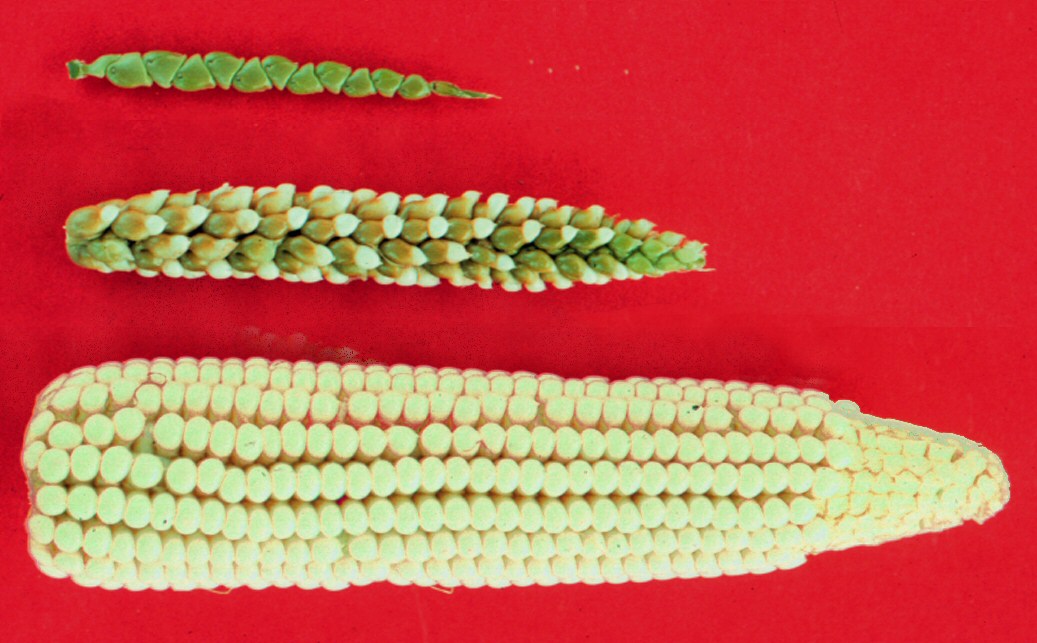
You are probably aware of the huge impact that farming can have on evolution. I mean, modern corn looks almost nothing like teosinte, the knobbly grass with which it shares ancestors. Modern corn can’t even reproduce without human intervention. The seeds get stuck inside the husk. And, well, farming culture has caused a lot of changes in the DNA of human populations, too. Some of which seem to have had negative impacts of human health.
But by farming, you can make a lot of food, so the ancient farming communities typically had larger total populations than the hunter gatherers. Even though the individual farmers were less healthy, if there was ever a conflict between the farmers and the hunter gatherers, over land-use or whatever, the farmers were likely to win. No matter what modern action movies have taught you, one single heroic hunter-gatherer is not likely to win a fight against a dozen bedraggled farmers.
So, after a few more thousand years had passed, most of the hunter-gatherers were gone from Europe, and most of the people still living in Europe were farmers. With pale skin.
But in other places around the globe, whole populations maintained cultures where they ate food with enough vitamin D. In those cultures, a child’s likelihood of survival did not depend on the color of that child’s skin2.i A mother’s chances of seeing her babies survive did not depend on the color of her skin. The people ate fish, and hunted deer, and gathered wild plants and mushrooms, and probably sun-dried their food for winter.
That last bit is speculative, obviously. We have no evidence proving that people living in North America long ago were sun-drying food to prepare for winter. Cultural behaviors like that do not make fossils. I mean, think about it, we call the ancient past “the stone age,” even though a lot of the most important early technologies were probably woven fishing nets and baby carriers and whatnot. But stones turn into fossils. Fishing nets do not.
Still, we know that ancient people living in those various high latitude places survived the winter, so they must have been preserving food for winter somehow, and we know that sun-drying food is a common preservation technique used by indigenous communities around the world today. So it’s a reasonable guess. And, right, by sun-drying food, the people would have been increasing their access to dietary vitamin D. In particular, they’d get more dietary vitamin D during those crucial months when the sunlight was at its dimmest.
And in any case, in all those places, human populations living at high latitudes still had dark skin. Not just in ancient times. Populations in North America and South America and Greenland and even in northern Europe and in coastal regions of northern Asia, in all those places, people whose ancestors lived there for thousands of years still have dark skin. Which you’d think some researchers studying the evolution of human skin color would have noticed.
But apparently they didn’t?
#
It gets worse. For decades, many researchers have been telling an inaccurate story about the evolution of human skin color, because those researchers didn’t pay enough attention to human culture.
But also, those researchers felt so certain about their inaccurate story that they prepared a lesson plan for high school students. And in this lesson plan, high schoolers are asked to look at a graph of data about skin color and vitamin D. High school biology students would be shown this graph, and the graph seems to show that black people living in the United States have less vitamin D than white people.
Except … this graph is fraudulent.
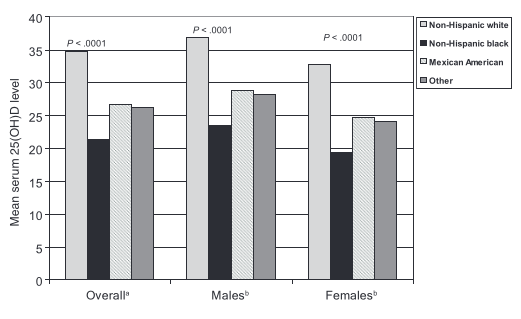
To create this graph, a team of researchers asked middle schoolers and high schoolers to volunteer to have their blood drawn, and then the researchers measured how much vitamin D was in their blood. And then the researchers graphed how much vitamin D the white kids had, and how much vitamin D the black kids had. On the graph, the black children have less vitamin D.
Except that most of the white kids had their blood drawn during the summer. Most of the black kids had their blood drawn during the winter. And for students who are indoors at school from like eight a.m. till three p.m. every weekday during the fall, winter, and spring, no student is going to be exposed to enough sunlight for their body to make any vitamin D. So what this study actually showed is that middle schoolers and high schoolers spend more time outdoors in the sunlight during the summer than during the winter. Not a major revelation, but there you go. That is what the study showed.
Also, you could probably conclude that the people in this study, especially the black students during wintertime, did not get enough vitamin D from their diets.
Still, it’s important to recognize that the finding from this study was not about skin color. It was about people’s different behavior during different seasons of the year. But because so many researchers felt certain that skin color would make a difference, they claimed that it did, even though they were measuring something else.
A mistake like this might even be the origin of this whole story. Because for a long time in the United States, there’s been this idea that black people are at a high risk of vitamin D deficiency, and associated diseases like rickets, because of the color of their skin. But this is and always has been primarily a story about the food we eat.
Think about it: middle schoolers and high schoolers are indoors from eight till three on school days, and that is precisely when there’s bright enough sunlight for a human body to make vitamin D. Lots of adults are also indoors during those times of day, for large portions of the year.
So lots of people need to get vitamin D from their diet.
And that’s easy to do. You can take a vitamin. Or eat fortified foods. Because, well, in the 1920s, a biochemist from Wisconsin named Harry Steenbock discovered that you could increase the amount of vitamin D in many types of food by treating it with ultraviolet radiation … basically, a laboratory version of why preservation through sun-drying gives food more vitamin D … and Harry Steenbock patented this process. Then he licensed the patent to some food producers, because lots of people in the United States were suffering from vitamin D deficiency in the 1920s. Factory workers, office workers … there was a big shift in culture, and people were spending more time indoors, so they didn’t have enough vitamin D. But soon they’d be able to get their vitamin D from fortified foods.
Great news, right?
But because Harry Steenbock wanted to protect Wisconsin’s dairy industry, he refused to license the patent to margarine producers. So, butter was fortified with vitamin D, but margarine was not.
Many poor families used margarine instead of butter because it was cheaper. But this meant that poor families were more likely to suffer from vitamin D deficiency.
Which is awful, right? A deliberate effort was made to prevent a food for poor people from being fortified with vitamin D. And then the medical community began to warn that black people were at greater risk of vitamin D deficiency. But this was because many black people were poor. Not because of any intrinsic biology due to the color of their skin.
#
The story of human evolution is a story about culture. Evolution is a process by which traits that are beneficial in a particular environment become more common, and human culture creates the environment that we live in.
This is important. Culture is something that we create. We invent and re-invent our culture all the time.
So, let’s say you have relatively pale skin. And maybe you live near the equator. Well, that’s okay! You just need to create a culture in which you wear sunscreen. Maybe even go inside while the sun is highest in the sky on a bright summer day.3 And then you’ll be fine.
And let’s say you have relatively dark skin, and you’re living in a place that’s far from the equator. Well, that’s okay, too! You just need to create a culture in which you eat foods with vitamin D. Take a multivitamin. Boom! You’ll be fine.
And, honestly, even if you have relatively pale skin, you should also plan to get vitamin D from your diet. Because for almost the entire year, your skin color does not affect how much vitamin D your body could make. During the summer, if you’re out in the sunlight for about half an hour, you’re going to max out the amount of vitamin D that your body needs, no matter the color of your skin. After about half an hour, you’ll stop making more.
And during the winter, the sunlight in a lot of places is too dim for any human body to make any vitamin D, no matter the color of your skin.
Skin color only has any effect on human vitamin D production for a brief period of time in the spring and in the fall.
Those two brief windows of time were enough for some populations of humans to evolve light skin … but evolution is a horrible process. The story of the evolution of human skin color in Europe, particularly, is a story where almost all the ancient people were unhealthy, where over half of all children were dying before they reached reproductive age, where people with lighter colored skin were just a little bit less likely to die young. That’s awful.
And we don’t have to live like that. We can take a multivitamin.
.
.
.
.
- Actually, there’s another important step in the logic of this claim that I’ve omitted in the main text. Just because a particular trait would be beneficial to a population does not mean that the trait will arise in the population. For example, maybe humans living in a place with a lot of tall cliffs would have benefited from having big leathery wings that allowed them to glide from cliff to cliff, and there are plenty of populations that lived near cliffs for hundreds of generations without evolving wings. DNA instructions that give rise to a beneficial trait cannot become more common in a population until those DNA instructions are present in the population. With skin color, though, many of the DNA instructions for light skin were already present in the population at low levels in Africa, before humans migrated into Europe — a lot of the mutations that give rise to light skin are simple loss of function mutations, which tend to arise more commonly anyway — and so it’s more justifiable to claim that these traits were not favored in that environment at that time, since the traits were probably present and did not become highly prevalent, the way that they did in farming communities. ↩︎
- This is different from situations like we see in the contemporary United States, where skin color is correlated with different lifespans due to things like contemporary prejudice or the lingering ramifications of a history of extreme prejudice. Six or eight thousand years ago in Europe, children with darker skin who lived in farming cultures would have been less likely to survive until reproductive age because their own bodies produced less vitamin D during the fall and spring. It’s possible that parents would have eventually noticed this differential survival, and that associated claims about skin color would have arisen in that culture, but evolution can be driven by pretty small differences in the likelihood of survival over many generations, so it is also possible that the underlying cause of selection may have been too subtle for anyone actually living at that time to notice. Rather than being caused by malice, for humans living in that environment at that time within that cultural framework, there really was an appreciable difference in biological fitness caused by skin color. ↩︎
- And if you have pale skin, live near the equator, and happen to be pregnant, you should also make sure that you’re getting enough folate in your diet, either from eating beans & lentils & leafy greens or from taking a multivitamin. In addition to protecting humans from skin cancer, dark skin protects the folate in a person’s blood from being degraded by sunlight, and a developing fetus needs folate. ↩︎

 Frank Brown Cloud