Folding and putting away laundry. Cleaning the floors. Spreading mulch over a garden. Cooking dinner. Loading the dishwasher afterwards.
All these tasks take time. And often that time feels like drudgery.
It would be so much more efficient for one person to specialize in floor cleaning, or mulch spreading, and then do it for us. With practice, experience, & a routine from habitual floor cleaning, that person might get very fast. Might be able to clean two floors in less time than we’d need to take care of one.
With so much floor cleaning ahead of them, that person could invest in all the latest and greatest floor cleaning technologies. Perhaps a specially designed wedge-shaped scrubber brush useful only for corners where two planes meet. And an alchemist’s array of solvents, each precisely formulated for whisking away a different sort of muck. No spritzer bottle of all-purpose scented cleaner for our specialist!
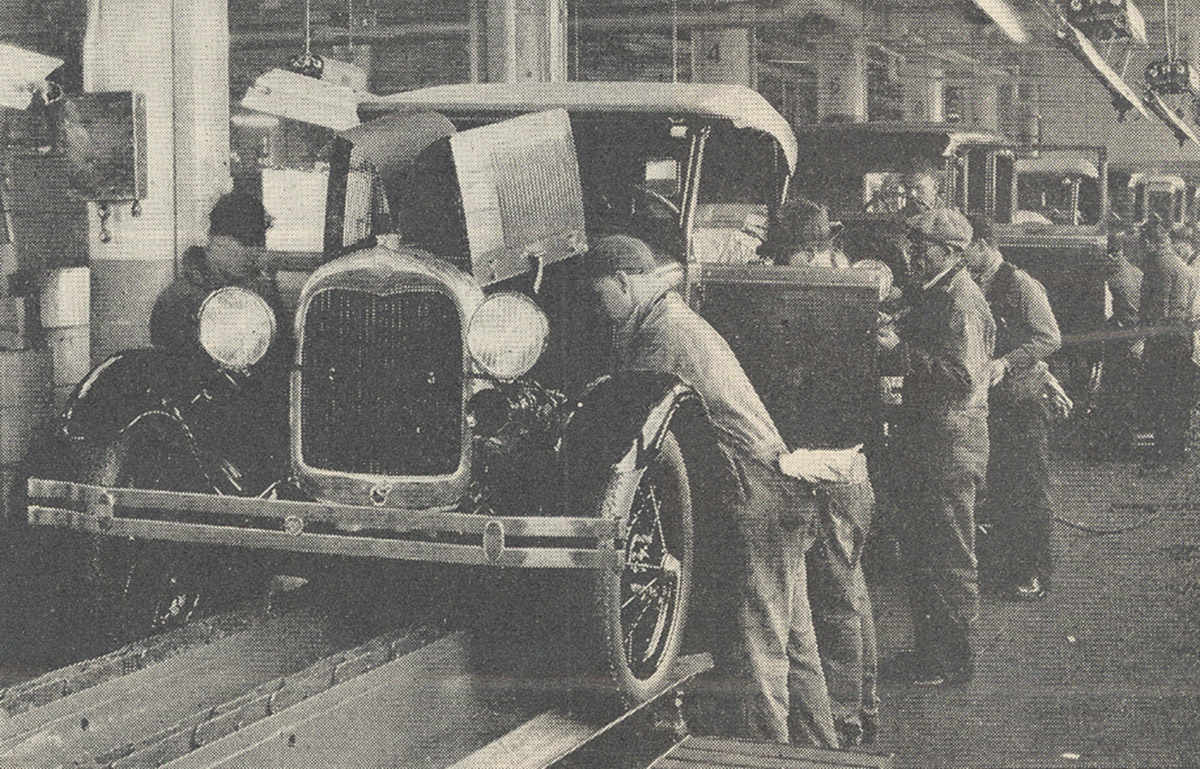
Given a sufficiently large population, specialization is more efficient. This would just be Henry Ford’s factory model – rather than hiring a few workers and training each of them to build cars, instead hiring many workers and training one worker to tighten a particular sort of bolt, all day every day spent tightening only that one particular sort of bolt before the car-to-be is moved along the assembly line – as it could be applied to the rest of our lives.
Instead of cooking, we can eat takeout. Instead of stopping by a restaurant to pick up that takeout, we can place an order and have a well-practiced delivery person weave their way through traffic and wait in line and then bring the food directly to our home.
Indeed, all the things we need can be acquired with a few taps upon a glowing screen. No need to stand up. No need to change out of those comfy sweatpants. It’s all very efficient.
#
Our time is finite, and thereby precious. We shouldn’t waste it. Surely you’ve seen that Mary Oliver quote screenprinted onto canvas grocery bags: Tell me, what is it you plan to do with your one wild and precious life?
Isn’t all that efficiency a reasonable way to demonstrate how dearly we have cherished the gift?

We live but once, and for but a little while. We tap the glowing screen in celebration. After all, there’s stuff we need! Maybe the smoke detector is chirruping again, alerting you to its fear of going hungry. We’ll need to offer it a battery. But traveling to a store and finding a nine-volt battery on the shelf and waiting in line and then needing to interact with an actual human cashier, no bag is fine, I can just carry it in my pocket – all of that takes time! Whereas you could just place an order and have that battery waiting for you when you get home.
Someone still has to get that battery to you, but that’s another form of efficiency. Economists use the term “comparative advantage.” Maybe you’re fit and clever and would be great at racing through the store and finding the precise battery you need, then zooming all fast & furious through traffic to bring it home right quick … but if you’re also really good at some other task for which you’re given money – perhaps you’re also great at reading through reams of financial data from publicly traded companies and identifying which companies have issued stocks that enough other people will soon want for their share prices to be about to rise – then the “opportunity cost” of buying a battery yourself, in terms of money.
As measured in units of dollars, each moment of your wild & precious life might be deemed more valuable than each moment of someone else’s. Like that cashier’s. Like that delivery driver’s. Taking a thirty minute break away from your financial wizardry might well cost more money than you’d have to offer to somebody else in order to entice them to spend a few hours attending to your delivery.
#
Of course, it’s easier to muse upon your wild & precious life while staring into the alien eyes of a cricket than while considering the strange relationship between time and money. I happen to live in Indiana, where the median salary is less than fifty thousand dollars per year. For the majority of people who spend their time each day working, fifty thousand dollars will become theirs.
And also: for even a marginally competent investor, it’s fairly easy to get about a five percent rate of return on money that you already own. Heck, right now you could get close to that by investing entirely in certificates of deposit, rather than the mix of stocks and bonds that most financial advisors would recommend.
So for each hundred thousand dollars that a person already owns, they can expect to be given five thousand more per year. For each million that somebody already owns, they’ll be given as much as the entirety of someone else’s working life. Without needing to do a thing! That’s excellent efficiency.
There are many ways in which our world’s future can be eaten by the past. A history of territorial boundaries, perhaps – I recently reviewed two books about John Calhoun’s dystopian mouse experiments, where some mice were put into a supposedly utopian enclosure but then several generations later no members of the colony even continued breeding, and mostly found it disheartening to read about Calhoun’s efforts to fraudulently over-sell the importance of this finding, because it was observed only once, and because colony collapse was known not to occur if the initial colony was sufficiently well-populated to avoid a historical legacy of large territories controlled by a few dominant males.
Oh, and climate change – past wealth accrued from extractive industries might seem suspect. Or past wealth accrued from slavery, still passed down through the generations.
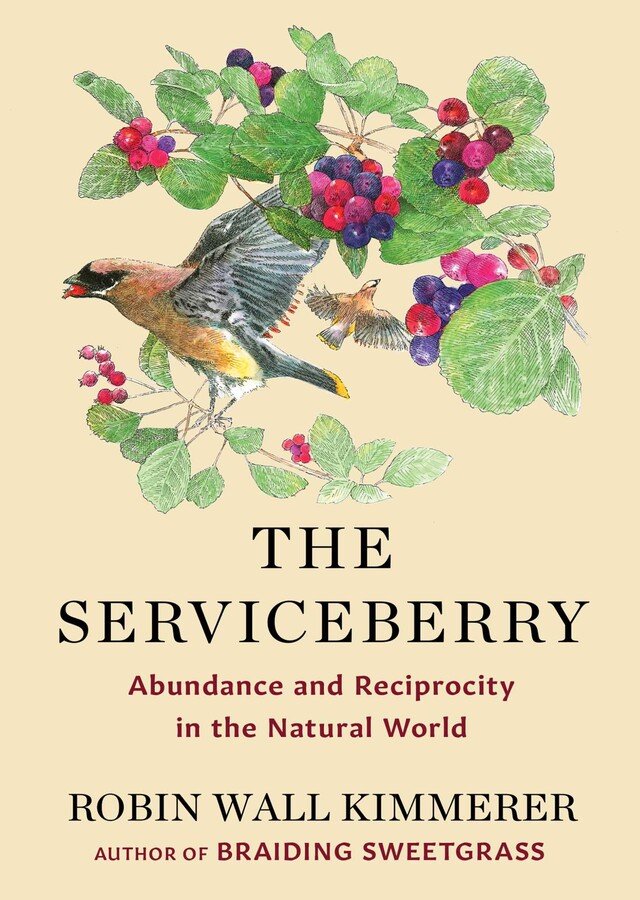
It’s the general phenomenon. Capital gains: a means for the future to be eaten by the past. Contrasted by a quote that Robin Wall Kimmerer includes several times in The Serviceberry – “I store my food in the belly of my brother.” There is a hope for mutual aid. Not a promise. Not a guaranteed 5% increase. But a dream that our lives will stay entwined.
Of course, it may require some inefficient use of time to maintain the bonds between our lives.
#
Our bodies are fascinating amalgams. We are mobile slivers of the sea, encapsulated salt water that can somehow set off tromping along the street. And although nearly all the cells in our bodies are terminal – each such cell created with no hope that it might persist for more than a century or so – there is also an unbroken lineage of ancestry through the cells of our germ line. Cells grow, and divide, and continue growing. It’s the same cell. Cell division isn’t death, but sharing – a cell expanding its reach through space.

For several billion years, the lineage of cells that led to us has grown and divided and grown and divided and never, never died. We are heralds of the immortals. Our cells have been alive for several billion years; nestled within our fleeting bodies, we harbor cells that could survive for several billion more.
As does every other currently living thing.
Which is not to say that these cells can’t die. They can and will, for most things living. Many animals and plants and fungi will perish before mating. Many, many bacteria will die. At this very moment, some bacteria inside my body may find themselves being engulfed by the phagocytic cells of my immune system, and that’s the end for them. In each such case, a branch of the lineage will come to an abrupt stop. A cell survived for 3.7 billion years – growing, dividing, growing, dividing, accumulating subtle changes from mistakes made copying its own DNA – but that cell might not last for 3.7 billion years and a day.
This is the fundamental asymmetry of immortality: all cells alive today have been alive for billions of years, and yet most of them are soon to die.
The past was long. The future, fleeting.
But in the present moment, here we are. With these lives, these cells.
And each such cell – every bacterium – in every plant or fungus – every cell that makes up your body – is an inefficient capsule of fire.
We burn the world.
Slowly. Inefficiently.
In human cells, much of this happens inside mitochondria – the little organisms inside our cells that look like ancient bacteria, trapped and forced to do a bit of work for us. If you were feeling generous, you might say that the mitochondria were “hired.” You might even mention the comparative advantage that each mitochondrion has, metabolizing. We do feed them, after all. Shelter them. Ferry them from place to place.
Our cells have also taken essential sections of the mitochondria’s DNA in order to hold them hostage, guaranteeing that they can never leave.
Inside our mitochondria, sugar is sloooowly set aflame.
#
When my kids are with me and we buy groceries, I usually leave the cart in one of the parking lot carrels. The kids have already climbed into the car and buckled their seatbelts. I don’t want to leave them waiting. And, inside the carrel, the cart is safely out of the way. It’s unlikely to roll off and dent somebody’s parked car.
Later in the day, a grocery store employee will trudge outside wearing a day-glow vest and collect all the carts and push them inside, doing their best to steer the somewhat unruly line of fifteen or twenty carts linked by a bungee tether.
It’s rather efficient that way. Like economies of scale. The cost per task drops as tasks are batched in bulk. Navigating the parking lot with that haltingly vertebral chain of shopping carts can get slow, but it’s much faster than bringing the carts back one by one.
When I’m shopping by myself, though, I’ll often wheel the cart back inside the store. Leave it where I found it. This takes about thirty seconds of my life. And: gone. Those wild & precious moments.
But my life is that inefficiency.
I’m being inefficient each time I choose to eat food and metabolize it for energy instead of simply setting it aflame. A propane torch, even a match: these would be much more efficient than my body. They can oxidize food more quickly.
Walking around, pushing shopping carts from place to place, a few seconds waiting for a car to pass, perhaps a minute spent talking to someone outside the doors – that’s what life is. The idea that it could be made more efficient – by that logic, better to just burn food than bother living.
I like to imagine that I find more pleasure from being here than would fire.
#
Not all life is quite the same as me.
Again: all living things share an unbroken, not-yet-dead lineage into the past (but not undying, since recent offshoots of that lineage are dying all the time), but some living things are “heterotrophs,” like me, meaning things that exist only as slow fire, taking molecules that were made by others and burning them, and some living things are “autotrophs,” which can also inefficiently burn the world, like you or I do, but can also slowly scatter sunlight.
In the beginning, 3.7 billion years ago, when we first quickened, in that moment when the immortal cell that still lives on in each & every one of our bodies first flickered into life, that cell was an autotroph. It had to be. There were not yet other living things to eat. And so that cell – which we were, as that cell would eventually become the present-day’s “us” – that cell took in energy – from the sun, perhaps, or from the molten core of the Earth – and that cell used the energy to build extravagant organic molecules.
And then, inefficiently, that cell also began to burn its own creations.
That, then, is an autotroph. Energy to art to fire. The fire returns energy to the world. But more chaotic, now. And redder.
That is what we do. Our wondrous planet, all its teaming greenery, its endless forms most beautiful, the buzzing insects and rustling foliage and wide-eyed lemurs peering between the leaves: our planet takes in some number of well-organized photons from the sun, and we crumble them up & scatter them. We make those photons redder, and more abundant, and instead of flying in an orderly path from the sun towards the Earth, we send them out in all directions.
From the perspective of the universe, that’s the function of life.
But a function is very different from a purpose.
#
The first cell was an autotroph. It began living at a time when nothing else did.
That first cell took in energy & made molecules & let them burn.
That cell grew. And then it split. Divided itself into two. So then that one organism was spread into separate bodies. Each resulting body shared the same moment of origin – when a cell is growing and splitting, there’s no meaningful distinction between parent & child, just two cleaved embodiments of an enduring thing – and each body would go on to grow and split and grow and split again.
Or die.
Quite often, they died. But some of them – some of the bodies in which this as-to-date immortal entity instantiated itself – endured. Some of its bodies did not die.
And during the ensuing billions of years during which the cell, within those bodies, managed not to die, it changed. All life is change – you, for instance, are a continuously conscious creature because you have a lifetime’s worth of memories within your mind, but also, if you have new memories – if, for instance, you can remember reading the previous sentence, or can remember having eaten breakfast – then your brain is physically different from the brain you had when you woke this morning. The patterns of connections between your neurons have physically changed.
For that immortal cell that we embody, as it grew and divided, it needed to copy all its DNA, and sometimes, in the copying, it made mistakes. Our cells have different sequences in their DNA than they used to, billions of years ago. And so in that time, some embodiments of that first cell ceased building certain sorts of molecules, some specialized perhaps in only the slow burning, and not the scattering of light; some perhaps concocted the unconscious plan of scaffolding an entire frame of terminal helper cells.
Ahhh, yes, that’s what we are – a scaffolding of helpers, granted consciousness by portions of our embodiment that are guaranteed to die. During a person’s life, some 10,000,0000,000,000,000 cells may have composed that person over the years, yet it seems exceedingly unlikely that any more than 10 such cells would carry on with their as-yet-unbroken 3.7 billion years of immortality.
And there, in the parking lot, an amalgam of perhaps 100,000,000,000,000 cells paused while pushing an empty shopping cart back toward the store.
I was outside. Experiencing the temperature of the air. The faint sound of the wind. The sight of many other people – fellow encapsulations of the sea – bustling about their days.
The act of pushing back the cart would leave me with thirty seconds gone.
And yet, not wasted. Those moments, & moments like those: that is life.
Our existence is an inefficiency.
Wild, precious inefficiency.
#
I wrote this essay because I was thinking about cells, life, and efficiency. And I wrote with the hope of conveying some potentially interesting ideas to others, ideas at the intersection of biology, economics, & philosophy. But I didn’t write this for you. Not you, personally.
For most of human history, when people made an effort to communicate, they could address only a small audience. Talking with one other person, or gossiping with a group of friends, or even telling a story to a gathered crowd: the audience would be known. And so the words could be tailored to that audience, inefficiently. In communicating, a constant nudge to consider whom you were communicating your words to. An exercise in empathy.
Now we can communicate more efficiently. Instead of telling people something from our lives, we can write a missive for Facebook, Instagram, The Platform Formerly Known as Twitter. Make a post and move on. The focus is on our own lives. How the words will make us look.
Sometimes, sure, we have someone particular in mind. A person we hope will see.
Maybe next time … just let that person know? You don’t have to go full Luddite, break out your fancy paper & pens & an envelope & stamp & sealing wax (although receiving letters in the mail feels pretty cool!). But maybe … send a text? That’s only a little less efficiency.
But it will be different for your brain. To communicate with a person, and not the amorphous internet at large.
In The Serviceberry, Kimmerer writes that the future our planet could be best preserved if more people thought to store abundance “in the belly of my brother” rather than in a private larder. This, too, is similar. Inefficient, and worth doing.
To store your kindness in the heart of a friend.

 Frank Brown Cloud