In The Parrot and the Igloo, David Lipsky describes an episode from 2010:
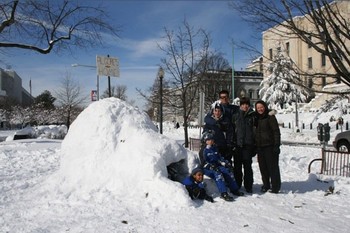
The February weekend two feet of snow fell on Washington, the Inhofe family – the daughter and grandchildren of Senator James Mountain [Republican, Oklahoma] – tramped across the Capital Mall. They spent five hours rolling together and standing up an igloo. They plonked a cardboard sign on the roof. AL GORE’S NEW HOME! And HONK IF YOU LOVE GLOBAL WARMING.

With every frigid winter storm, some people claim that climate change must be a hoax. But, wait! Maybe we can understand why the hotter average global temperatures brought about by greenhouse gas emissions might cause some places to experience much colder weather!
#
My college roommate earned a double major in art theory & practice (among my favorites of her works were a gigantic fabric sculpture of a human heart and a beautiful painting of swimming koi) and biomedical engineering. To complete a biomedical engineering degree, one of the most dreaded courses is Fluid Dynamics. This is the study of stuff that flows, like liquids and gasses, and it’s an incredibly thorny subject. The math behind it is a convoluted mess of differential equations, and it’s sufficiently close to the cusp of chaos theory that the rounding required for computer simulation can give dramatically wrong results.
But I’m not going to broach the math here. Instead, I’d like to offer a simplified model that can help you better understand global weather patterns.
Fluids with different properties tend not to mix well. Cold and warm water, cold and warm air: they can linger in separate layers. The sharp difference in temperature acts like a barrier, and it usually takes turbulence to mix them.
Much of the time, the air near the poles of our planet is much colder than the air closer to the equator. These distinct temperatures of air often won’t mix.
But as the planet warms, that polar air – which is still going to be colder than equatorial air! – becomes less cold. And so the boundary is more permeable. It’s easier for cold polar air currents to make incursions toward the equator and envelop us in winter storms.
And there are other ways in which this peculiarity of fluids – that starkly different temperatures of air or water are difficult to mix – has made our planet a pleasant-ish place to live for the last ten thousand years.
Many countries in Western Europe, based on their latitude, ought to be much colder. These countries have been kept warm by an equatorial ocean water current that flows northward and then eastward without mixing much with the surrounding waters. If these waters mixed, the current would be colder, or might vanish entirely, unable to carve a distinct path across the ocean.
As the surrounding waters warm, the temperature difference that has prevented that equatorial current from mixing with the surrounding waters will become less stark. And if the temperature difference between the equatorial current and the surrounding waters becomes small enough, these waters would mix, and so the warm current would not reach Europe.
On a (slightly) warmer planet, countries like England, Ireland, and Norway would be (much!) colder.
We think. Honestly, fluid dynamics is a really complicated subject, and you can probably tell that using a collection of overturned jam jars filled with water and food coloring isn’t the best way to model the complexity of our real world’s climate.
Fluid dynamics is so complex that research teams still publish scientific articles about their efforts to understand the mixing of hot and cold air inside simple systems like enclosed pipes! A few seconds of internet searching led me to an article from August 2024 titled “Computational fluid dynamics of hot and cold air flow inside short and long mixing tees,” among many others.
We can’t predict with certainty exactly how much warmer our planet would have to be for any particular manifestation of climate change – harsher winter storms in the continental United States! Significantly colder year-round climate in Western Europe! – to take hold.
But the basic idea is pretty simple. Sharp contrasts in temperature keep fluids from mixing. That’s what made climates stable enough for agriculture and complex civilizations to flourish for the past few thousand years.
And if we disrupt those sharp contrasts – which will happen as average global temperatures rise – we will lose that stability.
I’d prefer that we not become the evil ancestors whom our descendants look back upon to think, From them, we inherited only chaos.
 Frank Brown Cloud