The earliest scientific reports that could double as earthworm erotica were published in the 1800s, but apparently some of that early voyeurism was inexcusably cavalier. For a 1926 study in which the authors A.J. Grove & L.F. Cowley watched worms mate while the worms were confined between the glass slides of a microscope, Grove & Cowley write scathingly that their predecessors “mistook the constricting bands seen during coition for the ends of the cocoons, and further, failed to distinguish between the slime-tube formed during coition and the cocoon slime-tube.”
How could you ever again trust a researcher who had failed to distinguish between these various types of slime-tubes??!
Grove & Cowley then provide a very detailed description of worm sex: to wit, thirty-one long sentences that steadily progress from the worms’ “increased tumescence in the clitellum” to “caressing of the anterior segments,” eventually resulting in little shivers that pass in waves over the surface of each worm during “the flow of seminal fluid,” until at last the two worms part and each commences “backing out of the coition slime-tube, which is left behind.”
Why, yes, indeed, there are multiple illustrations.
In many ways, I regret having read this paper. I did not need as much exactitude as Grove & Cowley provide regarding how slippery the worms became during arousal, or quite so many sentences that extolled what the worms did next to their partner’s “tumid lips.” But I did need a sense of timing. How long, I had wondered, does worm sex take?
In some animals, like gorillas or most birds, copulation lasts for a few seconds or less. In others, like the antechinus – a tiny marsupial that is closely related to kangaroos but looks rather like a mouse – the week-long breeding season might include several extended pairings in which non-stop copulation lasts fourteen or more hours (which is apparently so taxing for the males that their metabolism churns into overdrive, their immune systems fail, and every male dies by the end of the week).
From Grove & Cowley, I learned that earthworm sex often takes an entire afternoon, with most of that time devoted to caressing and lubrication and other such activities that we humans sometimes (mistakenly) distinguish from sex by calling them “foreplay.” The portion of their festivities comprising penetration and orgasm might last thirty minutes to an hour.
And I needed to know about the duration of worm sex in order to better understand the findings of Alberto Velando, Julio Eiroa, & Jorge Dominguez, who conducted a 2008 study in which they asked: how will worms respond to different erotic scenarios?
Are there some situations that earthworms find so sexy that they’re willing to pull out all the stops?
Well, I suppose Velando & colleagues didn’t phrase their central question in quite those words, but that’s the gist of their study.
Velando & colleagues confined a bevy of baby earthworms in separate Petri dishes and raised each worm in solitude. Then Velando & colleagues transfered pairs of these sexually-naive adult earthworms into shared dishes, then waited several days to determine whether the worms would learn to mate and choose to do so with each other. (This experimental design involved significantly less annelid voyeurism than Grove & Cowley’s – instead of constantly watching, they just checked each day for signs that the worms had mated. So I was not forced to read about the fumbling efforts of first-time worm lovers, but nor can I comment on any contrast between such situations and the smooth, self-assured entwinings described at length by Grove & Cowley.)
I should clarify that, among earthworms, there is far more sexual equality than among us human beings. When worms mate, each worm might soon become a father, or a mother, or both. Every adult worm has both biological sexes, and each worm will fulfill both male and female roles when they mate. In the typical orientation of their bodies, each worm, according to Grove & Cowley, will slip inside their partner: “The tanks used permitted the observation of both sides of the worms, and it was possible to determine by direct observation that the flow of seminal fluid took place on both sides of each of the co-operating worms.”
So, Velando & colleagues had some worms. Some of the worms had been given a chance to hook up. The researchers then took some of these “sexually experienced” worms and placed them with new partners. At which point they concluded that worms, when paired with an experienced partner, will typically try harder at sex.
Since we know that worm sex takes several hours – thanks, Grove & Cowley! – there was plenty of time for each worm to assess the likely level of recent experience of their current partner.
I should probably mention that I’m definitely not a fan of lethal animal experimentation, because all these worm studies eventually swerved from lighthearted (albeit weird & squiggly) erotica into the unpleasant snuff variety. The worms in Grove & Cowley’s 1926 study were killed either during or after sex so that their various sexy bits could be carefully examined under a microscope. And the worms in Velando & colleague’s 2008 study were killed so that the total volume of semen that each had received could be measured.
After all, that was the researchers’ proxy for how much effort a worm was putting into sex. They learned that worms ejaculate more when fooling around with an experienced partner.
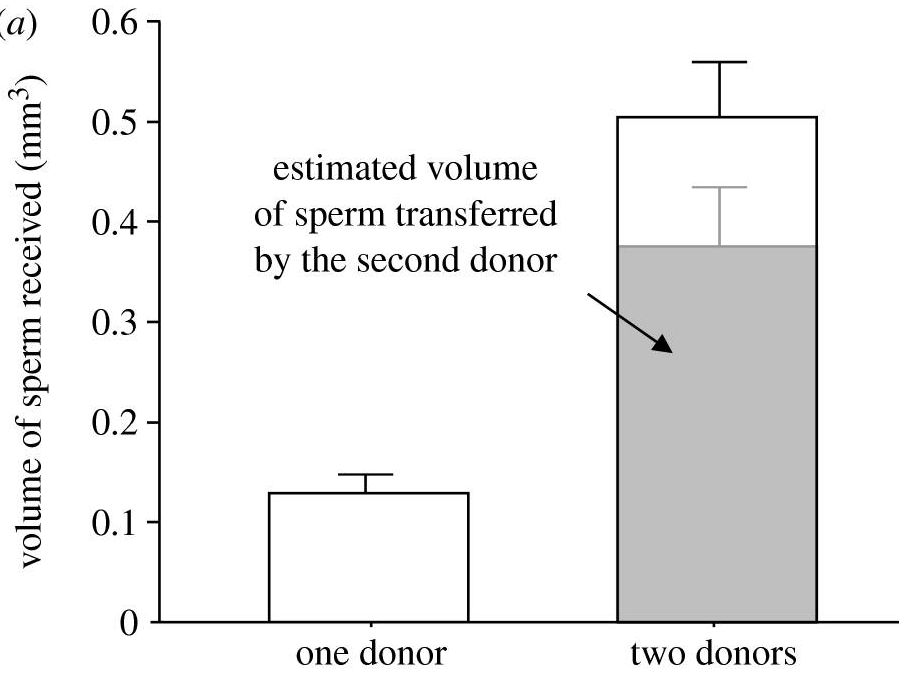
Yes, yes, I’ll admit that my language above lacks a bit scientific precision. That the word “experienced” might conjure up the image of a human lover who knows all the moves, perhaps has a nightstand stocked with a variety of toys & supplies, whereas this study investigates worms’ behavior only when they detect recent pairings with other partners, perhaps through scent or touch. In a discussion among evolutionary biologists, someone would use the phrase “sperm competition” to explain genes that increase the volume of ejaculate after a worm detects traces of another lover. A worm with such a gene might sire more offspring, and thus the gene would spread.
But I still think this is an interesting finding. When discussing animal behavior or mating habits, many biologists imply that mating is a low-cost activity for the partner who won’t put much effort into caretaking. The act of mating probably needs to seem enticing or fun for one or both partners – after all, the only way for a sexually-reproducing organism to currently exist is to be descended from a long line of ancestors who all felt inspired to mate – but in some species, one or more partners will stop helping after that.
By definition, male animals are less likely to put effort into caretaking than female animals. Please bear with me for a moment – this isn’t just patriarchal nonsense, despite how it sounds. In biology, the words “male” and “female” don’t actually refer to anything about chromosomes – in humans, males usually have XY and females XX, but in ducks, males have ZZ and females ZW – or external genitalia – in humans, males usually have larger external genitalia than females, but in hyenas, female external genitalia are often larger – or testosterone – again, female hyenas usually have higher levels of testosterone than males – or anything as nebulous as psychology.
Instead, biologists define an animal as a male if it produces small gametes, and as a female if it produces large gametes. (The word “gamete” means a sex cell like a sperm or egg cell, which have half the usual number of chromosomes and are ready to pair with another gamete to make a new individual with a unique full set of chromosomes.)
Consider an animal like a coral, which has sex simply by releasing sperm or egg cells into the ocean and hoping that some of those cells will find a partner to merge with. (To improve the odds, coral will often release huge quantities of gametes all at once, which is why Marah J. Hardt wrote that snorkeling during coral mating season “smells like sex. As I pulled strands of mucous-y coral goo out of my hair, I caught the eye of the other researchers similarly engaged in de-spawning themselves. We smiled at one another with a knowing look. There is a certain level of bonding that occurs when floating amid the leftovers of one of Nature’s biggest orgies.”)
The only “caretaking” that a coral will do for the next generation is to provision those gametes with helpful molecules, and the egg cell produced by a female coral, being by definition the larger gamete, has more of those helpful molecules.
#
Certain types of cooperative equilibria are inherently unstable. Consider students working on a group project where everyone gets the same grade: as soon as one person puts in extra effort, everybody else has an incentive to shirk.
(Of course, actual empathetic human beings might feel inspired to work harder when they see how much effort a classmate put into a group project. Here, I’ll consider only the behaviors of Homo economicus, that perfectly rational imaginary being who would undoubtedly seem like a sociopath if set loose within the real world.)
If I slack off, I’ll get a crummy grade – that seems fair, because I did a crummy job. But you? You’ll get the same crummy grade as me, even though you’ve already worked hard. And so when I slack off, you might compensate – otherwise, the sunk cost of your prior hard work is wasted.
Over evolutionary time, as females poured more energy into every egg – or every gestation, or every act of child rearing – males could get away with giving less and less.
That’s not how evolutionary history has unfolded in every species, obviously. The initial imbalance was small – I don’t think that anyone would deem a female coral to be some heroically self-sacrificing caretaker after launching a slightly bigger gamete out into the ocean water – and in many lineages, like seahorses, sticklebacks, guardian frogs, tamarins, Siberian hamsters, or even humans, the vagaries of evolution have produced species wherein the males do (or are biologically predisposed to be able to do) as much or more caretaking as females.
But even in species wherein one biological sex does more caretaking than the other, there’s still parsimony in sexual activity. Worms paired with an inexperienced partner ejaculate less. Even though that moment marks the end of the worm’s caretaking (for those potential offspring), and even though the activities leading up to that moment may have felt pleasurable for the worm, it still costs time and energy.
Similar reasoning helps us understand a strange behavior seen in stickleback fish. Among sticklebacks, males are the primary caretakers. Male sticklebacks build and guard a nest, and they’ll constantly flap their fins over their fertilized clutch of eggs to ensure that each egg is bathed in freshly-oxygenated water. Otherwise, the eggs will die – during the breeding seasons, males spend up to two-thirds of their time just flapping their fins to fan fresh water over the eggs.
Females visit and inspect several nests before deciding where to lay their eggs. And because all that fin-flapping is apparently hard work, the females are often attracted to burly-looking male sticklebacks, those whose supple muscles suggest that they’ll dutifully flap-flap-flap fresh water over all their precious little eggs.
Also, though, female sticklebacks seem to think that brightly colored male bodies are sexy. All else being equal, they’re more likely to lay eggs with a male who is fancifully decorated for the breeding season. Even though those bright colors will make that particular male more likely to be eaten by predators, which would doom the eggs.
Who should an expectant mother stickleback seek out: a dutiful, well-hidden parent, or a flashy, eye-catching showboat? It’s hard to balance these conflicting desires! I mean, it’s hard even for us big-brained humans: we’ll often swoon over people whom we know are probably bad news. So why would we assume that these choices feel any easier for a fish?
Occasionally, they might put their faith in others’ judgment: do you think that he seems nice?
Sticklebacks often seem to pay attention to what other sticklebacks are thinking. For instance, if a potential predator is spotted near a shoal, two sticklebacks will often break away from the group in order to inspect the threat. This is dangerous, and becomes even more dangerous if your partner gets spooked and swims back early, leaving you alone near a hungry predator with no ally nearby to help you escape. So sticklebacks seem more willing to inspect a predator when paired with a fish who hasn’t abandoned them before.
Which brings us back to the eggs: after building a nest, a male might decide to roam the breeding grounds, steal some fertilized eggs from another nest, then bring them back and commence fanning them, assiduously caretaking the stolen eggs as though they were his own.
Maybe fanning eggs feels intrinsically rewarding to sticklebacks – I definitely don’t need to believe that I might be genetically related to a particular baby to feel good if that baby smiles at me. But also, even though female sticklebacks don’t do any caretaking for their fertilized eggs, they still act parsimoniously. As with worms, they’re evaluating potential partners before deciding how much effort to put into sex.
And their judgment can be swayed by the opinions of others. If another female thought this male was good enough to lay her eggs here, maybe he’s good enough for mine! Carefully tending to another fish’s eggs might help a male stickleback to procure some of his own.
#
Human behavior is so flexible, and so heavily swayed by local culture, that we don’t have as many predictable behaviors as worms or fish. There are cultures in which many people are great parents, regardless of their biological sex; in other cultures, ingrained stereotypes discourage certain people from putting effort into caretaking; in still other cultures, no children receive as much care as I think they need.
Yet I still find it fascinating to consider the ways in which other species engage in the delicate dances necessary for the continuance of life. Who will care for the coming generations, and how?
Worms act as though they’re thinking. Worms act as though they’re considering and making judgments about how to best provide for the future. Fish, too, appear to act with intent (which seems less surprising to me – it’s easier for me to imagine the thoughtful inner life of a fish than of a worm!). So it doesn’t seem like too much to ask that we humans also do as much: to consider the well-being of future life, and act in ways that might support it.
.
.
.
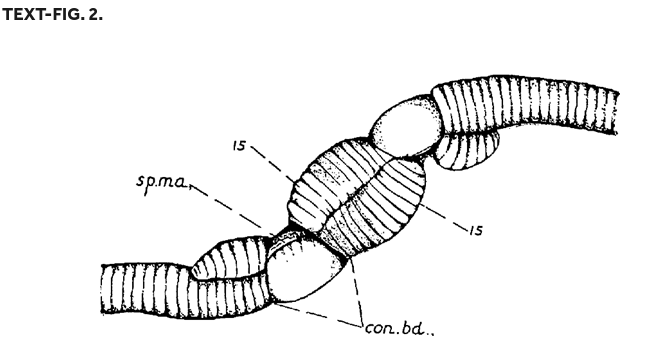
header image from Grove & Cowley, “On the reproductive processes of the brandling worm,” Quarterly Journal of Microscopical Science, 1926.
 Frank Brown Cloud