Content warning: Weigl’s original poem, which I’ll link to and be quoting from, includes violent imagery from the Vietnam war. I’ll also include quotations from people who discussed this poem with me, and their remarks will include descriptions of some of the violence and trauma that they have experienced while incarcerated.
#
Almost every Sunday, I spend an hour or two inside the Monroe County Jail discussing science, philosophy, or poetry with people who are incarcerated.
I experience a wave of dread each week before I press the buzzer on the exterior door. It’s a bit like the sensation of getting ready to go running on a cold & drizzly day, or steeling myself to jump into frigid water to swim.
I’ll be glad to have done it. I believe that volunteering there, to help the people who are held inside, is the right thing to do. Once we’ve begun our class, the experience might not even be so bad. Sometimes we laugh during our conversations; even on the hard days, I often learn a lot. But the prospect of walking inside the jail still brings me down, almost every time.
#
After I’d been buzzed in the first door, then buzzed in the second door, then buzzed in the third door, then escorted to the elevator, then escorted to the classroom, then left in the locked room, then heard a guard unlock the door to allow eight men to come inside the classroom with me, then heard the door slam & lock behind them, I handed out a stack of printed poems.
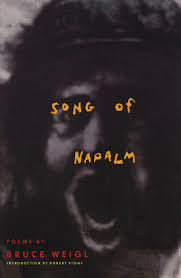
The poem at the top of the stack was Bruce Weigl’s “Song of Napalm.” It’s a hard poem – a really well-written description of PTSD, exploring the lies that we might try to tell ourselves in order to carry on, and how it feels in the moments when the lies won’t work.If you want, you can read the full poem here.
In the beginning of the poem, the narrator stands beside his spouse and attempts to enjoy a peaceful evening, looking out over a horse pasture illuminated by shafts of rosy light after a storm. The sight should have been beautiful. But the sound of thunder had wrenched the narrator’s mind away from this life, this place:
branches
Crisscrossed the sky like barbed wire
But you said they were only branches.
Okay. The storm stopped pounding.
…
I turned my back on the old curses. I believed
They swung finally away from me …
But still the branches are wire
And thunder is the pounding mortar,
For people with PTSD, a trick of the light might soon be accompanied by a trick of the mind. A memory is triggered, then past & present merge into one. The narrator sees something that isn’t there. As much as he wants to stand beside his spouse and just be happy, it isn’t working.
Red offered his reaction: “In prison, if there’s movement, and then you see someone moving against the flow of movement – everyone is going one way, but you see somebody or a couple somebodies moving in a different direction – that is when you’ve got to look out. That is how you know something is about to go down.
“And I spent a lot of time in prison in upstate New York. The system there, you get a whistle, and you get a warning shot, and then they shoot to kill. Standard policy, a whistle, and if you don’t drop, if you don’t drop immediately, they shoot you in the leg, and if you’re not down, the head. They do not fuck around.
“So there I was, like, this was maybe a few years ago, I was with my ex and we were at our kid’s little soccer game. You know I don’t like crowds, I don’t like being around big groups of people, but I went to it with her. I was trying to watch my boy. But the kids, they’re chasing the ball, they’re running every which way, they’re not going in the same direction. I can’t handle it. And the referee, he’s got that whistle. Pretty soon, I’m not at that soccer game. I’m back in prison. I can feel it, something’s about to happen, everybody’s running everywhere. And the ref blows that whistle, boom, I drop, I’m on my belly, face-down on the ground.
“My ex, she was looking at me like I was mental. But she didn’t know. I mean, I’m glad she doesn’t know, but, still, how do you come back from that? How are you supposed to live in a world that doesn’t understand that you cannot not drop when you hear that whistle?”
The narrator in “Song of Napalm” tries to find a way. He tells himself a story that doesn’t end in the wartime death of a child.
Still I close my eyes and see the girl
Running from her village, napalm
Stuck to her dress like jelly,
Her hands reaching for the no one
Who waits in waves of heat before her.
So I can keep on living,
So I can stay here beside you,
I try to imagine she runs down the road and wings
Beat inside her until she rises …
In a world where the horrors weren’t the final endings, where military tragedies were softened by the sight of innocent victims rising into the sky as angels, the narrator could return to his country and live easily again. He could enjoy watching horses meander through the pasture after thunderclouds rolled away.
A story – even a story that had such an overwhelming ring of falsehood – might let the narrator sleep.
This, after all, is the fundamental trick pulled by the narrator of The Life of Pi, described inside the narrative as “a story to make you believe in God.” Rather than murder and cannibalism, there was a tiger, and a fantastic, nigh-unbelievable adventure, a story that could be celebrated in a collection of yellowed newspaper clippings.
Inside the jail, a man with such deep laryngeal scarring that every word sounded as though it were coated in a crackle of static offered his own version of such a story – as he spoke, he stood and paced in tight circles in the corner of the room, gesticulating for emphasis and staring fixedly at the floor, avoiding eye contact with any of the rest of us.
“I saw a kid in prison, he’d only been there two fucking weeks, kid got into a fight, you know these fucking kids, they’ve heard about prison on the fucking T.V. and they think they’ve got to get into a fucking fight fucking right away, kid got into a fight and they slammed him into a metal bench, again and again and again they slammed him. I saw the fucking kid when they were taking him away, fucking face smashed, eyeball was hanging out his head, I could not handle it, his eyeball out his head. And they took him to the fucking hospital and somebody claimed ‘oh he was okay’ but I saw his head and I saw his eye and that happens to your brain, maybe you don’t die but you are not going to be the same. You are not okay.”
But the lie swings back again.
The lie works only as long as it takes to speak
And the girl runs only as far
As the napalm allows …
… Nothing
Can change that; she is burned behind my eyes
And not your good love and not the rain-swept air
And not the jungle green
Pasture unfolding before us can deny it.
In the dark moments, we might remember that the story we’ve told – an angel with wings, a tiger with the child on the raft, a hospital bed that saved him – was only ever a story. Make-believe. The truth might have a darker ending.
At such moments, this poem’s narrator knows that the nightmare was real, that the happy ending was a myth, and nothing – not even the way that he is loved by the people he has returned to – can change that.
The narrator felt that he needed the lie so that he could “keep on living,” but he doesn’t have the lie.
And yet. Bruce Weigl did go on living. He survived. He wrote this poem, which he dedicated to his wife. He still survives – a friend who often volunteered inside the jail with me, and with whom I’ve discussed several of Weigl’s poems – sent me an elated email recently because Weigl had read my friend’s first book of poetry.
And the people in jail: their circumstances inside are grim, which is why I volunteer. But also, they will be let out. They will get to go on living.
And they will live among us.
We could build a world where the horrors won’t always be at the forefront of their memories.
 Frank Brown Cloud