While traipsing through the stacks of the university library, Sassafras Lowrey’s Lost Boi caught my eye. I liked the title and was charmed by cover.
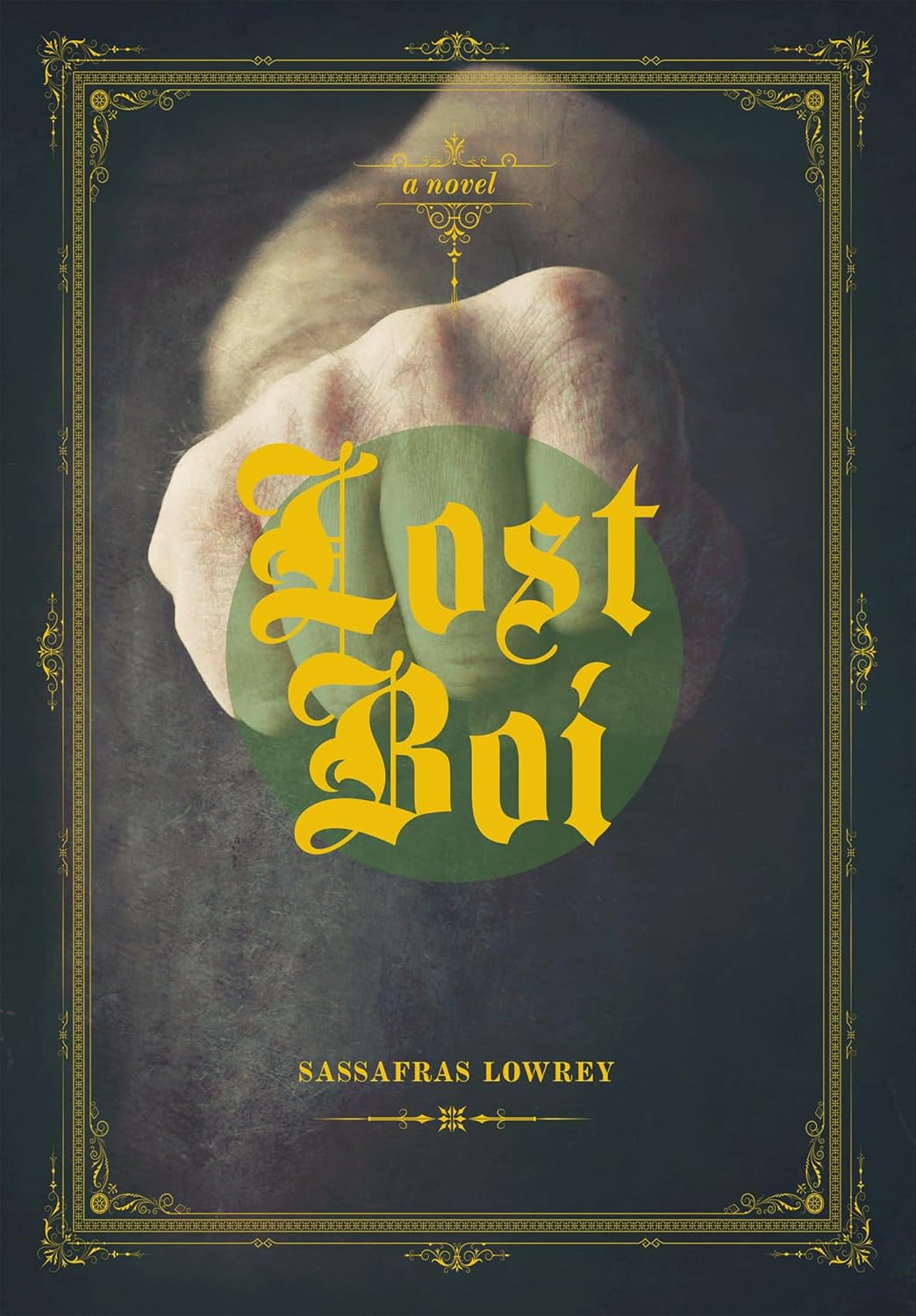
Reading that evening, I was impressed by the Lowrey’s conceit: a contemporary, realist, genderqueer re-telling of Peter Pan set in an urban kink community. Most elements of the original are incorporated in clever ways, like the crocodile:
Pan didn’t tell Wendi about the Mermaids’ dirty little secret, but I guess he spared her ours too. He didn’t mention the liquor bottles thrown into the river from the attic window, the SOS message of dirty needles. Pan didn’t know it, but Wendi would figure out soon enough that the Crocodile was always after them.
The Mermaids liked to think that the Crocodile was their friend, that they had tamed it, and it protected them against their work, against those men. The Mermaids were always making bargains and deals, but the Crocodile always took their money and swam away, leaving them dazed and confused.
After all, heroin is heroin no matter what you call it. You can’t domesticate a monster.
The Lost Boys’ ability to fly is portrayed through suspension bondage, in which participants are lofted above the ground with the same sorts of ropes and rigging that would allow a stage performer playing Peter Pan to soar inside a theater:
I flew that night under the hands of Hook. I knew he was an expert rigger; it’s why all the conferences wanted him, why Pan flew under him too. I thought we were going to fuck. Hook had me suspended wearing nothing but my boots and briefs – so different from Pan, who prefers bois to be clothed.
I wasn’t sure how I felt about being fucked by Hook and what it would be like for him to slip into one of my holes. I’d never thought about it before, and in that moment I realized that I wasn’t even sure of Hook’s preferences, though I was certain I would soon find out.
Peter Pan’s arbitrary rules, which in Peter Pan resemble the tyrannical whims of a child dictating activities on a playground, become instead a full-time dominant & submissive relationship:
Neverland is a paradise, his paradise, and it runs by Pan’s rules, and his alone. Pan explained, as they walked along the tracks, that Wendi and John Michael had to swear their allegiance to him, as all of us had once done.
In return, he would care for them, and he promised that they would always be well used. John Michael, who was not experienced with sex games, quickly realized that this was more than that, much more complicated. Her hands were sweating as her mind raced.
“Yes, Pan …” she finally muttered.
Pan stopped walking and turned to her. The gold in his green eyes, glistening in the dim light, met hers for the first time, and she understood how deep this all would go. “Yes, what.” It was not a question.
“Yes, Sir,” John Michael replied, her face glowing red.
And the crucial tension between either staying in Neverland or returning to the real world and growing up is depicted through the fatigue that settles over aging members of a punk anarchist collective as they contemplate finding steady jobs with predictable hours so they won’t have to scrounge through dumpsters or hustle or engage in sex work in order to eat:
In his own way, like Pan and all us lost bois, Hook avoided growing up. He never had to have a grownup job but lived in a world of sexual outlaws, traveling from kink conference to kink conference, teaching his history and helping others to appropriately train their submissives. Hook not only trained others in the rules passed down to him from the great leather Pirates who’d come before, but he dedicated his life to their honour and made sure not one member of his crew ever forgot that. In that way, his world inside the Jolly Roger was like our Neverland, separate from the morality and judgments and the expectations of adults.
But the Pirates are our enemies because they are rich yuppies. Their fridges were always full. But they were different from grownups, because they lived by their own rules. Rules, Hook maintained, ensure the keeping of good form, and Hook was at his most seductive when he spoke about the importance of good form.
I’ve never read Fifty Shades of Grey, and I’m not personally aroused by the sort of BDSM games that course through Lost Boi (although many people are, and that’s totally okay! – as Gillian Anderson writes in the introduction to a BDSM-themed section of Want, a compilation of women’s erotic fantasies that are presented anonymously because even now our culture denigrates women who dare to describe their desires, “It is perhaps unsurprising that of the hundreds of letters written to me, the predominant theme was that of power, domination, and submission”) where the “battles” between the lost boys and the pirates are consensual scenes in which mutual flagellation and performative violence is enjoyed by all. For instance, when Wendy finds herself “captured,” bound, and teased by Captain Hook, she can always safe-word out.
I saw her first. Mommy Wendi, with her skirt and petticoats around her hips, her arms laced above her head, tangled in a spider web of pink rope. The mascara had run down her round cheeks in dark winding rivers, and I wanted to lick them away, but of course I couldn’t move toward her. Hook’s left hand was in, to the wrist, and his right one rested almost tenderly on her stomach. …
“You could stay with me and my men,” Hook said as he twisted his wrist and pushed deeper into her. Wendi moaned, which wasn’t an answer, but Hook was encouraged. “You could be my Pirate Bride. I could be everything to you that Pan can’t be. … Do you really think you can keep all your bois clean? You’re going to lose them, Wendi. You know what can happen to bois who don’t listen to their Mommy, and it’s so much harder to make them listen out in the real world. You’ll be visiting them in cemeteries and prisons.”
Hook’s husky voice trailed off. Wendi seemed to be drowning under the weight of his words. Could she stay? Could she build a life here among the pirates? What did Hook know about what Pan had never been able to give her, anyway?
Wendi studied Hook’s well-built frame, and her eyes came to rest on the intricate tattoo on his left forearm: a skull, a suspension hook, and roses wrapped around the words “Death Before Dishonor.”
“Never!” she shouted and strained against her ropes, and then yelled the word “Red!”
The scene was over. Hook had lost her. His right hand grabbed the ornate handle of a knife from his belt and sliced her ropes, bringing her down to sit on a nearby stool. Wendi rubbed the rope marks on her arms.
And yet, even though I’m not the right audience to appreciate Lost Boi as erotica, I was charmed by it as a intricately constructed, psychologically insightful work of art.
I felt compelled to re-read Peter Pan, which I hadn’t thought about in years. After Lost Boi, the original text of Peter Pan felt different. I was hyper-aware of how much Peter Pan and Captain Hook secretly love serving as the other’s foil – indeed, all the lost boys and the pirates need each other for their lives to feel complete.
Though J.M. Barrie makes clear that Peter Pan is a selfish, ungrateful, untrustworthy figure, Lowrey accentuates the hunger and the ever-present ache of life in Neverland – a much darker reading than many people had drawn from the original. At the time of this writing, the Wikipedia page on Peter Pan opens with the statementthat “Peter Pan has become a cultural icon symbolizing youthful innocence and escapism.”
And all this highlighted for me something that I’ve always found particularly uninspiring about James Joyce’s Ulysses.
Modern English is built on a foundation of The King James Bible and William Shakespeare – the former, plagiarized from a person whom we burned at the stake for his efforts; the latter, Lord Regent of Bad Penis Puns, as though his very name compelled him: Willy-I-Am Shake-Spear, old Billy Wagcock, the great I Am a Dick now brandishing said dick.
Our literature: begun with a bloody tale of dragon baiting; vernacular eschewed till Chaucer reaped fame from crude jokes and sex slang; the modern form a mongrel mix of guttural Germanic old and ornate Norman new.
And the modern modern era ostensibly began in Year 1 p.s.U – the first year “post scriptum Ulysses,” which was, according to T.S. Eliott, “the most important expression which the present age has found,” teetering at the peak of a Harvard committee’s 92% male twentieth century centenary – a year otherwise known as 1922, since few aside from the antisemetic fascist Ezra Pound agreed that the publication of Joyce’s tome compelled such a sharp break with the past that we’d need a novel calendar.
Ulysses itself is supposedly in conversation with the past, but the conversation only flows one way. Joyce’s focus is Joyce: knowing the Greco-Roman myth changes how a reader reads Ulysses, but Ulysses won’t alter our perception of the past (unless it’s to cast undeserved disparagement upon Penelope, privileging post-agrarian men’s fear of female sexuality).
Joyce’s stand-in for Penelope is sexually voracious and untrustworthy. Joyce’s Odysseus masturbates in public at the sight of a schoolgirl’s undergarments. As though the original myth weren’t misogynistic enough – The Odyssey, in which Odysseus’s son Telemachus is congratulated for murdering servants who’d been raped, threatened, or coerced into sex by his household’s unwanted guests.
In Emily Wilson’s translation, Telemachus says, “I refuse to grant these girls / a clean death, since they poured down shame on me / and Mother, when they lay beside the suitors.” And then Telemachus executes his awful plan.
I far prefer modern works that twist the ancient myths to better show the underlying malignancy of tales that celebrate male gods & heroes having their way with all other denizens of the world, like Natalie Haynes’s Stone Blind, Madeline Miller’s Circe, Christopher Logue’s War Music, or Barbara Hamby’s poem, “Penelope’s Lament,”
VI. Penelope’s Lament
No sex for twenty years except with my handmaidens
and myself, so when you turned up like a beggar man,
O I recognized you but needed time to trade in
my poor-widow persona for something more Charlie Chan,
you know, a razor hiding behind a cream puff mask,
irritated by my number-one-and-only son,
ranting about food and money, hiding sheep and casks
of wine in caves, so the suitors would be forced to run
away. As if they would. A more ratty shiftless bunch
of creatures would be hard to rustle up. My bad luck,
they wanted to be king. I’d thought of giving them a lunch
of strychnine. Then you showed up, a geriatric Huck
Finn. So be my guest, finish them off, then I mean
to poison you. O Ithaka is mine. I am queen.
The past can be a slippery thing.
But while Joyce uses the past for his imprinting, in Ulysses the past is present as a parlor trick. He’s not querying the original myth – that might distract us from the essential task of discovering what Joyce himself means – but rather talks at the past in order to bask in his own cleverness.
Joyce aims to impress and overwhelm – “I’ve put in so many enigmas and puzzles that it will keep the professors busy for centuries arguing over what I meant, and that’s the only way of insuring one’s immortality” – as though only by speaking – not listening, not building relationships that outlast us – could we gift something of ourselves through time.
And yet, for all its faults, I do believe that Ulysses has a gorgeous scene, some thirty four pages long in my edition, “Scylla & Charybdis,” in which Stephen Dedalus, Joyce’s Telemachus, lectures lyrically on William Shakespeare.
As expected from an English text, sex jokes abound.
“Twenty years he lived in London,” Joyce’s Dedalus explains, “and, during part of that time, he drew a salary equal to that of the lord chancellor of Ireland. His life was rich. His art, more than the art of feudalism, as Walt Whitman called it, is the art of surfeit. Hot herringpies, green mugs of sack, honeysauces, sugar of roses, marchpane, gooseberried pigeons, ringocandies.”
“Sir Walter Raleigh, when they arrested him, had half a million francs on his back including a pair of fancy stays. The gombeen woman Eliza Tudor had underlinen enough to vie with her of Sheba. Twenty years he dallied there between conjugal love and its chaste delights and scortatory love and its foul pleasures.”
“You know Manningham’s story of the burgher’s wife who bade Dick Burbage to her bed after she had seen him in Richard III and how Shakespeare, overhearing, without more ado about nothing, took the cow by the horns and, when Burbage came knocking at the gate, answered from the capon’s blankets: William the conqueror came before Richard III.”
The writing here is beautiful; the content, though, quite questionable. Dedalus describes sexuality as essentially dirty, using the word “scortatory,” a term for sultry goings on that lacks the playful good humor of “fescennine” or the simple celebration of “sensuous.”
“Scortatory” is derived from the Latin scortum, for prostitute – the same misogyny that attempts to shame any woman who enjoys sex by referring to her with various synonyms for sex workers, as though there could be no motive other than commercial for tousled times.
And Dedalus’s use of the word “capon” – defined in 1398 by Trevista as “a cocke made as it were female by keruynge away of his gendringe stones” – is as childishly petty as the proto-incel internet’s adoption of the word “cuck” to describe any unwanted situation. Consensual sex described as though emasculating an uninvited party – not that the encounter between Shakespeare and the woman is clearly consensual, but the person supposedly castrated by Willy’s (which would have been Dick’s) dalliance is the burgher, apparently uninvolved in either pairing.
Sex as competition, which perhaps seemed sensible to Joyce since his very eloquence is competitive, a thunderous plaint demanding we recognize his exclusive triumph. This scene is a fractal microcosm of the whole novel: Dedalus’s competitive banter seeking victory for his own (and thereby Joyce’s) prodigious intellect.
Loving or laying or writing to win. Within a world where, without behavior like this, neither sex nor knowledge would be mistaken as finite goods.
In Lowrey’s Lost Boi, jealous tension and the fear of displacement are no less present, but the characters actively wrestle with these emotions in their attempt to build a better world.
I awoke suddenly and steadied myself so as not to fall from my hammock. Around me I could hear the shallow snores of the other bois. I squinted into the darkness and made out three empty hammocks, the two newly prepared ones and Pan’s. In the quiet, I could hear someone being flogged in the kitchen.
When a boi joins our ranks, Pan likes to spend some private time getting to know them. That new boi time always makes me jealous. I’m poly, so of course I don’t mind him being with another boi, but that special first night gets under my skin …
Lowrey makes clear that an expansive attitude toward desire and romance wouldn’t mean the end of anxiety. And, as one might expect given Lowrey’s effort to engage in a full dialogue with the past, this same tension is present in the original Peter Pan, though in a more subtle form. Consider, for instance, the negotiation between Peter Pan and Wendy’s mother, who both express their own forms of love for Wendy.
Peter says, “Well then, come with me to the little house.”
“May I, mummy?”
“Certainly not. I have got you home again, and I mean to keep you.”
“But he does so need a mother.”
“So do you, my love.”
“Oh, all right,” Peter said, as if he had asked her from politeness merely; but Mrs. Darling saw his mouth twitch, and she made this handsome offer: to let Wendy go to him for a week every year to do his spring cleaning.
Wendy would have preferred a more permanent arrangement; and it seemed to her that spring would be long in coming; but this promise sent Peter away quite gay again. He had no sense of time, and was so full of adventures that all I have told you about him is only a halfpenny-worth of them.
I suppose it was because Wendy knew this that her last words to him were these rather plaintive ones:
“You won’t forget me, Peter, will you, before spring-cleaning time comes?”
Of course Peter promised; and then he flew away. He took Mrs. Darling’s kiss with him. The kiss that had been for no one else, Peter took quite easily. Funny. But she seemed satisfied.
Funny, too: in a bawdy BDSM erotica, I found a more compelling engagement with the cannon than in Joyce’s oft-celebrated Ulysses. Your tastes may differ from mine, but I prefer Lost Boi.
 Frank Brown Cloud