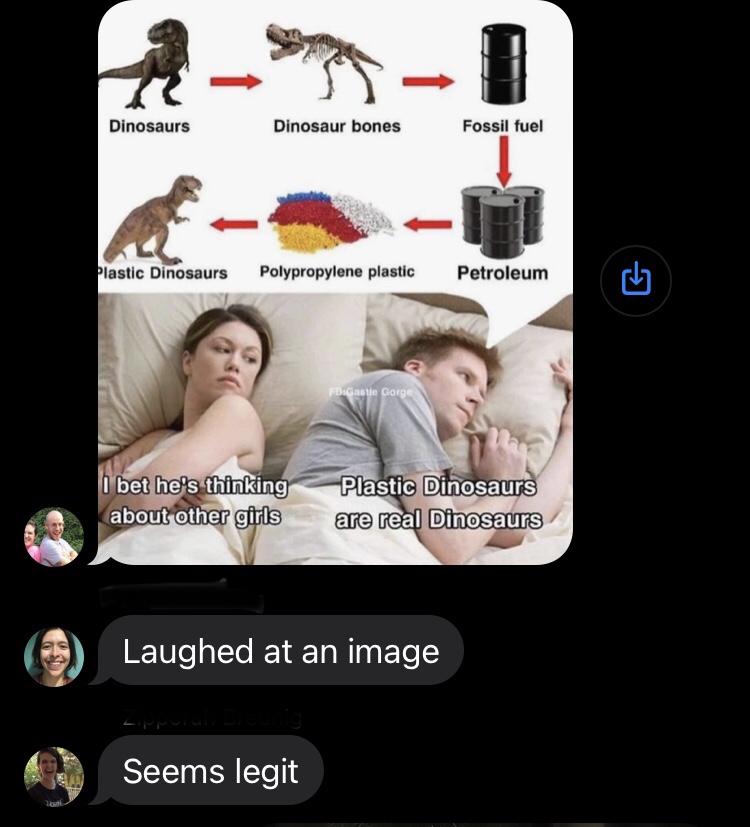
The other day, I received a message in my family group chat:
Of course, I had to write back:
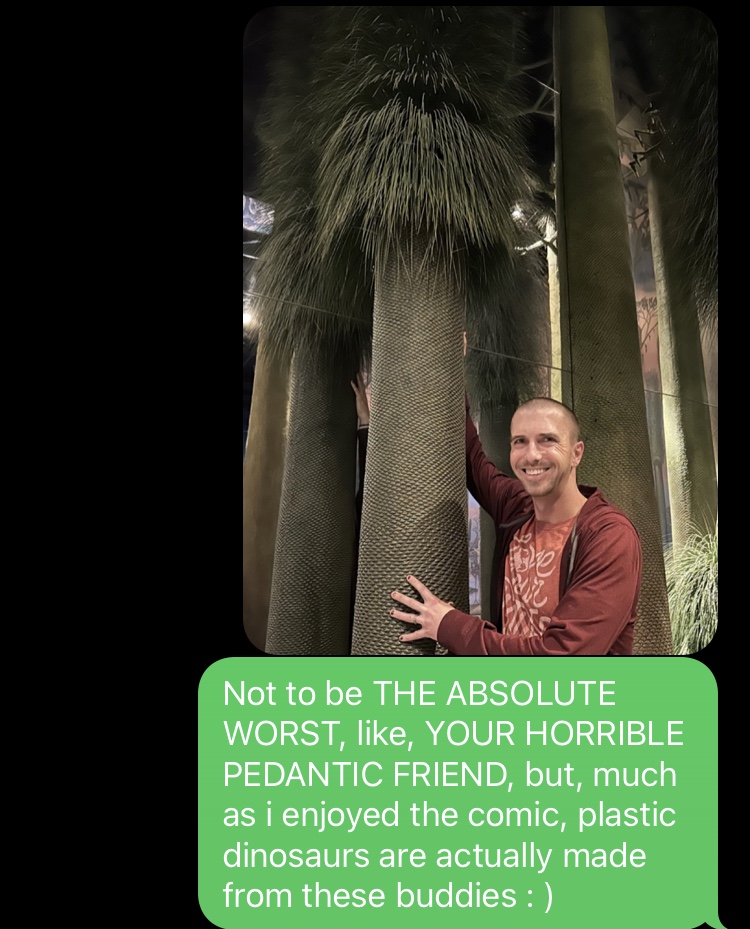
As it happens, my correction was also wrong.
Over the course of writing this essay, I read many research papers, like Motoaki Sato’s “Thermochemistry of the Formation of Fossil Fuels” in a special Fluid-Mineral Interactions issue of the Geochemical Society’s magazine. Which might sound boring. It was.
The quick summary is that ancient scale trees, which were often buried near our planet’s surface, probably formed coal. It takes fairly high temperatures and pressures to form coal – roughly the same temperature range that you might use to bake bread – but it takes much higher temperature and pressure to form the sort of petroleum deposits used to fuel a car or make plastic dinosaurs. Those fossil fuels probably came from ancient plankton that sunk deep into the ocean and were buried before they could decompose.
#
There’s been a lot of buzz about using carbon offsets to solve climate change. A mindset centered on privatization and resource extraction got us into this mess; surely it can get us out of it, too!
And so, rather than confront the mathematical absurdity of measuring the health of our economy in terms of its percentage growth – as though our goal should be a 2% to 3% increase in GDP every year, no matter that unending exponential growth would require careening toward infinity – we continue to commodify the natural world.
Perhaps we can continue taking just as many trans-Atlantic airplane flights; and continue cooling ever-larger server farms for Amazon, Google, & Facebook; and churn through ever more disposable, high-tech consumer goods … just as long as we also plant more trees!
After all, trees build their bodies with carbon from the air. If our problem is caused by greenhouse gases – too much carbon dioxide in our atmosphere – shouldn’t a trillion new trees solve everything?
#
For trees to grow, they need carbon atoms from atmospheric carbon dioxide, and hydrogen atoms from water, and energy from sunlight. They turn the carbon and hydrogen into sugars – and then use many sugars to synthesize complex molecules like cellulose and lignin – and get bigger. As they grow, they release oxygen back into the air. They store carbon in their woody trunks.
And then, eventually – several decades later for a “live fast die young” tree like a silver maple, perhaps several centuries later for an oak – the tree will die, and fall, and decompose.
As the tree decomposes, all that carbon dioxide goes right back into the atmosphere.
Each tree, while it’s alive, temporarily sequesters carbon from the atmosphere. But then the carbon will go back.
#
A world in which more total area was always devoted to forests would have less carbon dioxide in the atmosphere. But not all forests are equivalent. A diverse old-growth forest will typically sequester more total carbon than the same number of trees scattered elsewhere around the world. In an old-growth forest, less light typically reaches the forest floor, so trees grow more slowly, stronger, and straighter. These trees are less likely to topple during a storm. A diverse grove will be more likely to provide a variety of foods for insects and other animals throughout the year.
A monoculture that’s planted all at the same time, allowed to grow to a certain height, then all cut down and harvested for lumber, will not do much to slow the pace of climate change. Most of the wood will eventually decompose. It might be used to build a house, and covered in a coat of paint, and then the wood will stay … until someone decides to renovate, smashes a few walls, and tosses the old scrap in a dumpster. Then the material gets trucked off to a landfill to rot, and the carbon goes back into the atmosphere.
#
Long ago, there was an era when trees grew in a way that did pull loads of carbon out of the air. This lasted from about 360 million years ago until about 250 million years ago.
At that time, lepidodendrons grew. The scale trees.
These were cool plants. From my perspective – somebody who has a backyard full of sassafras and mulberry and other such modern trees – scale trees were pretty weird.
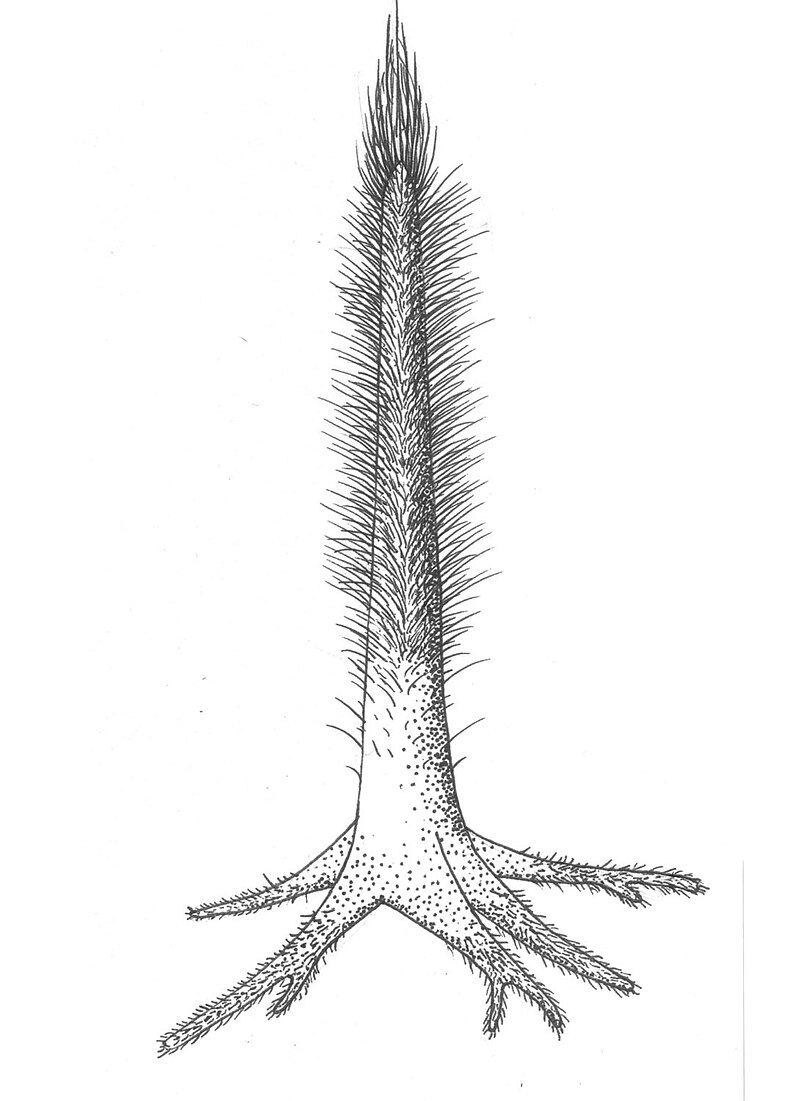
Scale trees grew in dense, swampy forests. And they didn’t branch out until after they’d reached nearly their full height, perhaps 150 feet off the ground. Until then, they’d grow as a leaf-covered trunk, a thick verdant pillar rustling in the breeze.
At that time, the world’s various decomposers – bacteria and fungi and insects and the like – were poorly equipped to consume scale trees woody trunks. Scale trees used carbon dioxide from the air to make sugars, just like modern trees, and then combined these sugars to form complex molecules.
In our world, all the complex molecules in tree trunks can be chewed up by wood-eating fungi. During the time of scale trees, though, the trees might grow, and die, and topple, and then the dead trunks would just stay there. They wouldn’t decompose. No organisms had yet evolved to consumed the lignins in a scale tree’s trunk. And so the carbon in a scale tree’s body would not return to the atmosphere. Other scale trees would grow around it, and the fallen tree would get covered in leaf litter, then soil. The dead scale tree would be buried, eventually.
And that’s a major reason why our planet now has so much carbon stored underground. The majority of our coal deposits are the last remnants of long-dead scale trees, which ancient decomposers were unable to eat.
Fossil fuels generally aren’t made from dead dinosaurs, because plenty of fungi and bacteria could eat dinosaur meat, so all of their carbon just went back up into the atmosphere.
#
There’s a scientific story that I’ve heard told about scale trees, that they caused sufficient climate change to bring about their own extinction. And this story sounds plausible! It fits some of the evidence we have about the ancient world.
But this story probably isn’t true.
About 400 million years ago, there was a whole lot of carbon dioxide in the atmosphere. Perhaps something like several thousand parts per million. And then, during the time when scale trees grew, the amount of carbon dioxide in the atmosphere fell precipitously. By 250 million years ago, the amount of carbon dioxide was perhaps down to about 400 parts per million.
Currently, the amount of carbon dioxide in the atmosphere is about 420 parts per million.
We’d predict that the scale trees caused their world to get a lot colder. Storms probably grew more intense, and the seasonal weather less predictable, as is likely to happen whenever there is a major shift in climate. Georg Feulner titled an article for the Proceedings of the National Academy of Sciences, “Formation of most of our coal brought Earth close to global glaciation.”
We’ve told a story that scale trees could no longer survive on the cold world that they had made.
In Otherlands, paleontologist Thomas Halliday writes that:
Nobody quite knows why the rate at which organic material is being laid down throughout the equatorial coal belt in the Carboniferous [the time period when scale trees thrived] is as high as it is.
One idea is that lignin, the main constituent of wood, is a relatively new material, and is simply not yet easily digestible by microbes. They have not evolved the ability to consume it, and so it turns to coal.
Others suggest that it is the unique geography of the Carboniferous that led to the laying down of coal, the only time in Earth’s history when the tropics have been both excessively wet and dominated by geographic basins. [The idea being that dead trees might sink beneath the water and be buried before they could decompose.]
Whether by experimenting with new materials faster than microbes can accommodate, or through happenstance of climate and geography, innovators like the scale trees are radically changing the composition of the atmosphere.
The Earth [of 250 million years ago] is spiraling toward climate change that will lead to a cooling almost to the point of a global ice age, and increased seasonality and aridity, and, ultimately, the wholesale destruction of the very ecosystem that keeps the scale trees alive.
This will be their extinction, as the sodden coal swamps of the Carboniferous give way to the droughts of the Permenian.
Partly, this story resonates with ecologically-minded scientists (like me!) because it sounds a lot like what we humans have been doing. After all, we are also a species that took advantage of favorable climactic conditions, flourished, and in the process might be changing the world so much that we doom ourselves.
And this has happened before. As I’ve described in a previous essay, cyanobacteria brought about their own damnation. Cyanobacteria conjured a world where the very air could burn them.
Long, long ago, cyanobacteria flourished and put oxygen into our atmosphere; without oxygen, there was no fire. In their abundant proliferation, cyanobacteria poisoned the ancient world’s many anaerobic bacteria; cyanobacteria caused iron to rust; cyanobacteria enabled the oxygen-fueled metabolism of organisms who would come to consume cyanobacteria.
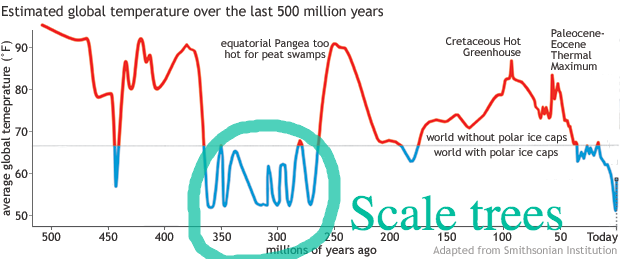
But if we compare the story about scale trees to a graph of our planet’s likely temperature – as approximated using the isotope ratios of ancient shells – we see that our planet was already pretty cold (as in, there were icy glaciers on the north and south poles) before the reign of scale trees.
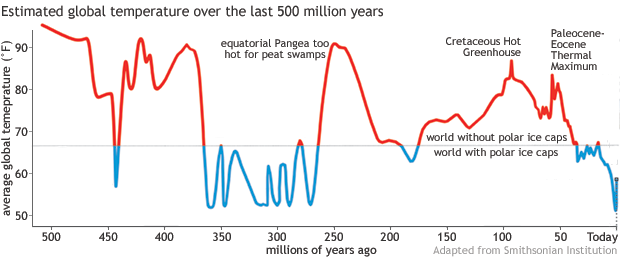
Scale trees lived and died and did indeed pull huge amounts of carbon out of the air, eventually burying all that carbon underground because ancient fungi didn’t eat their corpses. And the world’s climate changed significantly during that time, with occasional swings of 15 degrees or more, perhaps lasting millions of years at a time, but there’s no trend indicating that the scale trees’ massive sequestration of carbon caused any change.
#
There’s a message here, and it isn’t “Trees are rubbish, look how little they actually accomplished!” or “We understand so little compared to the vast complexity of this planet’s climate that there’s no reason to change what we’re doing!”
The world is complex, yes.
And we have tried to tell simple stories about that complexity in the past. Sometimes, our simple stories have turned out to be wrong. We were probably wrong about the influence of scale trees on ancient climate change. (Although scale trees did cause a huge increase in the amount of oxygen in the air, which is why dinosaurs were romping around a world filled with absolutely ginormous bugs. Insects send oxygen to their muscles through simple diffusion, not with a heartbeat-powered circulatory system like ours, so at times when there was more oxygen in the air, they could grow bigger.)
Instead, I think the central message here is that climate is very complex, and so we should probably try our best to avoid causing major changes in a system that we don’t really understand.
The relatively small impact of scale trees – which grew prolifically, and trapped carbon for millions of years (up until the moment when a clever cohort of apes decided to dig up their remnants and burn them) – shows that we probably can’t carry on with our current lifestyles and just plant a few more trees.
Also, the graph I included above shows that the planet’s climate has swung through massive changes before, including thirty degree changes in average global temperature. So we can feel confident that changing the climate by a few degrees would be no big deal for Earth, which has been through far more.
But it’s worth glancing at another graph — this one from Matthew Osman & colleague’s paper in Nature magazine, “Globally resolved surface temperatures since the Last Glacial Maximum” — which covers the time period of human civilization. This data comes from pockets of trapped air in ancient ice.
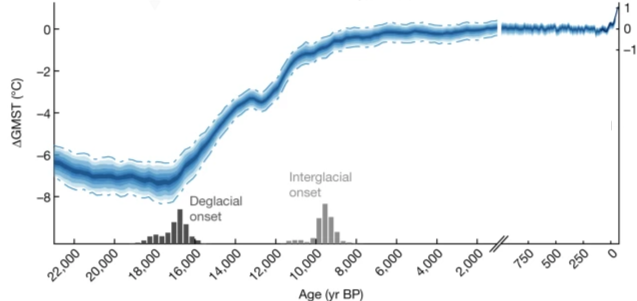
And, look. Domesticated agriculture, writing, Biblical stories, bread baking, large-scale governance, civilization – these all date to the last few thousand years. A time period in which there has been a remarkable lack of climate change. It’s really weird, and lucky, that we’ve had so much time with such a steady climate!
The Earth is going to be fine. But our complex civilizations might be doomed if we cause a change.
.
.
.
.
Illustration of a growing scale tree by Falconaumanni.
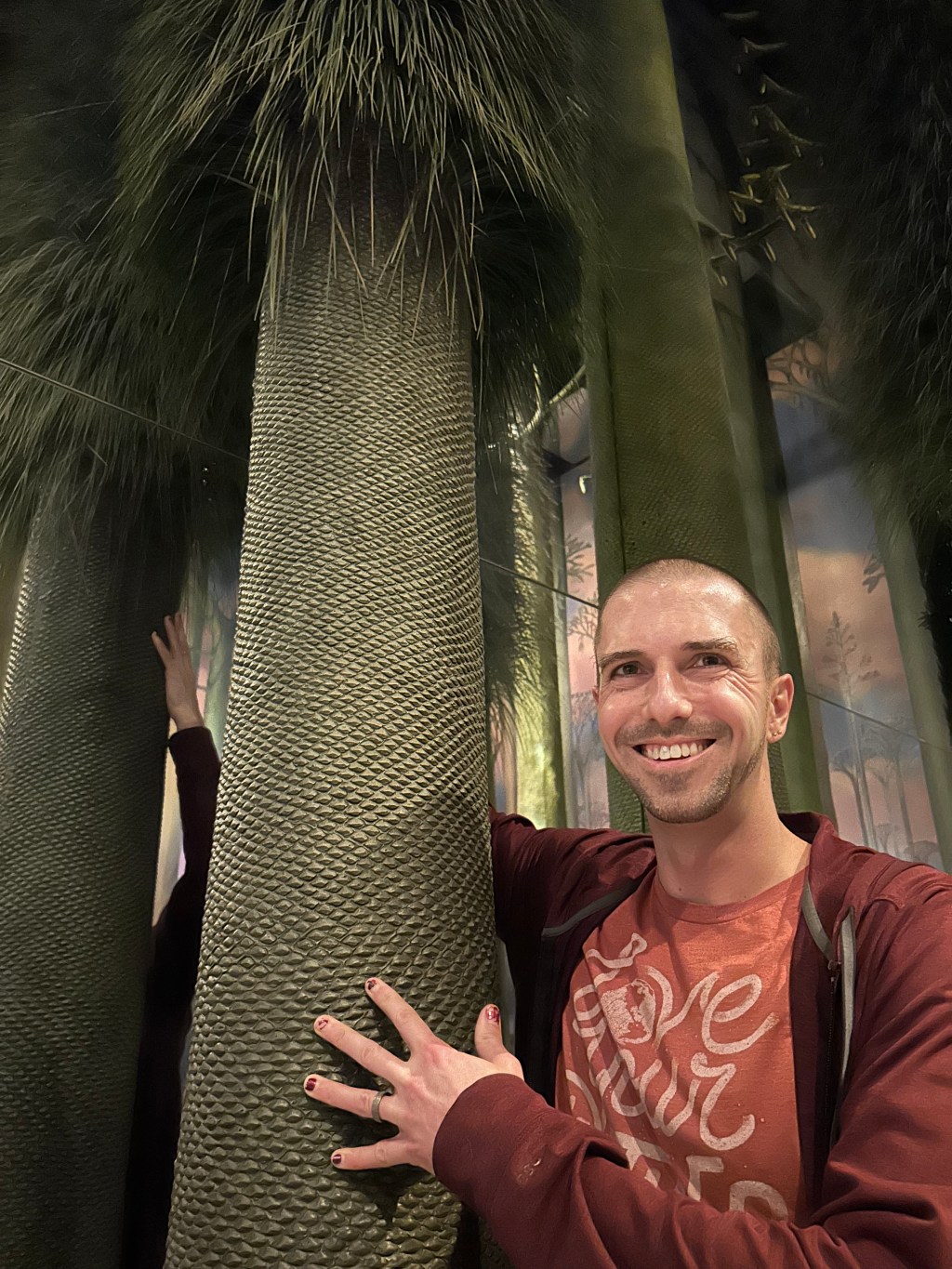
 Frank Brown Cloud
