I was typing in the children’s room of my local library during “8-Hour Comic Book Day,” an event intended to inspire people to create illustrated works of their own, when my seven-year-old shuffled over with a bleak expression on their face.
When they reached my table, they set a comic next to my computer – an issue of Teenage Mutant Ninja Turtles from the 2022 Free Comic Book Day – and glumly said to me, “I thought the turtles were supposed to be the good guys. But this is violent. Like, really violent.”
I said, “Well, sometimes heroes are violent. Like if they’re trying to stop something bad. And there’s been a tendency in comic books recently to try to depict the world as complex, which can make things seem dark, but also helps show that people aren’t necessarily all good or all bad. That sometimes heroes might inadvertently or even intentionally do bad things when they’re actually trying to make things better.”
I flipped through the comic book, and there was indeed a lot of blood streaking the turtles’ faces. The issue was inked with a very somber color palette, except for the bright bursts of red.
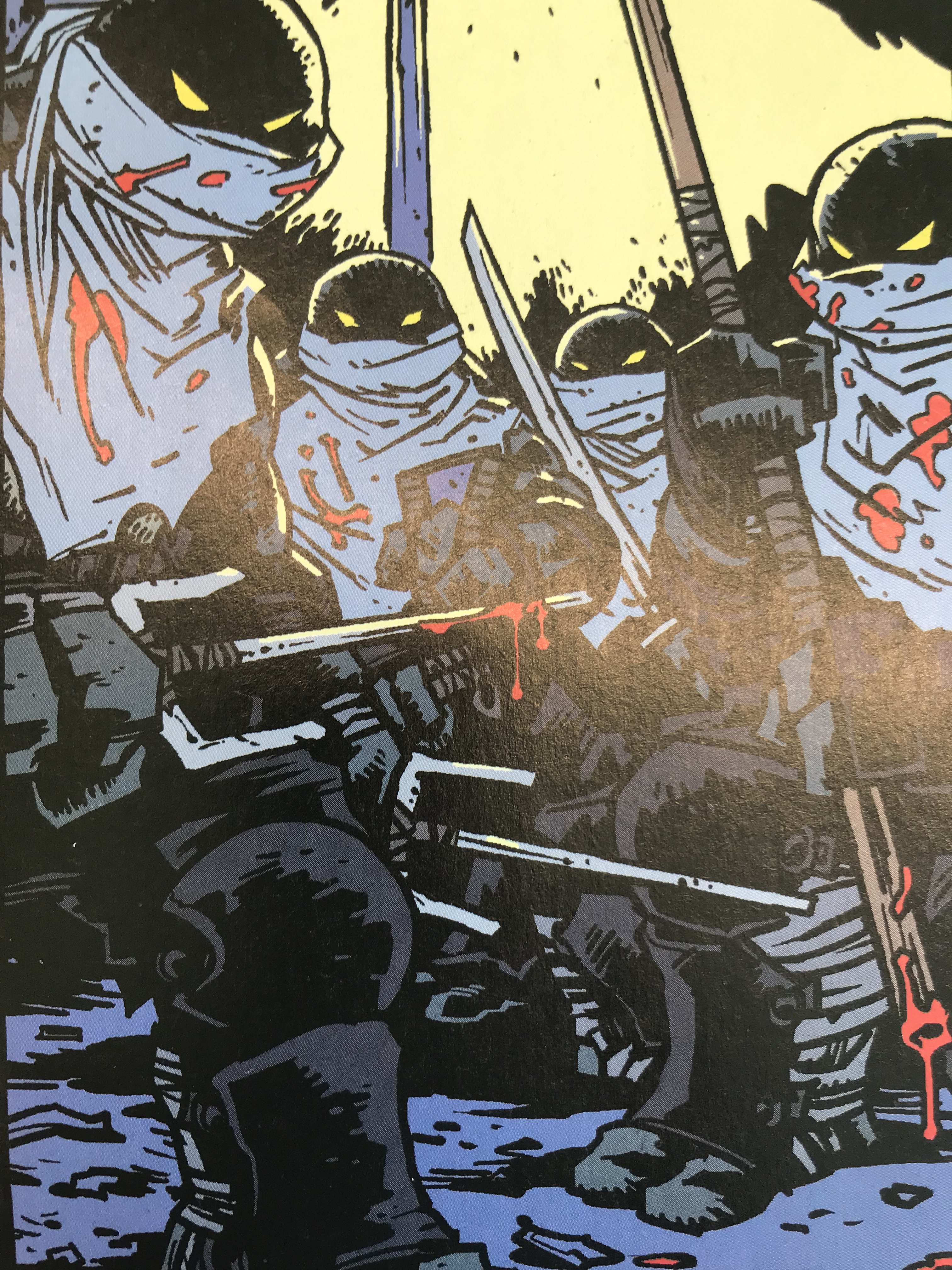
“But also,” I said, setting the comic on the other side of the table, away from my kid, “it’s not always clear who the heroes and who the villains are. You’re not always going to agree with whomever made a comic.”
What’s the right age for meta-textual analysis about authorial intent and our perceptions of morality? My kid had just read a comic full of guns and vigilante murder. We were sitting in a brightly colored space beneath a cheery poster that exhorted, “TALK, SING, READ, and PLAY. Grow a READER every day!”
So I decided it was high time to regale my child with a half-remembered summary of Matt Taibbi’s 2012 review of the Batman film The Dark Knight Rises. I should acknowledge that I’ve never actually seen the film, but, still, I tried to summarize Taibbi’s argument in language appropriate for a seven-year-old.
“Batman is supposed to be a hero. And the Joker is supposed to be a villain. But also, there were a bunch of relatively poor people, and they were rioting to protest the way that resources are allocated, and Batman’s role was to defend the property rights of the rich. That it would be okay for some people to have their giant castles while other people are struggling to eat.”
“Which might seem a little bad, right? If you believed that inequality was unfair, or that there are problems with unpunished pollution, or the legacy of awful acts that might explain why some people have a lot of wealth.”
My kid was looking up at me with a thoughtful expression on their face.
“Batman is extremely wealthy, and from what I read about the film, he went in and fought and hurt those poor people, preventing them from redistributing any wealth.”
“But also, the people who make movies, in Hollywood, they’re also immersed in a culture that has and celebrates a lot of wealth. So it might make sense to them for that vision of Batman to seem to be a hero, even if other people disagree.”
My seven-year-old said “Maybe the poor people should have enough to eat.”
“Yes,” I agreed. “Although that’s not the only story. Batman is a character, and many people have written stories about him. If you wanted, you could tell your own. So I’m pretty sure that the Joker is often bad.”
“He is!” my child exclaimed. “In one story, he burns down a house!”
“Ah, I didn’t know,” I said, nodding. “But, see. That’s bad, right. So in that story, you’d probably want for Batman to step in and stop him. In others, maybe not.”
“And it’s like that often. That different people will have different ideas about what good behavior might be. In one of my favorite stories from Hinduism, the Ramayana, there’s a prince, Rama, who is depicted as a hero, and there’s someone referred to as a demon king, Ravana, but in that story I always liked Ravana better. Rama hunts beautiful creatures for sport, and exiles his spouse when he hears people gossiping about her, and thinks his own honor is more important than his brother’s life. While Ravana is a scholarly vegetarian.”
“Or even the stories about God and Satan, that people tell about the beginning of Genesis. God wants humans not to have knowledge, and not to eat from the tree of immortality. Satan wants for humans to get to have those things. So who should we believe is on our side? Who is the good guy?”
Perhaps you went in certain that it’d be the pizza-eating turtle. But sometimes, maybe it’s not.
.
.
.
Teenage Mutant Ninja Turtle art by Sophie Campbell

 Frank Brown Cloud