Robert Sapolsky’s Determined is really two books in one. The first half of Determined provides a detailed description of the neurobiology of decision-making and action. The second half provides an impassioned plea for reforming our criminal justice system. Each of these topics, on its own, is presented reasonably well.
Unfortunately, Sapolsky links these ideas through a muddled argument about free will, and as a whole Determined adds up to far less than the sum of its parts.
#
There’s an old joke by Ambrose Bierce about free will and the criminal justice system, and I was somewhat surprised that Sapolsky never mentions it:
“There’s no free will,” says the philosopher;
“To hang is most unjust.”
“There is no free will,” assents the officer;
“We hang because we must.”
It’s perfectly conceivable that there could be a world very much like our own – indeed, potentially our world – in which humans and other animals undertook all manner of complex behaviors, and yet those behaviors were not freely chosen. With present-day computers, we can create simulacra like this. Artificial intelligence algorithms can produce stunning artwork and engage in meaningful conversation, even though the behaviors of these algorithms are mathematically pre-determined.
If an algorithm causes harm – let’s say the algorithm for a self-driving car had somehow included a line of code instructing the car to accelerate toward any object with black and yellow stripes, and then the car killed a pedestrian who was wearing a honeybee costume – it wouldn’t make sense to punish the algorithm.
You would want to prevent the algorithm from causing more harm. You couldn’t let that car back on the road, not unless you knew that this line of code had been corrected. But you’d be isolating the car in order to protect people, not to inflict pain upon the algorithm.
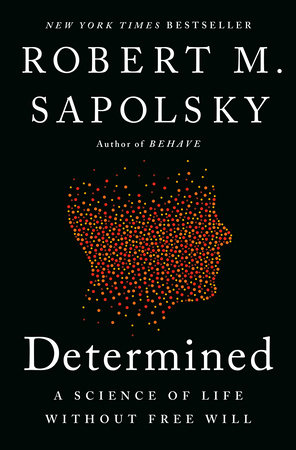
In Determined, Sapolsky argues that most people who commit crimes are like this faulty algorithm. Over the course of their ancestors’ lives, and during their own prenatal development, and through their childhood, and their early adolescence, and their experiences as adults, things happened that eventually shaped these people’s neural architecture in a particular way. And Sapolsky argues that this particular history has made their criminal actions inevitable. Sapolsky argues that everything those people do is inevitable. Sapolsky argues that they don’t have free will.
Which Sapolsky argues should have bearing on how we treat people who commit crimes.
The person could be isolated to protect others. Perhaps the person’s faulty neural architecture could be treated. But the person should not be considered responsible. The person should not be punished.
And yet who, exactly, would be choosing not to punish?
Throughout, Determined feels unpleasantly paternalistic. Sapolsky argues that (some) people have no free will, and thus their crimes were inevitable, and Sapolsky implies that (other) people have free will, and can choose to reform the criminal justice system and make our world a better place.
#
I find this muddled reasoning exceptionally frustrating, in part because I do agree with Sapolsky’s two main claims.
- I believe we should reform the criminal justice system. Over the past decade, I’ve devoted upwards of fifteen hundred hours volunteering for causes related to criminal justice reform. I think that criminal justice in the United States is far too punitive, and that it doesn’t help to keep us safe.
- I believe that, given all we know thus far about physics, chemistry, and biology, humans shouldn’t have free will. Our brains are made of particles, and the movement of particles follow the laws of physics. Right? So if we humans do have free will (which I also happen to believe), there must be something significant that we don’t yet understand.
But these two claims aren’t linked. They can’t be. As per Ambrose Bierce’s joke, either we all have free will, or none of us do.
#
In Determined, Sapolsky often argues that our brains work in a “deterministic” way. This word is used to mean the opposite of “random.” In a deterministic world, if you could scan a person’s brain in sufficient detail at two o’clock, then keep them isolated in a room, you could accurately predict all their thoughts at three.
In a deterministic system, an inevitable future flows from any initial condition.
But our world isn’t deterministic. Ever since the discovery of quantum mechanics, we’ve known that our world is “probabilistic” – there are elements of random chance in the movements of all the little particles that compose our brains and bodies.
Whenever there are many particles, the probabilities tend to cancel out. For every particle that flits a bit to the left, there’s often another that flits a bit to the right. When added all together, the probability of really strange things happening becomes infinitesimally small, which is why human-sized objects rarely walk through walls (even though single particles do it all the time).
It’s a bit like the way that, if you were to flip a single coin, you’d have a 50% chance to see no tails. But if you flip five coins, you’d have only a 3% chance to see no tails. And if you flip twenty coins, you’d have less than one in million chance to see no tails.
Your body, moving through the world, is like a huge number of coin flips. Even though there’s a chance to any one particle will suddenly blip a little to the left, the chance that every particle in your whole body blips a little to the left, all at the exact same time, is very, very, very small. Not zero, but it might as well be.
But your whole body doesn’t need to blip anywhere for the inner workings of your brain to be probabilistic. Occasionally, a neuron might be very near the cusp of firing. If it fires, it will send a message to other neurons, which can cascade into a whole slew of brain-wide ramifications. If it doesn’t fire, your subsequent thoughts will be very different.
Neurons fire, sending their signals, if enough sodium ions pass through their intermembrane channels. If only a few sodium ions pass through, there’s no signal. If many sodium ions pass, there is.
In such circumstances, the precise positions of just a small number of sodium atoms can have a major impact on your future behaviors. At the tipping point, a single atom. And these precise positions are probabilistic.
Sapolsky mistakenly discounts the role of probability in the function of our brains due to a misunderstanding about quantum mechanics. Sapolsky attempts to address the topic, but cites rebuttals of the wrong idea.
You see, several researchers have convincingly argued that the workings of our brains are not like quantum computers.
If you’re not familiar with how quantum computers work, you can read about it here: “Wavelike cats calculate faster than you can.”
In brief, quantum computers make use of the seemingly strange behaviors that occur when no information leaks from a particle or collection of particles. When no information leaks out, a particle can exhibit seemingly contradictory properties. After a “measurement” occurs – which doesn’t require a human scientist, because “measurement” really just means the transfer or leakage of information – the strange behaviors seem to cease.
The inner workings of a quantum computer have to be kept extremely cold and dark and isolated, because as soon as air molecules bump into a particle, or if some light shines on it, information will be carried away. Even if nobody knows to look for that information, the particle has been “measured,” and it won’t be in a quantum superposition any longer.
Our brains can’t work like quantum computers because the molecules in our brains are constantly jiggling about, crashing into each other, radiating information. Every time two molecules collide, they transfer information about their positions and momenta.
You can imagine dropping a ball onto the peak of a little pyramid. In a quantum-mechanical system, the ball can behave as though it had ended up on both sides. Our brains aren’t like that. As soon as information leaks away, the ball will behave as though it’s definitely on the left, or definitely on the right. No quantum weirdness. But it’s random which side it ends up on.
In much the same way, it’s sometimes random whether or not our neurons fire. Even with a fantastical brain scanner that gave you access to as much information as possible about the positions and momenta of every particle in a person’s brain, you couldn’t predict their future thoughts.
#
Of course, Sapolsky also explains correctly that random outcomes would not be the same as having free will. Indeed, many AI algorithms are designed to produce random behaviors, and might do something like check whether the current clock time has an even or odd number for the nearest thousandth of a second when it performs an operation. Which lets you generate a unique image from an AI algorithm each time you give it the exact same prompt.
But this algorithm’s behavior, though unpredictable, isn’t free.
So.
At this point in the essay, I would like to offer you a clear scientific explanation for how free will works. Unfortunately, I can’t. No one can. Because, as best we currently know, it shouldn’t.
At which point, you have a choice: you can either believe that our current scientific understanding of physics, chemistry, biology, neuroanatomy, etc. is correct and essentially complete, in which case there’s no free will. Or you can believe that you do have free will, in which case you’re also effectively believing in magic.
Except … well, no. Whichever choice that you make, if you’ve made a choice, then you must have had free will. Deep down, whether you like it or not, you believe in magic. Even if the choice you made was to believe (falsely) in your utter lack of agency.
And if you don’t have free will, then whatever choice that you suppose yourself to have made, it was actually outside of your control. Your apparent choice was actually a result of the positions and momenta of the particles in our universe, with no influence from any entity that might perceive itself to be “you.” Even if that entity (falsely) perceives itself to have chosen to believe in its own freedom.
This is why I think that scientific claims about free will, which contradict our day-to-day experience of the world, are fundamentally different from scientific claims about the movement of the Earth around the Sun, which also contradict our day-to-day experience.
We experience the ground as being stationary and flat. We experience the sun as rising in the east and setting in the west, orbiting around us. And none of that is true. We’re actually living on a round, spinning planet that’s hurtling through space around a gravity well centered upon a gaseous cavalcade of nuclear explosions.
But with planets, knowing the truth makes a difference. Now that we know the truth, we can send up satellites that power the GPS on our telephones; we can send astronauts to the moon; we can study the emission spectra of other stars to see whether there are more Earth-like planets out there in the universe. Seriously, science is great. It’s an awesome way to understand our world, and to potentially make our world a better place.
But with free will, knowing the truth couldn’t actually change anything. Either we can choose to believe in free will or not (in which case we actually do have free will, even if we disbelieve), or we don’t have a choice (even if the uncontrollable workings of our brains cause us to think that we’ve made choices).
And so we are better off living as though we have free will.
This is also fundamentally different from Blaise Pascal’s jocular argument for the existence of god – to wit, that an atheist can be right, and it won’t matter, or wrong, and it’s terrible, and a theist could be right, and it’s great, or wrong, and it won’t matter – because your experience of moving through the world will be fundamentally different if you choose to believe or disbelieve in a god.
But if you choose to disbelieve in free will, you still have to act as though you believe. You still have to get out of bed in the morning, or not. And that’s a choice. It will feel like a choice. Whether it really was a choice or not.

 Frank Brown Cloud