I was sitting in a cozy vegan restaurant across from Sam Avery Norrell, a physicist studying quantum computers. We’d been discussing his work – a lot of time spent making tiny tweaks with allen wrenches, since his experiments require a bevy of lasers to be perfectly aligned so that they’ll trap and cool a single atom – when I asked him, “So, I’ve been thinking about a metaphor to explain quantum computing to people. I wondered if you have a favorite, and if I might run mine by you?”
In addition to his work as a physicist, Sam is also a fine musician, audio engineer, and sailing instructor. I trust his ears and his inclination to explain things simply.
“Okay,” he told me, “my metaphor is from my advisor. He likes to say there are two types of inventions. There are light bulbs, where everyone can see at a glance how the world has changed, and there are lasers, which changed the world just as much, but they’re hidden away, in disc readers, in factories. And quantum computers will be like lasers.”
I smiled. I’ve scoffed at the impracticality of quantum computers before – it takes a huge amount of energy to isolate them from the surrounding environment, which is vital for how they work, so you’re unlikely to ever have a quantum computer sitting atop the desk in your home office – but a world changed by quantum computers that were all hidden from sight, perhaps running calculations on protein shapes to abet the synthesis of novel antibiotics? That’s easier to imagine.
Then it was my turn.
“So, lots of people know about Schrodinger’s cat, right?” I said, hoping to launch from there straight into my metaphor for quantum computing.
But, no. Perhaps I should mention: my spouse and my two elementary-school-aged children were also sitting at the table with us in that cozy vegan restaurant. And my spouse promptly interrupted me.
“For this audience,” my spouse said,gesturing at our attentive children, “you’ll need to start a few steps back.”
“But, Sam!” I said, gesticulating wildly in his direction. “Sam is my audience!”
My ten-year-old narrowed her eyes at me.
This would be a slightly harder task. I’d read Chris Ferrie’s board book Quantum Physics for Babies to my kids, but that was years ago, and I doubted that they remembered the way that Ferrie had explained this. I certainly didn’t.
But I was willing to try my best, and launched into an explanation that I hoped my kids could understand.
“So, a lot of quantum mechanics is about the flow of information. As information spreads out from something, like information about where it is, because something else bumped into it, then its possibilities shrink. It can’t be there because it was bumped into over here.
“But before the information spreads, it’s not that we don’t know where it is. It’s that there is no single place where it is. It gets to be both, and behaves as though it’s both, until something happens that would take information from it and move that information elsewhere.
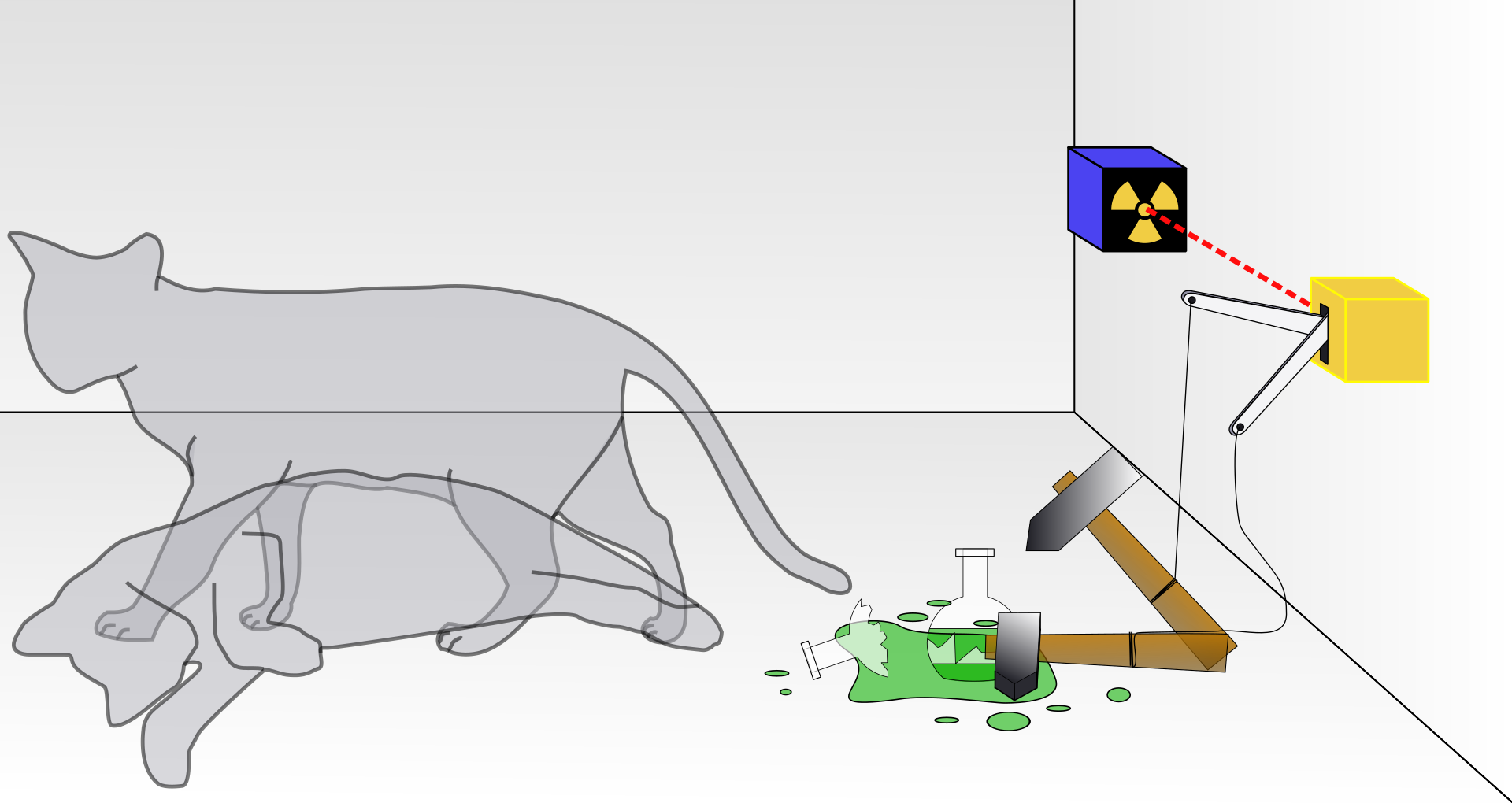
“Schrodinger’s cat is a thought experiment. It’s a big box that no information can escape from. No sounds or sights or smells,” I said. I didn’t tell my kids that the box would need to prevent the flow of even more types of information – it would have to be so perfectly balanced that you couldn’t even detect changing positions of mass inside it – but I think they got the gist that this is a pretty darn mysterious box, its secrets more impenetrable than any wrapped-up holiday gift.

“Inside the box, there’s going to be a random event. Maybe a radioactive atom at it’s half-life, which has a coin flip chance of having decayed. But, really, you can think of it as a coin flip. A chance that something has happened or not. And in the original story, it’s sad, Schrodinger said, ‘What if that coin flip will trigger the release of poisonous gas?’
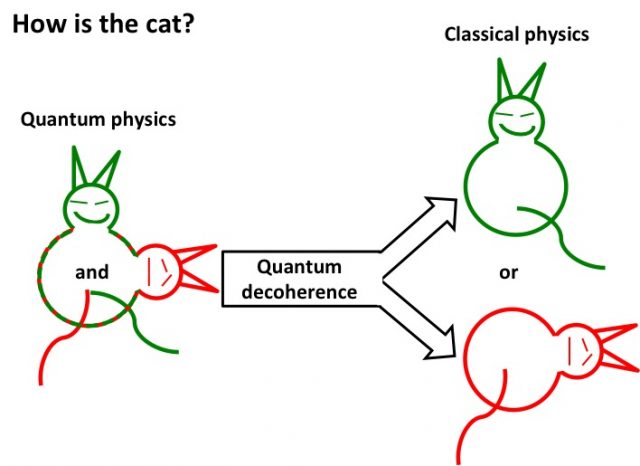
“After that, from outside the box, until any information has leaked out, it’s as though the cat is both alive and dead. It’s not that we don’t know. It’s that, outside the box, the world actually has a mix.”
At which point, finally, I could offer Sam my metaphor.
“So I thought I could explain quantum computers as being like Schrodinger’s cat. Like if you were trying to solve for the prime factors of a number. It’s guess and check. So you have a box, and a list of prime numbers in the box, and the cat inside, it has a calculator, and the cat knows, if the atom decays, if the coin flip lands heads, it’s supposed to check all the even entries on the list, and if it’s tails, the cat checks all the odds. And when the cat finds the answer, it presses a button, lets itself out of the box.”
Sam smiled at me. “That works,” he said, “although, really, it doesn’t have to be just one coin flip. To give you all the initial states that the cat could possibly check. If you use two distinct coins, like flipping a dime and a nickel, then the cat would check only every fourth number on the list.”
For those of us less adept at mental math than Sam, it’s because there are four ways for two coins to land: 1.) dime heads nickel heads, 2.) dime heads nickel tails, 3.) dime tails nickel heads, 4.) dime tails nickel tails.
Sam went on. “Or with three coins, a dime, a nickel, and a quarter, then it’s every eight. There can be any number of initial states, just as long as the cat is going to scream loudly enough for you to hear, right before it dies.”
I glanced at my kids, who both love cats, and gave a tiny cough. “Before the cat lets itself out of the box, with the right answer on its calculator.”
“Yeah, yes,” Sam said, nodding. “Calculator. But, yes. That metaphor works.”
And hopefully this is helpful for you, dear reader. Maybe you now understand a bit better how quantum computers work?
Because from our perspective, outside the box, the coin flip will land both ways. From outside the box, the coin flip seems to have landed as both heads and tails, and it’s only after information leaks out from the box that one of those possibilities disappears. (That moment is the whole “collapse of the wavefunction,” “quantum decoherence,” or “wave-particle duality” thing that physicists often talk about.)
So if there’s a single coin flip, the calculation will happen twice as fast. From outside the box, it’s as though the cat inside is checking both the even entries and the odd entries on the list, because the coin flip has an equal chance of having landed either way. And the cat was trained to leave the box only after finding the correct answer, so information exits – telling us how the coin flip resolved – only once we have our answer.
Perhaps we were trying to find the prime numbers that factor 37,937. In this case, the lowest prime factor is 59, the seventeenth smallest prime, so when the cat lets itself out of the box with its calculator screen triumphantly displaying 37937 / 59 = 643, the cat will also report that the coin had landed tails. But it could have been otherwise, so the calculating cat will have reached its answer twice as fast as if we’d been checking the list ourselves.
If we’d flipped three coins, and the cat was supposed to check every eighth entry on the list of prime, depending on the result, then it would solve the problem eight times as fast. If there were ten coin flips – ten quantum bits – then there would be two to the tenth possible results, and the cat could solve the math problem over a thousand times as fast. As long as it does all its calculating from inside the information-proof box.
And prime numbers are important because they’re used for many encryption techniques. With a very large number, it’s quite difficult to find the prime factors – here, I’m imagining that the cat is just using the strategy of “guess and check” – but trivially easy to do division once you know one factor.
But, as I hope I’ve explained, Schrodinger’s cat is very speedy with “guess and check.” With thirty quantum bits, Schrodinger’s cat would be a billion times as fast as the rest of us.
Of course, there are more layers of metaphor. Sam’s quantum computer, for instance, is a single cesium atom trapped at the intersection of all those perfectly-aligned lasers – Sam puts its single valence electron into an excited state and then tries his darnedest to prevent it from shedding any information. At the moment, I won’t inundate you with more metaphors to help you understand how that single atom is like your laptop.
And all descriptions of quantum mechanics are a little strange when presented in a metaphorical language like English. Quantum mechanics is logical, elegant, and accurate when described with the language of mathematics. It sometimes seems a bit less so when described with words.
But I do hope that my metaphor about quantum computers has helped you. I’m aware that it’s a little weird, both because quantum mechanics itself is weird, and because I seem to have slipped into talking about an oddly obedient, English-speaking, calculator-wielding, anthropomorphic cat no less creepy than any of the performers in the 2019 film Cats.
My ten year old told me that I hadn’t explained this very well.
“I was mostly following along,” she said, “until the cat had a calculator. And then I thought about those squishy calculator buttons, and I was pretty sure the cat’s claws would get stuck!”
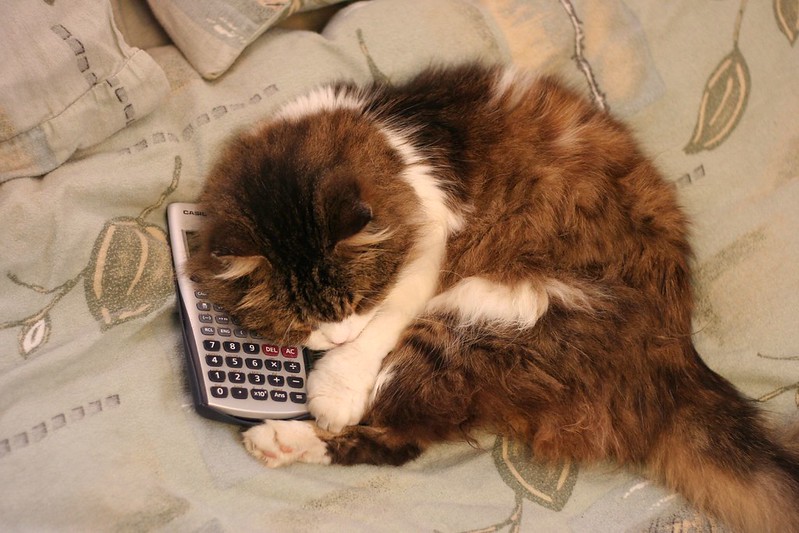
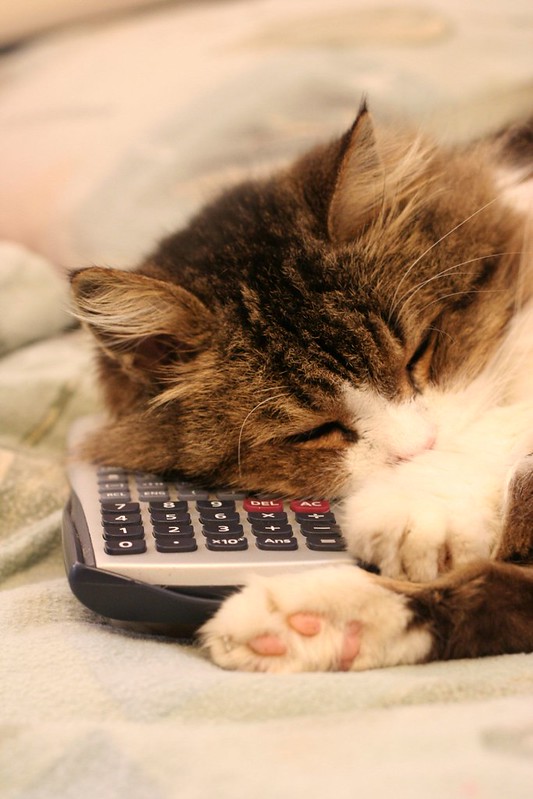
cat and calculator photographs by Felix Idan on flickr
Schrodinger’s cat illustration from LibreTexts: Chemistry.
quantum decoherence image by Daniel Moreno.
 Frank Brown Cloud