When my household visited The Field Museum in Chicago, my spouse attempted to hide behind a dinosaur skeleton so that nobody would realize she was related to the person loudly declaiming, “Kirstin, you’ve gotta come see morganucodon! It could chew! Chewing was a precursor to fire! Chewing was the first fire, Kirstin!”
Unfortunately for my spouse, I found her. My pedantic diatribe continued.
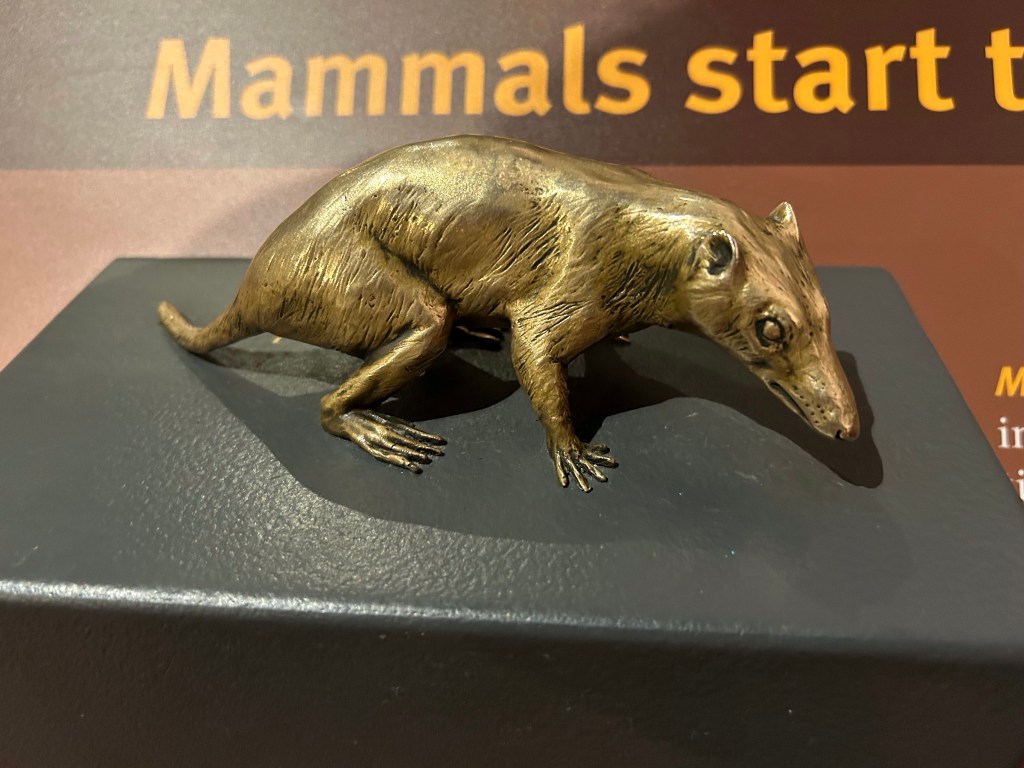
Fortunately for you, my spouse then relented and took my picture alongside a tiny metal sculpture of morganucodon. Weren’t these adorable little creatures? And they may have been the very first creatures who could chew the way we can!
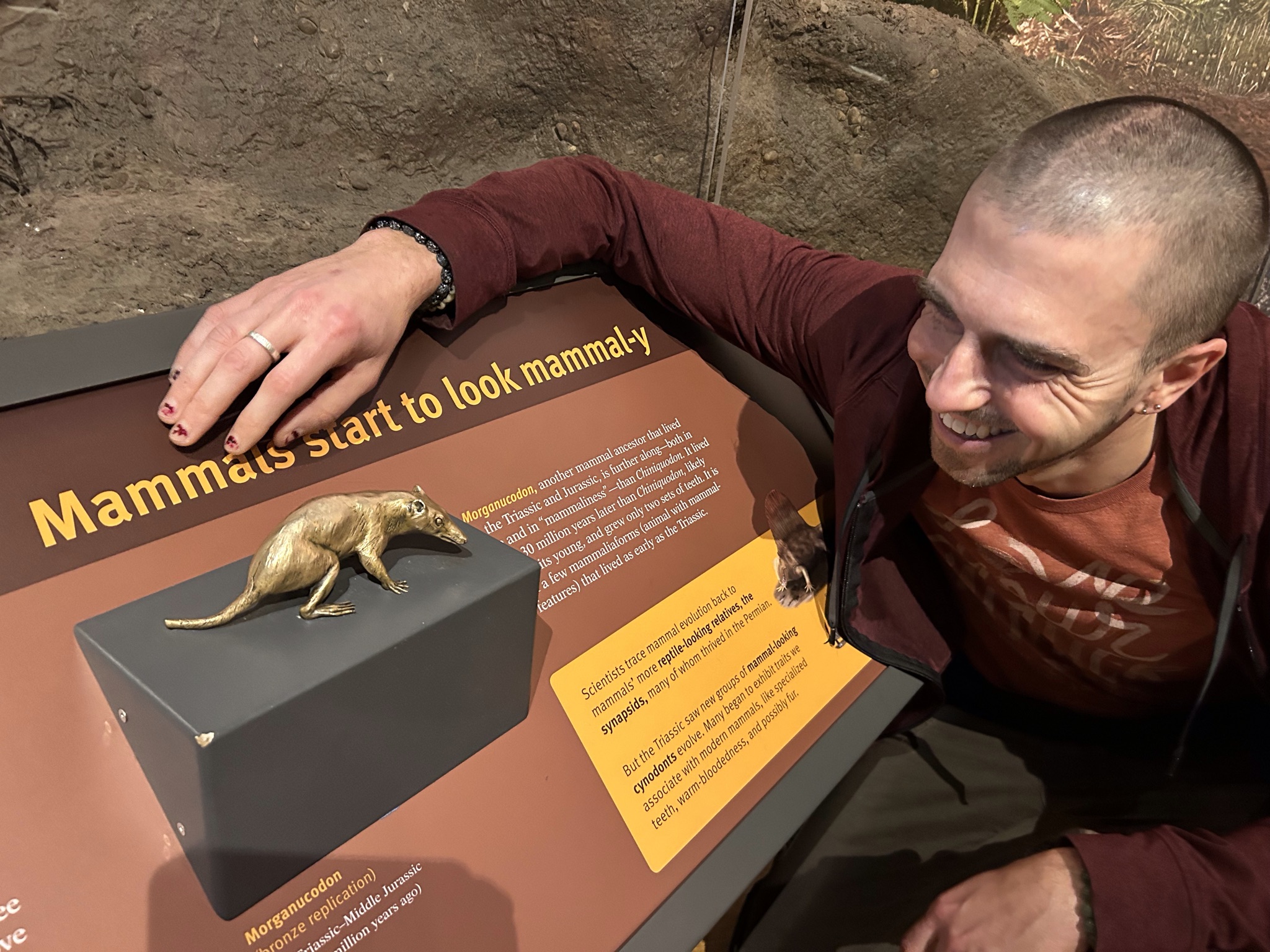
That little wriggle – a side-to-side motion of the jaw that let them better grind their food, extracting more nutrition from every bite than lizards could get – might’ve meant the difference between our world, now, and an alternate reality dominated by giant iguanas or whatever. In The Rise and Reign of the Mammals, paleontologist Steve Brussate describes the connection between chewing, energy extraction, and mammalian glory. With extra calories, our ancestors’ bodies could burn brighter. Metabolism churned, and then, over many, many generations, our ancestors’ brains bloomed; they became warm blooded; they hunted deftly through the dark & chilly nights.
If you were to ask most chemists to define fire, they’d probably say something pedantic about the rapid exothermic addition of oxygen across chemical bonds. But if you asked me to define fire (especially if you weren’t holding a chemistry textbook or standing beside a Bunsen burner at the time), I’d probably give an answer from either mythology – fire is the divine tool that let us reshape the world, which we humans were cursed for stealing – or from evolutionary biology – fire gave our species access to enough nutrition that our brains could grow, letting us reshape the world.
Either way, fire is at the crux of our dominion.
And this dominion dawned with the morning tooth. Morganucodon, munching up beetles, perhaps feeding her babies something a lot like mammalian milk; she was our lineage’s first flicker of light in the long dark night of dinosaurs.
#
I assume you’ve heard something about the non-avian dinosaurs going extinct. A giant space rock crash-landed; everything nearby was vaporized; everything near-ish was scorched; everything on Earth was affected by the ensuring tidal waves & sediment-clogged sky & climate change. In the coming weeks and months and years, a whole lot of plants and animals all died.
That was when morganucodon’s descendants began to shine.
Why?
#
Oh, who are we kidding – you knew that I’d claim this was all about teeth!
The only surprise here is that my argument isn’t quite as asinine as it might initially seem.
Times of great environment strife – mass extinctions and the like – aren’t uniformly bad. Some organisms benefit from widespread death and devastation. For instance, saprophytic fungi – these are the mushrooms and molds that eat dead things. A world full of fallen dinosaurs sounds perfect for them.
And this saprophytic frenzy probably killed a lot of living reptiles, too.
If you wanted to sound like an insufferable pedant – maybe my earlier description of fire wasn’t quite enough for you – you could define life as the process by which a slew of molecules keep themselves out of equilibrium with their environment. While you’re alive, all your bits stay in one place. Rain can fall on you without your body melting. The air around you might cool even while your body stays warm.
Except, well, cold-blooded animals don’t do this last bit. As the air cools, their bodies cool. In terms of temperature, a cold-blooded animal vaguely resembles a dead thing.
Saprophytic fungi might eat them alive.
Back when our world was filled with fungal spores, all gleefully wafting from the dead bodies of dinosaurs, cold-blooded animals were presumably at great risk of succumbing to fungal infections. Whereas the descendants of morganucodon, who dutifully chewed their food and so could spare a bit of energy on warming their blood, had bodies that were less hospitable to rot.
Teeth fueled the fire that warmed their blood, allowing their bodies to repel the grasping hyphae that staunched the lizards’ lines.
Even now, cold-blooded animals are far more susceptible to fungi. Fungal spores have wrought utter devastation for amphibians – our world should have so many more frogs than it now does! And the most at-risk mammals are bats, whose bodies cool to torpor when they hibernate.
But before we celebrate – a celebration that will no doubt include wriggling our hinged jaws in triumph – consider the ramifications of climate change. In Blight: Fungi and the Coming Pandemic, Emily Monosson offers a warning. As the whole world warms, more regions will have weather as hot as human body temperatures, so saprophytic fungi will evolve to better tolerate these temperatures. Warm blood saved us from fungi because our bodies burned hotter than any corpse sprawled out in the sun. In a warmer world, that might not be true.
And how disappointed morganucodon might be. Our ancestor, watching over us. She gave us our inner fire: oh, how thoroughly she chewed! But if she saw the mess we’ve made, she might wriggle her jaw in shame.
.
.
.
photographs by the incommensurable Dr. Kirstin Milks
 Frank Brown Cloud