DISCLAIMER: The scientific literature is replete with numerous papers suggesting that human populations living far from the equator have light skin due to sexual selection. The authors of these papers typically lived in racist, misogynistic cultures, and their papers often reflect these attitudes. I’m going to be engaging with their work, but hopefully it’ll be clear soon enough that I think their conclusions were rubbish from both a scientific and a sociological standpoint!
Phew! Okay, now let’s get to the good stuff!
The good stuff being, of course, a careful consideration of what makes various birds feel all hot & bothered.
And frogs! We mustn’t leave out the sexy frogs!
So, onward! Let’s learn some science together, shall we?
#
Many species have undergone sexual selection for aesthetically pleasing traits. Colorful plumage, trilling songs, elaborate artifice … at times, an animal wants to be wowed by something beautiful when choosing a mate.
And, among such species, nearly all have evolved according to the aesthetic preferences of whichever biological sex contributes more toward caretaking. If females raise the young, then usually the males of that species are the ones fanning fantastic feathers or singing sultry songs or building beautiful bowers. If males raise the young, females are more likely to be the showy ones. Honestly, exceptions to this trend are very rare!
*cough* agrarian human patriarchies *cough* *cough*
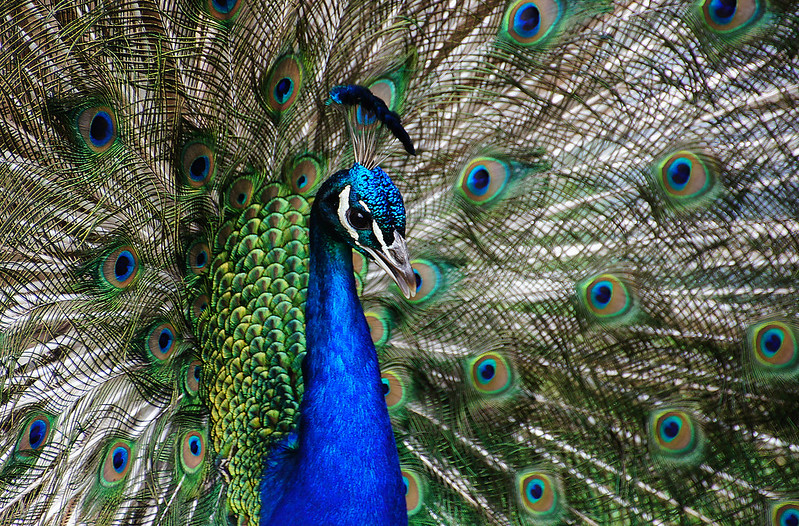
Consider peacocks. Male peacocks don’t do any caretaking. A male peacock is happy to have sex and contribute some genetic material to the next generation, but that’s it. He’s not planning to sit on the eggs or regurgitate grubs or whatever. Female peacocks raise chicks entirely on their own.
From a male peacock’s perspective, there’s very little cost to engaging in a new romantic dalliance. And, although I am definitely not a peacock (it would take so long to type this essay if I were hunting and pecking each letter with my beak!), I have to imagine that such dalliances are fun for peacocks. Evolution by natural selection tends to make the act of reproduction enticing enough that it keeps happening, or else a lineage would end. After all, the only creatures who can exist today are the ones whose ancestors, all the way back through time, happened to reproduce!
(A thought experiment: let’s say you were a male orb-weaving spider, and you knew that any heterosexual canoodling would result in your gruesome demise unless you catapulted yourself away from your partner immediately afterward. How tempting would sex have to be to make you want to try?)
As a result, male peacocks often seem as though they’d happily frolic with any sexual partner. Which means they aren’t exercising much choice.
In contrast, female peacocks get to choose the best partner from among all their potential suitors. And they’re presumably aware that the best partner is not going to help with the caretaking. The best partner is not going to stick around to offer a relaxing beak massage after a hard day. The best partner just wants to get it on then saunter away.
So, honestly, a female peacock is going to make her choice based on which male peacock is prettiest. Because what else does he have to offer?
For whatever reason, ancient female peacocks seem to have thought that long tail feathers were pretty. They were more likely to frolic with males who had long tail feathers. Over time, this meant that males with genes that inclined them toward having long tail feathers were more likely to reproduce, and so those genes were enriched in the population, and contemporary male peacocks have extraordinary tail feathers.
These enormous tail feathers look beautiful, but they also actively reduce the male’s chance of survival. Still, evolution by natural selection isn’t terribly concerned with any individual’s survival. In an evolutionary sense, there’s no difference between dying young or living a long time without having any children. In either case, the genes that produced that individual aren’t being enriched in the population. So if we imagine a world where some males had short tail feathers and survived, and other males had long tail feathers and were usually eaten by hyenas … but every single female chose to mate with the rare surviving long-tail-feathered males, then eventually every male would have long tail feathers. And be prone to getting eaten.
But the rare survivors would be enough to maintain the phenotype.
Or consider the club-winged manakin. All club-winged manakins have weird bone structures that inhibit their ability to fly well. To me, being able to fly seems like it’d be the best thing about being a bird (sorry penguins!), and club-winged manakins can only do a shoddy job of it. And the reason why club-winged manakins are bad at flying is because the males use their weird bone structure to make a funny twaaaaang noise that female club-winged manakins think is hot.

This is the power of sexual selection. The deformed bones in club-winged manakins reduce each individual’s likelihood of survival. But if a male club-winged manakin could fly well, then he probably wouldn’t be able to make the twaaaaang noise, and so he wouldn’t mate.
Perhaps you’ve already guessed that male club-winged manakins never contribute to caretaking. They make their twaaaaaang noise, they have sex if a nearby partner is willing, and then they fly off (poorly!) to find a good branch where they can practice their sick riffs. Twaaaaang.
Female club-winged manakins raise the young entirely on their own.
#
In many species, females contribute more toward caretaking than males, but there are some species in which the males do more caretaking. And in those species, there’s often been sexual selection to cultivate aesthetically pleasing traits in the females.
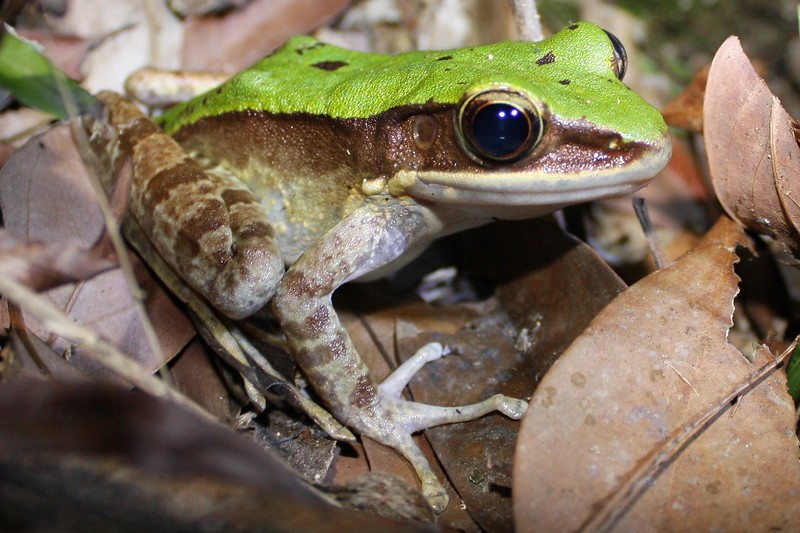
Consider the smooth guardian frog. After sex, males will assiduously care for their stockpile of fertilized eggs. The males carry their babies on their backs, ensuring that the tadpoles will have a safe pool of water to swim in. Perhaps the nook of a concave leaf? Yes, that might do nicely, with no dangerous fish about but still some insect larva for the growing tadpole to eat.
Female smooth guardian frogs sing stridently at night. These songs make the females more likely to be located by a predator – they won’t contribute any genetic information to the next generation if they get eaten – but also, the male smooth guardian frogs seem to like these songs. The males are more likely to choose to have sex with the females who sing loudly. This is a species where the males are doing the choosing.
Female smooth guardian frogs will hop away after laying their eggs, and they seem inclined to frolic with any willing partner who comes their way. Male smooth guardian frogs stick around to do the caretaking, and they will mate with only the most captivating partner.
This is the general trend in biology. Not that females are choosy and males are promiscuous, but rather: if one biological sex devotes more energy toward caretaking than the other, that biological sex tends to have more choice regarding which individuals will have reproductive success. The aesthetic preferences of caretakers are more likely to be favored by evolution.
The words “male” and “female” are designations based on gamete size. If a sex cell is small, it gets called sperm, and the individual animal who produces it is called male. If a sex cell is big, it gets called an egg, and the individual who produces it is called female. This definition doesn’t depend at all on the size of genitalia – the parts of a creature’s anatomy involved in reproduction, and which are often implicated in making reproductive-like acts fun — because there are some species, like hyenas, where females have more dramatic external genitalia. The definition doesn’t depend on chromosomes – in humans, most females have matching “sex-determining chromosomes,” labeled XX, and most males have XY chromosomes, but in other species the males have matching sex-determining chromosomes and the females are XY. All we’re saying when we label an animal as being “male” or “female” is that it uses either a small cell or a big cell to transfer genetic information to the next generation.
And so, pretty much by definition, a large “female” gamete takes more energy to produce than a small “male” gamete. But if a male frog sticks around to perform care tasks while a female frog hops away, that matters more than the size of their respective sperm and egg cells.
There’s not always an imbalance. Among many types of penguins, both males and females do an extraordinary amount of caretaking. Both biological sexes watch over and incubate the egg; both biological sexes make sacrifices to protect and feed a baby chick. And so both biological sexes seem to have a comparable degree of choice in selecting their partners. Most such partnerships are heterosexual, but as many as twenty percent of penguin pairings might be between two males or two females. Additionally, most penguins will occasionally have sex with individuals other than their primary social partners, so a pair of female penguins will often have at least one egg to look after, and a pair of male penguins might attempt to take an egg from a neighboring nest.
Throughout the natural world, egalitarian distributions of care tasks typically result in more opportunities for sexual choice. A short-tail-feathered, “unattractive” male peacock is unlikely to ever have sex with a female; nearly all penguins who survive to adulthood will have sex with one or more partners, in addition to forming socially monogamous emotional bonds with one.
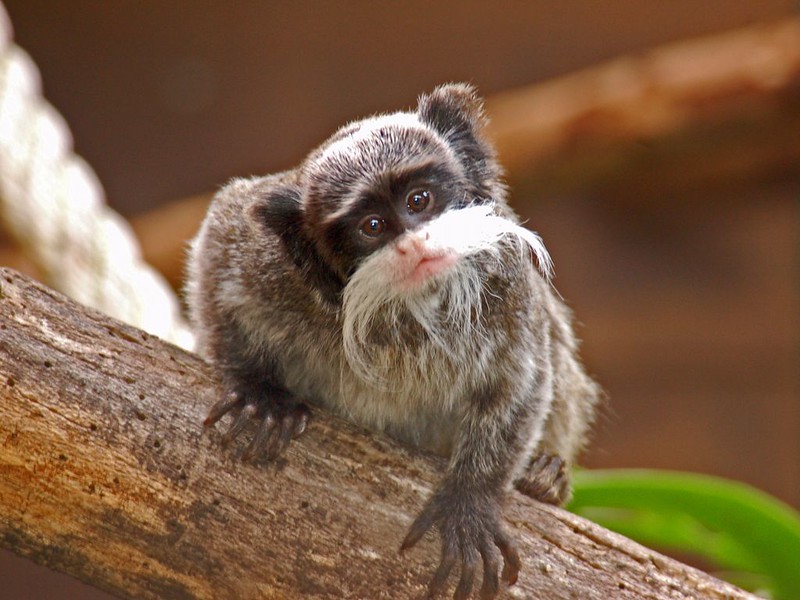
Similarly, in tamarins, both males and females make significant contributions to caretaking. Female tamarins nurse their young; male tamarins carry their children. Both biological sexes of tamarin are quite choosy when selecting their primary social partners, and both biological sexes of tamarin are sexually promiscuous when the fancy strikes them.
And that’s how sexual selection typically works in nature. The individuals who devote a lot of energy toward caretaking typically have many suitors, and so they get to choose. They might use any criteria — intelligence, compassion, looks, twaaaaaaang-making prowess – and, over time, the species will change to better suit those preferences.
#
My spouse and I recently co-authored a paper about the evolution of human skin color. In this paper, we discuss many recent findings about the skin color of ancient human populations, as well as the skin color of contemporary human populations whose ancestors lived in various regions for long periods of time.
We wrote this paper because, although there are many available resources for teachers addressing the evolution of human skin color, nearly all existing resources nudge students toward a model in which evolved skin color is a function of a population’s latitude. This model is both scientifically inaccurate and potentially upsetting, incorrectly implying that people with dark skin are ill-suited for life at high latitudes. But this model doesn’t match the available data for contemporary populations living at high latitudes in South America, North America, Greenland, northern Scandinavia, or northern Asia. This model only matches the data for contemporary populations whose ancestors adopted agricultural diets, as opposed to the (many!) populations whose cultures favored hunting, gathering, and non-sedentary land management. So skin color phenotypes seem to be a function of both ancestral latitude and ancestral diet, with populations that adopted low-quality agrarian diets experiencing the most skin depigmentation when they migrated to extreme latitudes. Hunter-gatherers who lived in high-latitude places, including in Scotland and Sweden, had very dark or black skin.
Generally, epidermal melanin seems beneficial for humans. One of few physiological “costs” to dark skin is that epidermal melanin increases the threshold for sun exposure that a person needs in order to make vitamin D. But humans don’t need to make any vitamin D if we get enough from our diets, and a typical hunter-gatherer diet would provide plenty of vitamin D. In contrast, grain-based agricultural diets didn’t have enough vitamin D, so the malnourished people who had adopted grain-based diets experienced selective pressure for depigmented skin.
But another theory is also prevalent in the literature: the idea that the evolution of human skin color could have been driven by sexual selection. This idea was first proposed by Charles Darwin, and has been repeated by a few researchers ever since. For example, biologist Kenichi Aoki writes (with no justification), “Available evidence suggests that in each society a lighter-than-average skin color is preferred in a sexual partner. Such a preference would generate sexual selection for light skin that counteracts natural selection for dark skin.”
Anyway, my spouse and I avoided this topic in our paper. We were focused on designing more accurate, less stigmatizing lessons for high school students. That’s not the right venue for speculative theories about human sexuality, in my opinion.
But I’d like to address these ideas here, because I think it’s interesting to consider exactly why these ideas are incorrect.
#
In humans, females often devote more energy toward caretaking than males. Females spend nine months pregnant; they might spend up to four years breastfeeding; they might spend an entire lifetime aiding their children (or even their children’s children!).

Over the past few hundred thousand years, it seems likely that human males also helped with caretaking. Human males are typically more helpful than the males of similar species, like chimpanzees, gorillas, or orangutans, who very rarely interact with babies in non-murderous ways. Still, I doubt that human males did as much caretaking as human females. So, over that time period, we’d predict that any sexual selection occurring in humans would reflect the aesthetic preferences of human females.
And among human populations, there is typically a sexual dimorphism in terms of skin pigmentation. Within any local population whose ancestors all lived in a particular region, human males tend to be more darkly pigmented than females. I don’t know why. Nobody knows for sure why. For instance, there’s a popular theory that the main evolutionary driver for human skin pigmentation was to protect folate (an essential nutrient) from UV light (which degrades folate) in pregnant people, but that theory suggests that females would benefit from epidermal melanin more than males. Another theory is that skin pigmentation protects our long-lived species from cancer, but, again, human females tend to have longer lives than males, and in their old age females often contribute more to the success of their genetic lineage than males do. This rationale would also suggest a bigger benefit for epidermal melanin in females. And yet the opposite dimorphism exists. Which might be coincidental. Perhaps the dimorphism is linked to some other aspect of our physiologies? Biologists Lorena Madrigal & William Kelly write: “[I]t seems to us that gender-specific roles are unlikely to explain the virtual universality of lighter human females than human males. We suggest that a hormonal basis to such a difference … might be a more fruitful line of research.”
Still, this dimorphism – darker skin in males, lighter skin in females – looked like it might be the result of sexual selection. After all, this sort of dimorphism often is a sign of sexual selection: to wit, male peacocks have longer tail feathers than females, because long tail feathers lead to more reproductive success; male seals are often much bigger than female seals, because only among males does increased size result in more reproductive success, etc.
In humans, since females do more caretaking, we’d expect for natural selection to reflect the aesthetic preferences of the females. There’s obviously no way to assess the aesthetic preferences of ancient humans, nor is there any way to study the aesthetic preferences of contemporary people independent of cultural context – just think about the wacky results you’d get if you asked people to rate the most aesthetically pleasing pants from year to year!
Not that researchers don’t make claims about universal preferences in skin tone – I’ve already quoted misguided remarks from the abstract of one of Kenichi Aoki’s papers (“Available evidence suggests that in each society a lighter-than-average skin color is preferred in a sexual partner.”). Or there’s anthropologist Peter Frost, who soaked photographs in developing solution for different lengths of time to make the faces appear darker or lighter, then asked young women to choose which photographs were most attractive. Despite obtaining essentially uninterpretable results (there were no trends in preference among the fifty young women queried, as you might expect in a world where everyone’s unique personal histories influence their perceptions of other people’s attractiveness), Frost claimed that varying hormone levels during the menstrual cycle shift human female’s aesthetic preferences.
That’s not what Frost’s data actually show. But some survey results suggest that, on average, human females might be attracted to people with a slightly darker range of skin tones than human males.
Which seems consistent with our expectations, since human males within any local population often do have slightly darker skin on average than nearby females. This suggests that, if the dimorphism were the result of sexual selection, either the males were selectively choosing lighter-than-average females, or the females were selectively choosing darker-than-average males. Otherwise the dimorphism wouldn’t persist.
And, in either case, we’d expect for the pigmentation levels of the entire population to gradually shift to better suit the aesthetic preferences of whichever biological sex had most control over mate choice. Alan Rogers and Arindam Mukherjee modeled the rate of change that you’d see in the average height of a population if human females had a preference for taller-than-average males, and they concluded that the average height of the total population would increase much more quickly than the height difference between males and females: “For example, if selection took 100 years to produce a one inch change in human stature, it might well take 6,000 years to accomplish an equivalent change in sexual dimorphism.”
Human skin color is a lot like height in that it’s a complex trait influenced by many different genes and environmental factors. So we’d expect to see a change in skin tone for the entire population more quickly than a change in the dimorphism between males and females. In each culture where females had the most control over mate choice – which is to say, each culture where females performed more caretaking than males – which is to say, nearly all ancient human cultures – we’d expect any influence of sexual selection on human skin color to increase pigmentation levels over time.
Again, this is not to say that there was sexual selection over skin color. Think about everything that influences whether or not you’re attracted to another person — Does that person make you laugh? Do you enjoy similar activities? Are you dazzled by their competence? – and then ask yourself, “Compared to all those other factors, how important would it be that this person had darker-than-average or lighter-than-average skin pigmentation?”
Ancient humans were people just like us. They fell into love and lust for reasons just as idiosynchratic and complex as our reasons, and it seems pretty dehumanizing to imagine that they were choosing their partners simply based on skin color.
After acknowledging all these caveats, the prediction we’d make is that sexual selection for skin color would result in more darkly pigmented populations, because we’d generally expect for human females to have most control over mate choice, since human females do more caretaking.
#
But our species isn’t simple – perhaps you’ve noticed that humans maintain social structures that are rather more complex than other animals?
It’s unclear the extent to which various human cultures have been either egalitarian or unequal in the very ancient past.
It’s certainly possibly to invent a story in which a certain fishing spot is more productive than other nearby bluffs, and then to invent a character who decides that only he or his family should be allowed to fish there. If that were the case, perhaps this person’s family would have more surviving children –researchers have estimated that more than half of all pre-modern children died before reaching sexual maturity, whether they were being raised in hunter-gatherer societies 30,000 years ago or in agricultural societies 300 years ago, and better nutrition could significantly increase a child’s odds of survival.
In that case, controlling resources could be seen as a form of caretaking. It’s a really passive, hands-off, patriarchal form of caretaking, sure, but natural selection isn’t concerned with anybody’s ethics, just whether or not a person is likely to have a lot of surviving offspring.
In The Dawn of Everything, David Graeber and David Wengrow consider archaeological evidence to estimate how unequal various human societies might have been over the past 30,000 years. Graeber and Wengrow conclude that high inequality requires a very peculiar set of circumstances to arise in hunter-gatherer societies: there would have to be extremely high yields of resources in a place that’s surrounded by relatively inhospitable territory, or else oppressed people would simply leave. This has happened before – for example, the Calusa coastal fishing kingdom in contemporary Florida – but was probably rare.
More often, the sort of inequality that might result in human male control over resources tends to occur in agrarian cultures. A major correlate of agriculture throughout (pre)history is that agriculture exacerbates inequalities in resource distribution through land ownership, construction, and organized violence. A good fishing spot might result in a slightly better catch, but the impact wouldn’t be anywhere near as significant as the ownership of land with exceptionally fertile soil in a sunny, well-irrigated field. It’s also much easier to store (and therefore horde) common agricultural products like wheat, rice, or corn than it is to horde the plant or animal foods favored by most hunter-gathers. Meat spoils; leaves rot; this time pressure nudges people toward sharing. The longevity of seeds in a granary abets some of the worst human instincts.
Among agricultural people, control over productive resources would have mattered more than among most hunter-gatherers. In these cultures, the “caretaking” done by human males – granting their children access to high-quality resources – might matter as much or more than the myriad care tasks performed by human females.
Within this sort of culture – and only this sort of culture – the aesthetic preferences of human males might steer the evolution of the species. This is something Kenichi Aoki gets right: [in some cultures,] “males vary in possession of resources that affect female fertility or offspring survival. … There will be variation in female reproductive success, with the ‘attractive’ females being more likely to mate with the resource-rich males.”
Even in cultures with unilateral male control over resources, some measure of geographical isolation between households would also be required to eliminate selection reflecting female choice. As Lorena Madrigal and William Kelly write in the conclusion to their 2007 study, “Human skin-color sexual dimorphism: a test of the sexual selection hypothesis,”
Independently from our results, we find it difficult to explain the emphasis placed on male choice of females and the absence of female choice in the sexual selection hypothesis. The evidence that women are willing and frequently able to engage in extramarital affairs is very strong, and suggests that they engage in mate choice, even if their husbands have been chosen for them. Unfortunately, that human females are ascribed virtually absent or totally passive roles in narratives of human evolution is not new.
For hundreds of years, male biologists assumed that sexual selection in humans would reflect the aesthetic preferences of men. This assumption reveals ignorance about either human behavior, or about the range of human cultures that exist and have existed across the globe, or about the general correlation between caretaking and sexual choice in most animal species.
But there’s a chance that within local populations that had adopted patriarchal, unequal, agricultural, monogamous or polygynous traditions – in which human males had the most control over reproductive success because their resource ownership determined the likelihood that any child would survive – the sexual dimorphism in skin color could result in skin depigmentation over time, because the females with the lightest skin might have been preferentially chosen by the males with the most resources, or because the males with most resources might have been preferentially chosen by females with the lightest skin.
Which is grim to think about! There are two major ways to model the differences in reproductive success that drive evolution, and I’d much rather think about the wistful version – a certain male bowerbird might build bowers that aren’t super sexy, and so this bird won’t have as many heterosexual encounters as his neighbors – than the really tragic version – a certain female giraffe might have a neck that’s too short for her to eat enough leaves, and so her milk supply dwindles and her baby dies. Gah, that’s horrible! Evolution is horrible!
But it happens, and that’s how our current world came to be. No matter what the underlying cause for skin depigmentation among European agrarians – whether it was that they didn’t have enough vitamin D or that all the wealthy males were only attracted to light-skinned females – the essential story is that a whole lot of children died before they could have children of their own.
I was explaining an outline of this essay to this spouse and she shouted, “Noooooo you cannot do all this build-up and end with a story about babies dying!” And I said, “But actually, it’s even worse, the story is a lot of eight- to twelve-year-olds dying!”
Seriously, if I hated the idea that evolution was being taught to schoolchildren, I wouldn’t bother arguing that “evolution is just a theory!” or whatever. I’d denounce evolution for being heartbreaking!
#
It’s also worth noting that the evolution of human skin color can happen really fast, compared with the typically sluggish speeds of evolution. Data from the genomes of ancient human bones in northern Europe suggest that dramatic skin depigmentation happened within just a few thousand years. Even though agriculture is a relatively recent form of human culture – arriving in northern Europe less than ten thousand years ago – this was enough time for humans who adopted agriculture to undergo selection that was strikingly different from the practitioners of other cultures. In Finland, for instance, the agriculture people ended up with maximally depigmented skin, but the Sámi hunter-gatherers who lived and still live there have significantly darker skin.
In a lot of ways, agriculture seems to have been dramatically worse than other human cultures. People’s lives became more unequal, avaricious, repetitive, malnourished …
I’m pretty stoked to be able to drive to the grocery store and buy fresh fruits and vegetables now, but there were a few thousand years of misery before agriculturalists got from there to here.
#
As a coda, I’d like to point out that there’s an alternate mechanism for the evolution of aesthetically pleasing traits in humans. And this alternate mechanism is far more likely to have influenced human evolution than sexual selection.
After all, for sexual selection to work, the most desirable individuals need to have more surviving children than other people. It’s certainly possible to imagine scenarios in which this would happen – a particularly beautiful male might get several people pregnant, or a particularly beautiful female might be doted upon by her many admirers and so maintain such stellar health that all her children survive – but these scenarios don’t really match what we know about contemporary hunter-gatherer cultures.
In a lot of the bird species with sexual selection, a tenth of the males might be the only ones mating with all the females. There’s extreme skew in terms of which individuals are desired. But human desire often involves emotional connection. We like to accumulate shared memories and inside jokes. Spend enough time collaborating with somebody and you might start to see their quirks as attractive.
In the movie Amelie, a bar owner explains the recipe for love: “Take two regulars, mix them together, and let them stew. It never fails.”
So there’s a lot less skew in reproductive success among human cultures than among birds. No matter how physically attractive a person might be, they simply won’t have enough time to entrance everyone! Any genes that contributed to that person’s attractiveness would be favored only slightly.
But it’s quite common among contemporary hunter-gatherer cultures for children to receive food, instruction, and protection from many members of their community. Given that about half of all children perished before reaching sexual maturity (again, evolution is the worst!!!), any trait that might induce community members to provide more help would be favored by natural selection.
Even now, children who are deemed “more attractive” typically receive more active instruction from their teachers, more help from their parents, etc. And this seems to be a reason why babies are so cute: the most adorable babies, who were best able to mimic grown-ups’ facial expressions and conjure laughter and love, probably received the most community aid.
And I like that babies are cute! Who doesn’t love a cute baby???
I just don’t like thinking about the grim process of differential survival that caused current babies to be so cute.
But here we are. Evolution is real, and it’s the pits. We might as well enjoy all those giggles and toothless grins, now that we have them.
.
.
.
Odorrana chloronota frog photograph by Thomas Brown on flickr
Peacock photograph by Bernard Spragg on flickr.
Club-winged manakin photograph by ryanacandee on flickr.
Tamarin photograph by Ettore Balocchi on flickr.
Schematic of a pregnant human female by j4p4n on openclipart.
Peacock tanning bed image composed using a photograph of a peacock by Tambako the Jaguar on flickr.
 Frank Brown Cloud