Before publishing a cover image with a feminine face, magazine editors use Photoshop to lightly blur each surface. Each faint line or blemish is smoothed away. Celebrities past their thirties don’t get to be seen as they are, but rather as digitally-edited avatars, as timeless and lifeless as porcelain dolls.
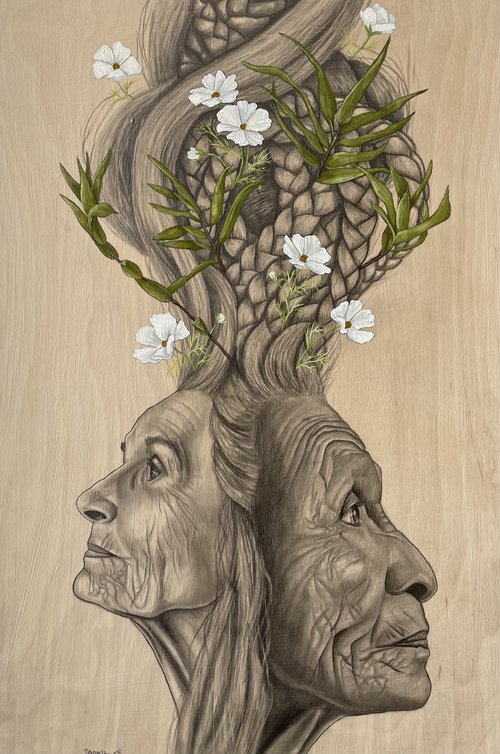
But Cara O’Connell – an artist whose work I saw at the Minneapolis Institute of Art – lovingly depicts each line, each crease, each indication of age. She takes care to show that her models are people who are living, and who have lived. The result is stunning, and beautiful.
#
As we live, we gain memories. We learn. Through learning, we may become better able to care for the world around us.
It’s easy to imagine a world in which people prized signs of this journey.
In the Disney film Moana, the demigod Maui bears a tapestry upon his skin, a growing collection of tattoos to document his adventures. Maui regards these marks of passed time proudly: the changes in his body allow others to see how much he has endured.
Similarly, in an essay describing her effort to balance living well with living ethically, Jenn Shapland celebrates the signs of experience in her own body:
“My hands have begun to speckle. Sometimes at a glance I see my mom’s hands. I write it all down in a notebook. I picture the years passing in my rocker on the back porch beside [my partner], our hair growing long and gray, our faces relaxing into folds, our garden becoming ever more unruly.
Each day is a question we ask ourselves – what is life? – and answer: this.
…
I wanted to grow up, to be not a messy twentysomething but a woman in her sixties, her seventies, with long gray hair, wrinkled and worn …”
Shapland remarks that she most enjoys spending time with people much older than herself. After she has resolved to care for the world in ways other than by raising children, she feels distanced from the friends and colleagues with whom she’d attended graduate school, and instead closer in outlook to her newfound elderly friends and neighbors.
Shapland learns to prize the sight of them, these people around her who might possess so many stories and so much accumulated wisdom to share. Much as our ancient ancestors were drawn to the red gleam of ripe fruit, which eventually gifted our lineage of frugivorous primates with trichromatic “color” vision (most mammals see the world through only blue and green, the limited color palatte a vestige of our even-more-ancient ancestors’ lives as nocturnal insectivores, for whom the world was too dim for color), Shapland finds herself drawn to the visual signs of time.
Because, like Maui, we all display some evidence of our adventures. The passage of time leaves marks upon the skin. Wrinkles are a sign of having lived, and Shapland is right to associate their appearance with the potential for wisdom or knowledge.
In Mona Awad’s horror novel Rogue – a nightmarish fairy tale about beauty and the skin care industry – this correlation is made explicit: the rejuvenation of skin is possible only through the intentional erasure of memory, wisdom, and knowledge. A person’s entire life history is stolen in order to restore their youthful visage, rendering them into a perfectly smooth, perfectly empty vessel. As the narrator strives to conform to an ideal of untouched, pallid beauty, she soon finds her “memory scrambled and full of holes. But who wouldn’t want to exorcise a few demons, kick a few skeletons out of the closet, for that Glow?”
Knowledge itself is treated as a toxin that might sully one’s appearance – within the novel’s beauty cult, the only way to restore beauty, to become desirable, is to excise all the wisdom you have gained:
“Memories are all connected, aren’t they? They are, they are … If you extract one memory, the bad one, the absolutely unnecessary Free Radical of the Mind … the one that’s dulling and creasing and darkening your visage so hideously, it’s bound to affect the others, isn’t it?”
Indeed, in the 1950s, shortly after United States medical doctors began experimenting with the intentional destruction of a patient’s brain tissue to treat traits like epilepsy, schizophrenia, obstinacy, independence, and willfulness, some doctors decided to use the technique upon their spouses.
Journalist Luke Dittrich interviewed several neurosurgeons about these procedures:
“It was a different era,” he said. “And [Dr. William Scoville] did what at the time he thought was okay: He lobotomized his wife. And she became much more tractable. And so he succeeded in getting what he wanted: a tractable wife.”
Which leads Dittrich to muse upon the interplay between gender and the perceived value of wisdom:
“While researching [Scoville’s] career as a lobotomist, it struck me that a great majority of the people he lobotomized were women. When you consider that the side effects of the lobotomy – tractability, passivity, docility – overlap nicely with what many men considered to be ideal feminine traits, that disparity is perhaps not surprising. Doesn’t mean it’s not horrifying, though.”
Indeed, our culture has maintained a stark asymmetry as to which people are allowed to age – to gain experience, knowledge, and wisdom – and still be deemed attractive or valuable. Mick Jagger smiles from tabloid covers in the grocery store checkout aisle. An older, wrinkled man might be considered venerable. Western fairy tales feature old kings with young queens, old warriors wooing young women by saving their lives. Which are all far more celebratory than the witch tales.
So I was delighted to see Cara O’Connell’s piece “Free Falling into the Cosmos” when my family visited the Minneapolis Institute of Art. Not only is the painting visually compelling, but O’Connell is also making a powerful philosophical statement by documenting the aesthetic appeal that can reside in a feminine visage with visible signs of accumulated experience, knowledge, and wisdom. Through careful linework, O’Connell has lovingly recreated each mark of time. And the viewer is coaxed into an appreciation of these models’ faces, the contrast between their aged skin and the ephemeral petals of the flowers that seem to bloom from their very minds.
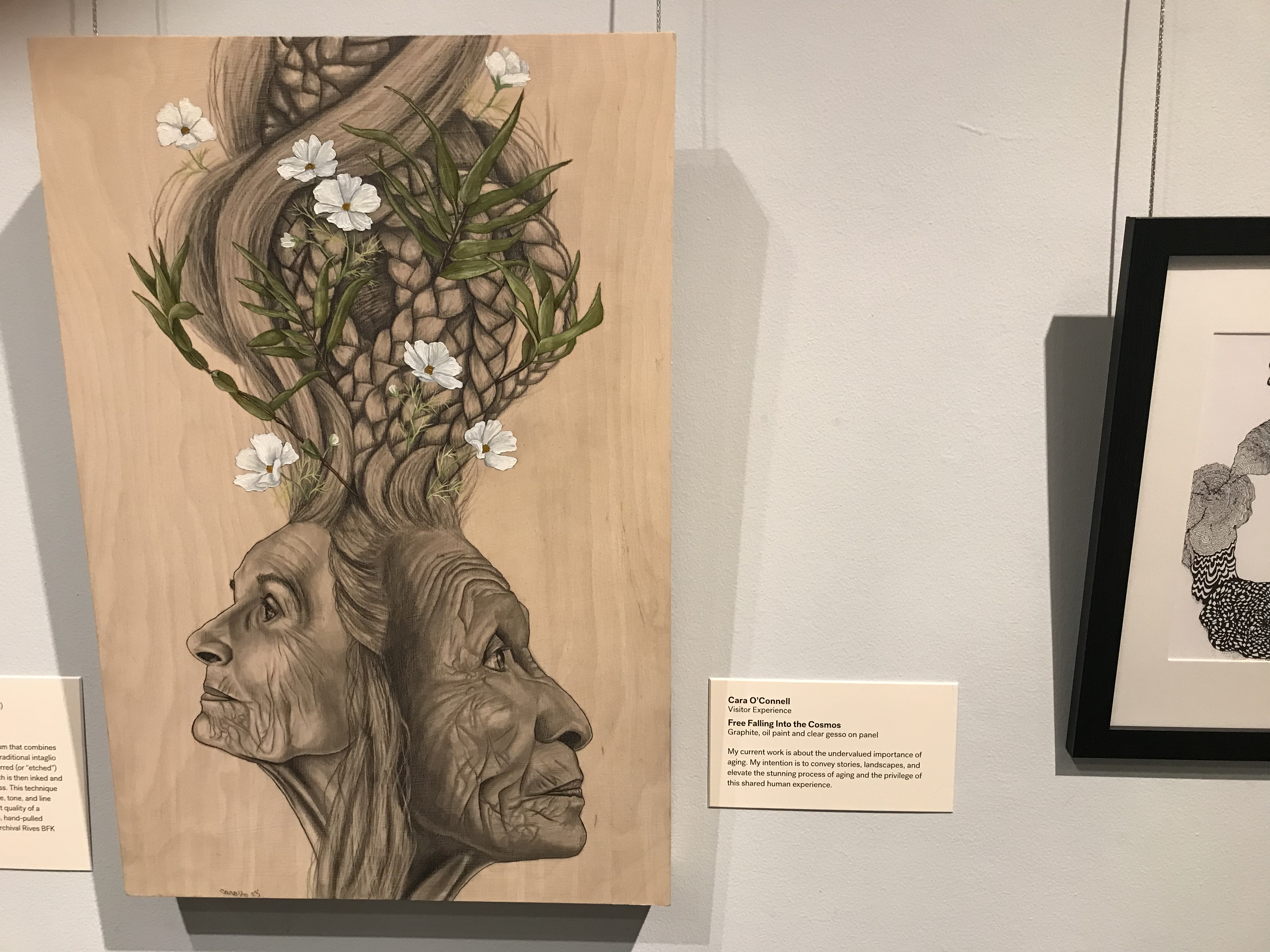
This painting was displayed in a gallery showing works that had been created by the museum staff. I’m grateful that curators at several major art institutes have been devoting space to installations like this: indeed, some of my favorite contemporary artworks that I’ve seen in museums recently were created by people who also labored to make my visit possible. Maintaining a museum requires such an outpouring of energy. The people taking tickets, patrolling the galleries, cleaning after hours, curating the collections, responding to visitors’ emails – all their care makes my visit possible. And it should come as no surprise that many of these people, who are acting with such love to allow visitors to immerse themselves in art, are also artists themselves.
At the Minneapolis Institute of Art, O’Connell works in the visitor experience department. And as an artist, O’Connell writes that “My intention is to convey stories, landscapes, and elevate the stunning process of aging and the privilege of this shared human experience.”
Through O’Connell’s work, we’re granted a vision of a world in which knowledge and wisdom are prized … in all people. Where the celebration of time helps to remind us of our connection to so many other lives. The gratitude that we should show as the descendants of so many people who have passed, and the humility that we should show as the ancestors of so many people yet to be.
 Frank Brown Cloud