Apocalypse is to remove the veil, to uncover, to glimpse a vision of the end.
Apocalypse is itself the end, that portended devastation.
In both senses of the word, ours is an era of climate apocalypse.
We’ve been granted vision, not through our eyes and dreams, but rather through air entombed beneath miles of ice, and through the agglomerated shells of ancient sea things. We see the future through the past: the visions merge because what has come before can come again.
And we are living amidst signs of accelerated devastation: the early melts; the rising seas; the summer fires; the sudden storms.
The planet is not doomed. The planet has been through this all before.
Humans, though?
In the era of civilization, these calamities will be the first.
#
To see five hundred million years into our climate’s past, researchers have pummeled the land-bound fossils of ancient sea things.
The ocean floor is subsumed so rapidly that few fossils older than one hundred million years remain beneath the waves, but shells still linger where the oceans have disappeared. On land, we have rocks that are billions of years old. And in some such rocks, the younger ones, there are tiny shells. And in those shells, there are molecules made from atoms that were once within our oceans. And among those atoms, the ratio of isotopes seems to have changed with changing global temperatures.
Obviously, there are approximations. Can effects other than changing climate alter the ratios of atomic isotopes? Why, yes. Indeed. The depths and eddies of our oceans differed; the preferred habitats of those sea-creatures may have differed, too. And our atmosphere is complex. It is not, nor has ever been, homogeneous or well mixed. At some point, every researcher has to make approximations. Only thus can we scry temperatures from shells.
To the extent of my knowledge, these approximations seem reasonable. Thank you to Kristin Bergmann and colleagues for opening a window upon our the ancient world.
And so we see something our past.
And also our future?
We’re shown the patterns of the world we live upon.
#
Quite often in the past, the world has been much hotter than it is today. On rare occasions, the world has been colder.
Rarely has our planet lingered long in the middle. The climate acts like a switch. Ice reflects sunlight; a cold planet stays cold. Bare earth absorbs sunlight; a warm planet warms.
Clouds trap heat; heated water makes clouds; clouds trap heat; heated water makes clouds; …
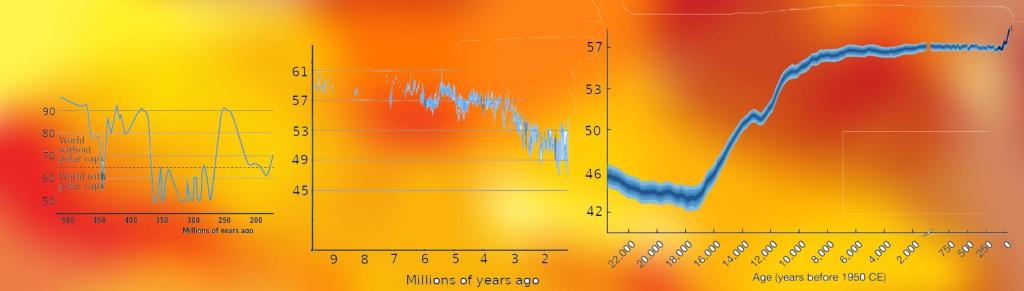
On a timescale of millions of years, the planet’s average temperature has seemed to plummet or to rocket upward. Obviously, these transitions still took time. Our lives are not even specks at this scale. And yet, the message: our planet has tipped from one state to the other. Very hot, then cold.
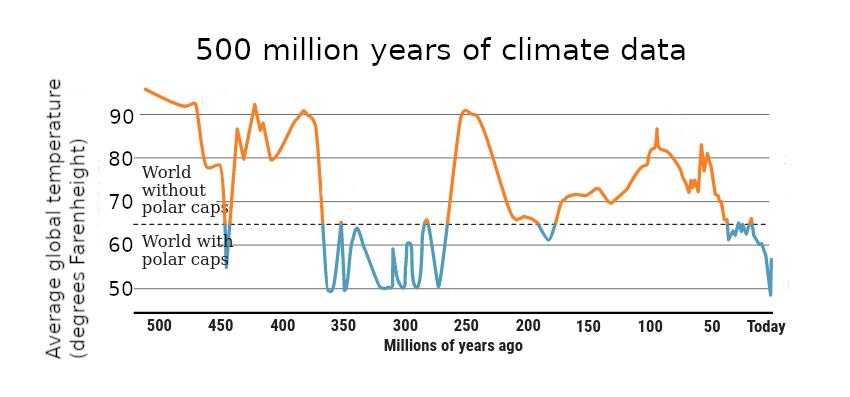
Our world is a cold world – an average global temperature, year round, summer fall winter & spring, could be over ninety degrees if our world were “hot.” Within our “cold” world, with average global temperatures below sixty degrees, some places still reach temperatures well over a hundred during their summer months. Imagine, if you will, another thirty degrees warmer than that. You might bake bread by setting a bowl of dough behind a pane of glass.
#
During the history of life on Earth, there have been five mass extinctions. Five episodes during which the majority of all living organisms went extinct, sometimes as many as 95% of all plants and animals.
Which does not mean the Earth was lifeless at those times. When a dinosaur topples and dies, scavengers and molds will feast upon its corpse. During the dying, a some organisms thrived. White fungal blooms, grasping hyphae, air filled with plumes spores. Perhaps this is why ours is a world of mammals and not reptiles; mammals have higher body temperatures, which inhibits the growth of fungi and molds; living reptiles are more susceptible than mammals to organisms that evolved to feast upon the dead.
Until our world warms. When outdoor temperatures more closely resemble mammalian body temperatures, we will see more fungi that can infect and grow within a healthy human body.
But first, a timeline of the dying. These five occurred at approximately 445, 370, 250, 200, and 65 million years ago.
We can look at the planet’s temperature again. At these times, what happened?
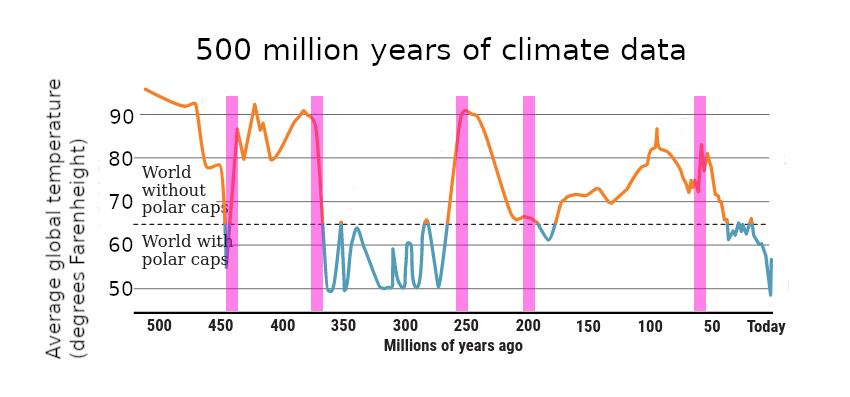
The climate changes. Many creatures die.
The twinning might seem to go both ways; events that can kill creatures might also change the climate. Asteroids, volcanoes. And yet. Each localized disaster kills within a region; climate change affects the world.
#
During the mass extinctions, most organisms die. But some survive.
What might be true of the survivors?
We can consider the more recent past; 10 million years. During that time, there were creatures that looked vaguely like us.
Near the beginning of that time – six million years ago – those like-us creatures had rather small skulls. They probably had bodies covered with fur. They may have used simple tools. They did not travel terribly far from home; they all lived within a small region of our world.
And many types of creatures like us succeeded them. At times, our Earth has harbored about a half dozen species who all looked human. Time passed; certain individuals were more successful at raising surviving offspring; this enriched their genes within each population; future generations were more likely to resemble those successful ones.
Our arms are shorter than the arms of our ancestors. Our toes, less nimble. Our hips narrower. Our brains larger.
During that time, our world’s climate was in flux. The world was always “cold” – average global temperatures were never above sixty degrees. But the world was changing, see?
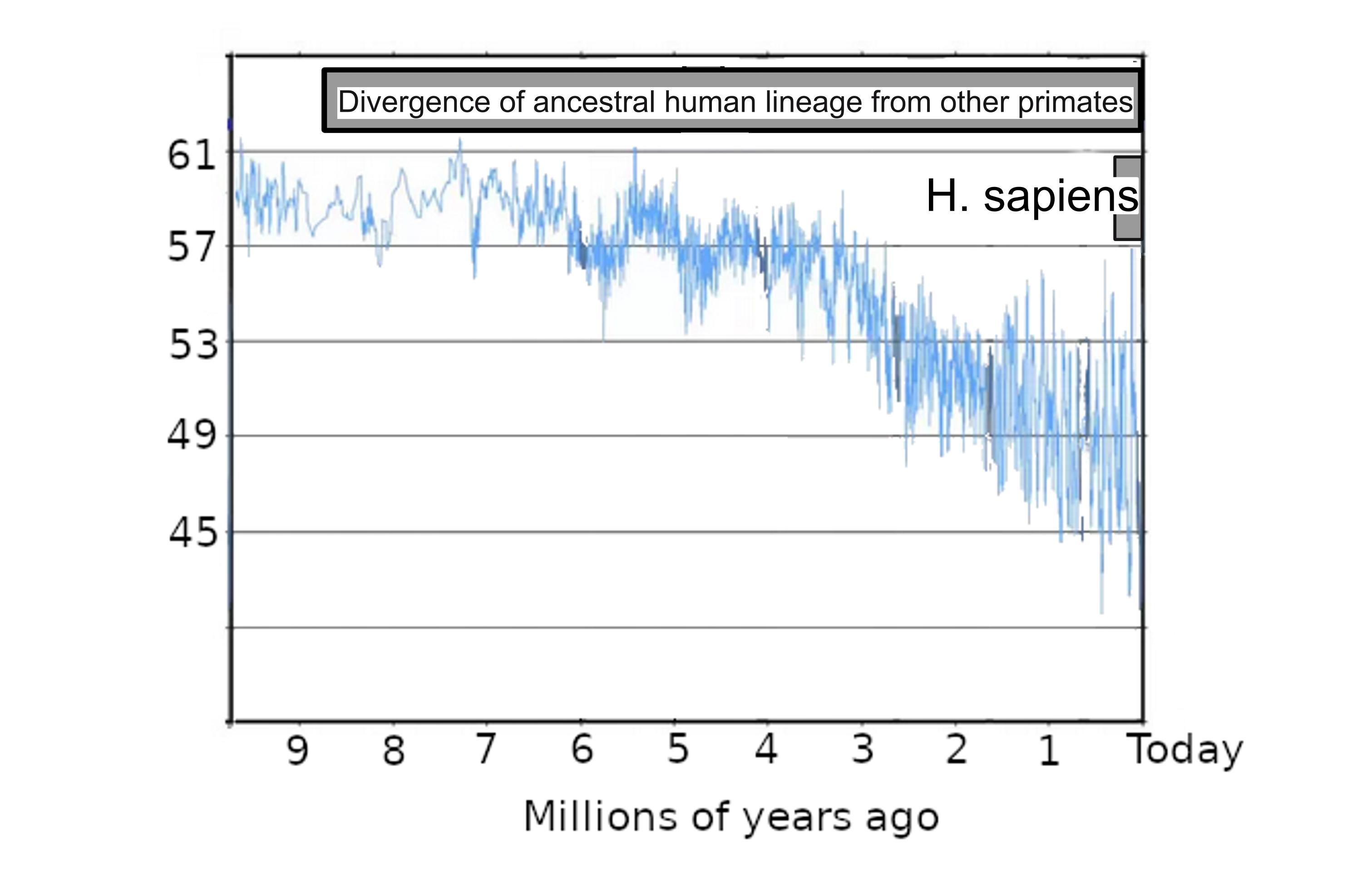
To my mind, each million years is an impossibly long time. Break a million years into ten-thousand parts, and there you have the very longest human lives.
But each such moment, to those living in it, was not a yawning expanse of time. Those moments were their lives. And when we look at this graph of average global temperatures, we see such jagged lines; these jags exist within and between their generations. Grandparents knew a lake; the grandchildren find a desert. In such a world, creatures might not endure by instinct. Each generation might have to find new ways to survive.
Our large brains, such a gift. But the gift was bought by suffering. That’s how evolution works; it is a game of numbers. Things that replicate themselves more rapidly are more likely to be found at a later time.
As the climate turned hostile, whipsawing between generations, lineages with larger brains were more likely to survive. Which means: other lineages died.
#
As we approach the present, our measurements are more accurate. We need not measure ancient shells; there are small pockets of air trapped within glacial ice. Drill deep enough, melt each segment slowly, and measure what was there.
In the past twenty thousand years – which is perhaps a thousand human generations – the climate of the Earth has changed. During this time, humans hunted. They gathered fruits and plants and seeds to eat. They might clear away the weeds that grew near something good, and hope that the good food could spread. Humans domesticated dogs. They invented new types of boats and clothes and stories.
Most babies and children died — childhood mortality probably exceeded 50%, as it does among both related species and near-contemporary groups of hunter-gatherers — but when someone became an adult, they could survive into their seventies.
Humans had reached every part of Africa, and Europe, and Asia. They’d reached the western coast of North America. They’d reached the islands of Indonesia.
But we did not yet have “civilization.” A system resembling our current world. Interconnected cities. Accumulated intergenerational knowledge; agriculture; writing.
Likely, we could not have had these things. How often, previously, had our world maintained the necessary constancy? How often had the knowledge of grandparents – “That is where you’ll find a lake” – matched the experience of their grandchildren – “But grandfather, that lake bed is dry.”
Beginning ten thousand years ago, our planet’s climate has been remarkably unchanging. A myriad in which average global temperatures wavered no more than a degree.
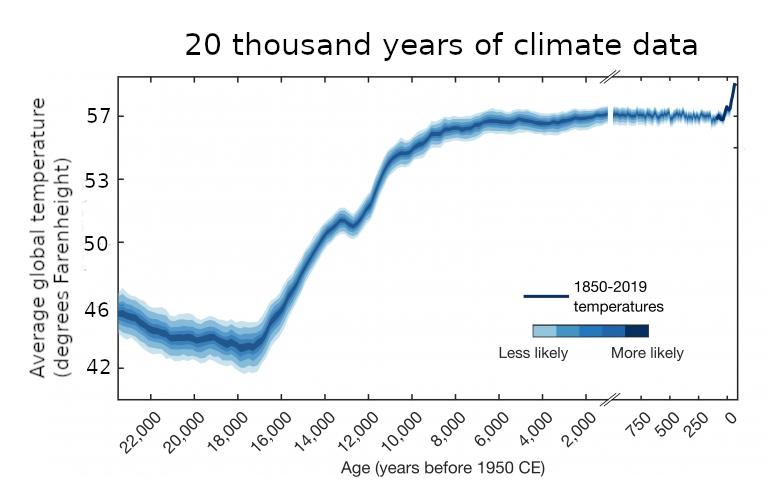
Civilization is an enterprise that needed constancy. The humans who lived ten thousand years ago were no different, biologically, from the humans who had lived before. It was the world that changed.
#
Compared to the erratic swings seen in the past – 370 million years ago, average global temperatures plummeted by forty degrees! – our recent rise in might seem like such a trifling thing. On the scale of the graph showing 500 million years of our planet’s climate, you wouldn’t even notice a rise of two degrees.
But the risk is not to Earth. The risk was never to Earth.
The risk is not to life. Some organisms are sure to survive.
The risk may not even be to humanity. Our species is notable for our large brains and adaptability. Ten million years; the whims of chance mutation, selective pressure, and time; our kind came to be because of our propensity to survive.
Civilization, though?
The last time temperatures changed this much, there was no writing.
There were not yet buildings made of stone.
.
.
.
.
The graphs for 500 million years of climate data were lightly adapted from a 2019 article in Science by Paul Voosen, “A 500-million-year survey of Earth’s climate reveals dire warning for humanity.“
The graph for 10 million years of climate data was adapted from data in a 2020 study by Thomas Westerhold and colleagues, “An astonomically dated record of Earth’s climate and its predictability over the last 66 million years.“
The graph for 20,000 years of climate change was adapted from a 2021 article in Nature by Shaun Marcott and Jeremy Shakun, “Global temperature changes mapped across the past 24,000 years.“
 Frank Brown Cloud