Loneliness kills. The U.S. Surgeon General estimates that loneliness can be as dangerous for elderly people as smoking fifteen cigarettes a day.
And so many of the endeavors we might undertake are an awful lot of work! Mustering up the money for rent can be hard; dealing with the emotional fallout from inevitable moments of disconnect between our hopes & dreams and our careers can be hard; raising children has always been very hard.
All these aspects of our lives are so much easier when we have a team. Confidants who might be willing to sit and listen to our worries or ideas; allies who’ll pitch in and do the work alongside us or in our stead.
In the essay, “The Babysitting Co-Op that Reshaped My Family Life,” Elizabeth Doerr remarks on how much happier she became after she developed closer relationships with people in her local community.
“My first experience with community child-rearing was well before I had my own children, when I was a Peace Corps volunteer in rural Malawi. There, families often live in intergenerational compounds, and babies are passed from arm to arm and children constantly moved from compound to compound, all the amayis looking out for any of the children that happened to be in their presence.
…
Thinking back to Malawi, it strikes me that my parental isolation is in large part due to my privilege. … In the United States, the more education we have, the more affluent we become, the further away from our families we tend to move.
…
But as we learn to ask for help, we’re also learning that it’s less about accepting defeat and more about creating community.”
Obviously, we do need help. We need friends and family in our lives. And, if possible, we need love. People whose company brings us joy; people whom we feel thrilled at the prospect of bringing joy to in return.
How many such people? Of late, that’s been up for debate.
#
Most American parents tend to smooch and slip out of their clothes with the people whom they trust most to look after their children.
Which is a rather sultry way of phrasing something simple – not that most Americans are necessarily acting out the “seducing / seduced by the babysitter” trope that’s prominently featured in John Irving’s The World According to Garp as well as all manner of online pornography, but rather that many of us co-parent with our romantic partners.
Often, each person only has one such romantic partner, but not always: in the essay “Polyamorous Sex Is the Most Quietly Revolutionary Political Weapon in the United States,” Olivia Goldhill profiles several polyamorous families. Of one such multi-parent family, Goldhill writes that,
“The family knows combining parenting with polyamory is controversial but laughs at the suggestion that there’s anything unhealthy about the arrangement.
‘Our joke is always, “won’t somebody think about the children?” says Elise’s mother, Jill. ‘People say that all the time to disparage non-traditional relationships. But our kids have this house full of folks who are interested and engaged with them.’ ”
Although our society is becoming more accepting of alternative family arrangements, intolerant attitudes were rife in the recent past. For example, when polyamorous educator Ryam Nearing appeared on a daytime talk show hosted by Geraldo Rivera in the 1990s, Nearing was heavily criticized for her parenting choices. As described in Christopher Gleason’s American Poly,
“Geraldo argued that the natural reaction to infidelity was rage and obsession. He pointed out that although Nearing and Barry had been married for decades, it was Hill who was the [genetic] father of Nearing’s two-year-old son. He asked whether that was confusing to the child. Another audience member reiterated the concern, asking whether such confusion was child abuse.
Visibly upset, Nearing angrily responded that there was no confusion, [her son] simply called the men by their names and that love was no abuse.
To Nearing, it was apparent that, despite the laughter of the audience, she took marriage more seriously than they did. She certainly took it more seriously than Geraldo, a fact he confirmed when he bragged that she could not tell him anything about marriage. He had been married four times and had four children by three different women. He believed her lifestyle was detrimental to her son and that, like the children of his gay neighbors, her child was in a qualitatively different position than others.”
But polyamorous relationships, consensual non-monogamy, and collective child-rearing are not new phenomena. Many hunter-gatherer cultures structure their societies in similarly sex-positive ways, including by promoting the belief that everyone who shares intimate physical affection with a pregnant person becomes a biological parent with the responsibility to help care for that person’s child. And even in modern European and American societies, numerous historical figures have intentionally structured their lives and relationships in similar ways.
In the essay “Storming then Performing: Historical Non-Monogamy and Metamour Collaboration,” Brian Watson and Sarah Stein Lubrano discuss their findings from an investigation of the biographies, letters, and archives of public figures like writer Virginia Woolf, quantum mechanics pioneer Erwin Schrodinger, Wonder Woman creator William Marston, and others. Watson and Lubrano write that,
“Our research locates a wealth of examples of metamours [people who share a common lover] supporting one another in material, social, and psychological ways throughout their lives.
…
Our research suggests that while existing societal (and social-scientific) norms primarily focus on competitive behaviors, consensual non-monogamy suggests another important area of study: that of sexual collaboration.
By this we mean not only that individuals may assist one another in biological reproduction and the raising of young (although our research provides many examples of this type of behavior), but also that individuals may also form connections that assist one another in maintaining sexual and romantic relationships of the type they desire.”
#
Most of us are also prone to smooching our most trusted emotional confidants. In romance novels, the protagonists often establish their relationships by laying bare their hopes and fears.
But we don’t share our feelings only with the people we kiss; nearly all relationships benefit from some measure of emotional openness and honesty. In the essay, “Long Live the Work Wife. Just Don’t Call Her That,” Charlotte Cowles discusses the deep emotional bonds that many people establish while spending many hours each day collaborating with another person. Cowles writes,
“Even as our workplaces have turned against close relationships [as a result of the Covid-19 pandemic], researchers have found that they’re more important than ever. In [a 2022 Gallup poll of 15 million workers], respondents who had a best friend at work were significantly more likely to be happy with their jobs, successful in their roles, and loyal to their employers. What’s more, the correlations between work friendships and overall well-being were even stronger in 2022 than in 2019.”
Depending on the level of emotional intimacy, working relationships can feel fraught … but, honestly, as someone who has collaborated on many professional projects with my spouse, I really enjoy the experience of having absolute trust that my teammate will do a good job and immediately talk to me if there are any problems. The fact that we also kiss doesn’t hamper the work we do together; a dash of romance can often make work more fun, as Bonnie Garmus describes in her novel Lessons in Chemistry:
“… and while the scientific community would later marvel at [Elizabeth Zott’s and Calvin Evan’s collaborative] productivity, they probably would have marveled even more had they realized most of it was done naked,” while the heroes bantered about their ideas before, after, or even during sex.
But just because there is trust, kindness, or even love between a pair of people, does not mean that those people will feel desire for one another, or feel desire exclusively for each other.
In a profile for The New York Times, Bill de Blasio and Chirlane McCray discuss their enduring love for another another … in the context of their plans to begin dating other people. Journalist Matt Flegenheimer writes that,
“As the conversation neared its end, the former mayor pulled out his phone to play a song called ‘Mango,’ saying it might best explain their feelings now.
‘I don’t want nothing but you,’
it went.
‘Getting what you need
Even if it ain’t from me.’ ”
Indeed, “Mango” by Kamauu is one of the best songs about polyamory. In past eras, most polyamorous songs were boastful compositions like Lou Bega’s “Mambo No. 5” or Jay Z’s “Girls Girls Girls” in which a (stereotypically masculine) singer rattles off the names of a bevy of romantic partners. More recently, though, several songs celebrate polyamory as it would be defined by educators like Cunning Minx, who hosts a radio show called “Polyamory Weekly” and whose views were summarized by Christopher Gleason in American Poly:
“Minx recognized the diversity within the [polyamorous] community, and the polyamory she preached was devoid of hard and fast rules or excessive moralizing.
She rejected harsh distinctions between polyamory and swinging, urging her listeners to find solace in the communities that brought them comfort even if they sometimes overlapped.
According to that philosophy, polyamory meant stability with loved and trusted people, but also the ability to have adventures outside of that realm.”
Along those lines, in the song “I’ll Be Lovin’ You,” Miranda Lambert sings,
“And when I’m lonely
And I’m needing something new
…
I’ll be lovin’ you.
No matter where I roam
I’ll be lovin’ you.”
And in the song “Hold U,” Indigo De Souza sings,
“You are a good thing, I’ve noticed, I’ve seen it,
and I want the best things for you,
…
I’m not the only body,
I’m not the only one,
…
Hold me, hold me,
And I will hold you, I will hold you.“
#
In an essay for The New Yorker, Jennifer Wilson discusses the seemingly sudden influx of art, literature, and television about polyamorous relationships; Wilson writes,
“What are all these open couples, throuples, and polycules suddenly doing in the culture, besides one another?
To some extent, art is catching up with life. Fifty-one percent of adults younger than thirty told Pew Research, in 2023, that open marriage was ‘acceptable,’ and twenty per cent of all Americans report experimenting with some form of non-monogamy.”
And yet, in a lot of the art and articles about polyamory, there’s very little discussion of either physical pleasure or emotional intimacy. The closest Jennifer Wilson comes to acknowledging that potential for life-affirming joy is in a quotation used as fodder for a damning dismissal of a memoir about consensual non-monogamy:
“The memoir [More by Molly Roden Winter] takes a long time to finish, not unlike a bad Ashley Madison hookup, but not before Roden Winter offers closing remarks in defense of open marriage. She echoes the common refrain expressed by proponents of polyamory that the lifestyle represents an abundance-oriented mind-set, whereas monogamy is a symptom of scarcity culture.
‘Because love is vast,’ she tells us. ‘Abundant. Infinite, in fact. And the secret is this: love begets love. The more you love, the more love you have to give.’
But there is no articulation of what that abundance might look like beyond her [extremely privileged] private life and the private spaces in which it unfolds. Ultimately, Roden Winter’s memoir represents a very specific, arguably very American version of polyamory – the extension of abundance culture to all corners of the bedroom, but nowhere beyond.
You can understand why Roden Winter might believe that she is ushering in a bright, abundant future by opening up her marriage. A good love affair, when you’re inside it, feels like it could change the world. But changing the world takes more than spreading the love; you have to spread the wealth, too.”
Which is a fair criticism. Personal happiness is important. Personal happiness can help us refrain from the sort of destructive consumerist activities that are endangering the planet; happy people tend to buy less junk. But our personal happiness needs to be coupled with the desire to make happiness possible for others, too.
Which is the crux of polyamory, on a small scale at least. Our personal happiness should not come at the expense of others.
As though this were a bizarre idea, Goldhill writes that,
“If [someone doesn’t] want to hug or talk to you then, polyamorists believe the only right way to respond is with acceptance. Those who have been polyamorous a long time know the practice isn’t simply about love and sex, but independence and autonomy.”
And in her autobiography, television actor Maitland Ward discusses how surprised she felt when her husband suggested that she should attempt to fulfill more of her lifelong fantasies. Ward writes that,
“I wasn’t missing anything in my marriage. We were happy and had everything you could want – intimacy, trust, stability, and love – but marriage doesn’t bring a person happiness completely. … Could I go through the rest of my life wanting to do something … yet stamp it out because I had everything else that I needed at home?
…
‘You’ll never be happy unless you do all the things that you want to do,’ [my husband] said, and he took my shaking hands.
‘But I’m happy with you,’ I said, and I meant it.
‘But you won’t be one day if you’re denied this.’ ”
Given our culture, it is shocking for someone to speak up so forcefully in favor of another person’s happiness. More common is for Americans to gaze upon others with envy. To feel as though they need to keep up – which is the heart of Robert Frank’s critique of unfettered capitalist consumption, Choosing the Right Pond, because so many people harm both themselves and others in the effort to elevate their perceived status above those around them – and to feel saddened by others’ joy.
In the poem “Notes for My Funeral,” Alex Dimitrov distills this feeling into a brief series of poignant lines, hoping that after he dies his friends will,
“Just think about me.
Think of New York.
How the people who
never liked me never
liked me because they
always assumed I was
having too much fun.
And you know what?
I was. I loved being alive.”
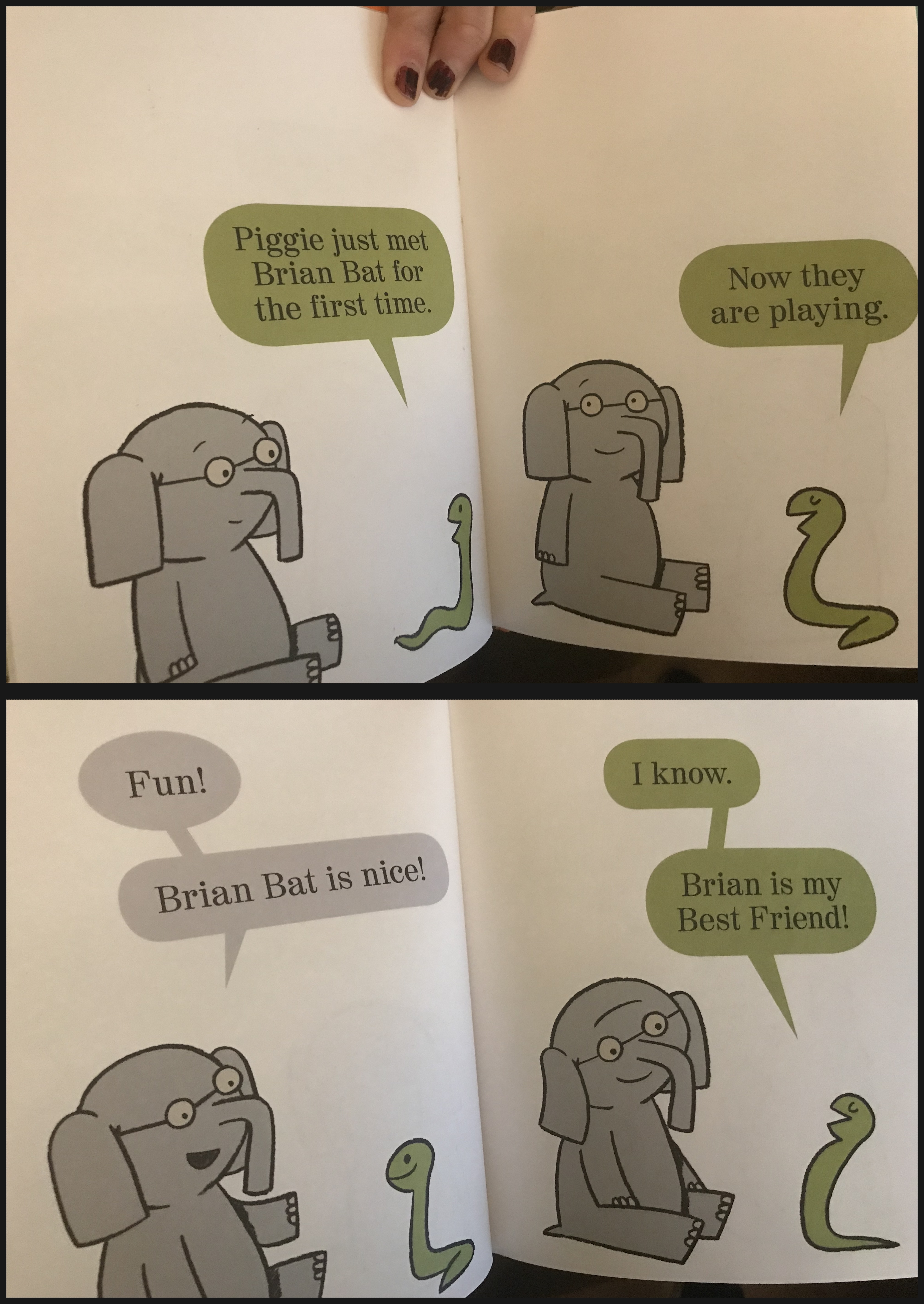
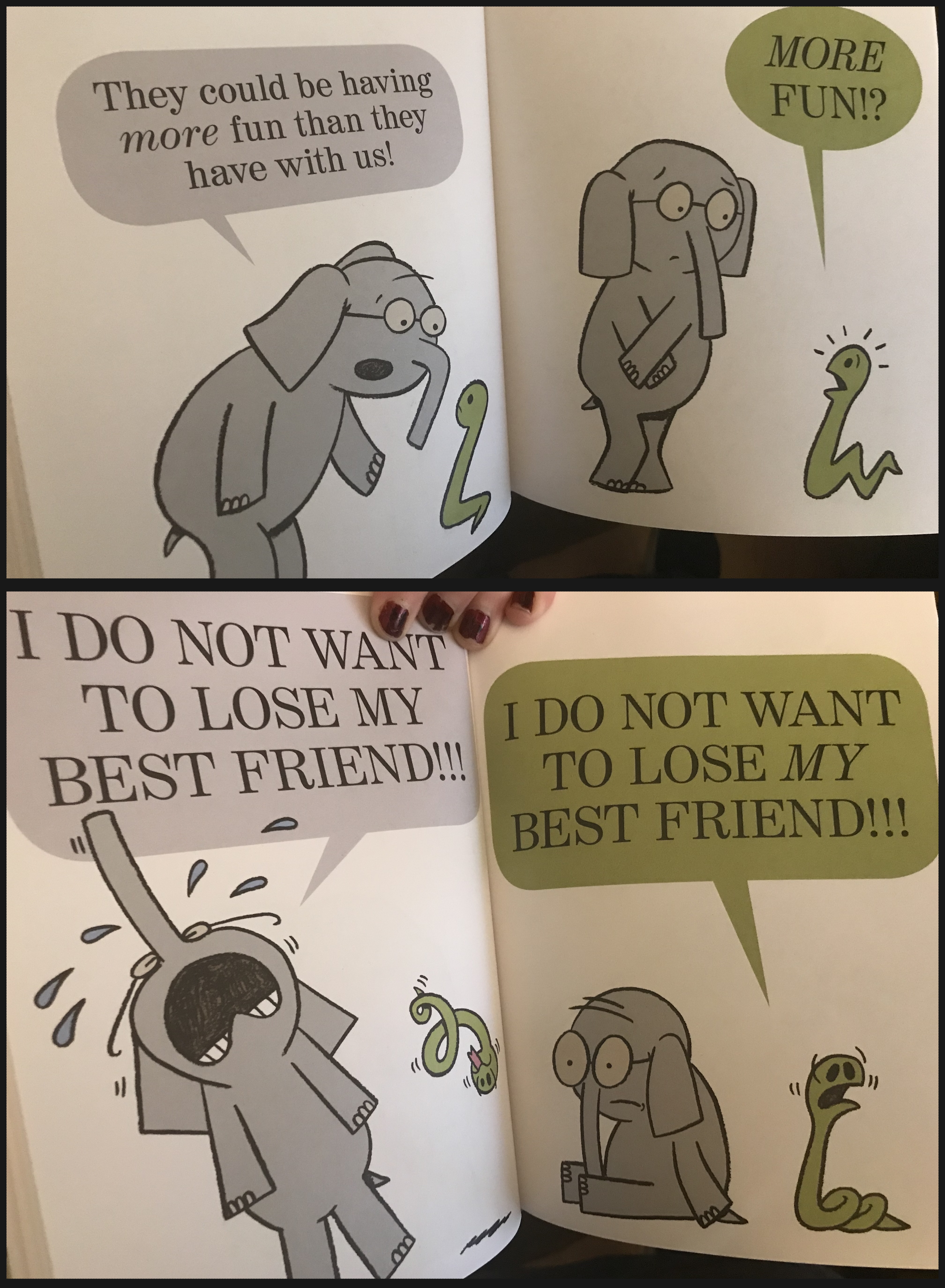
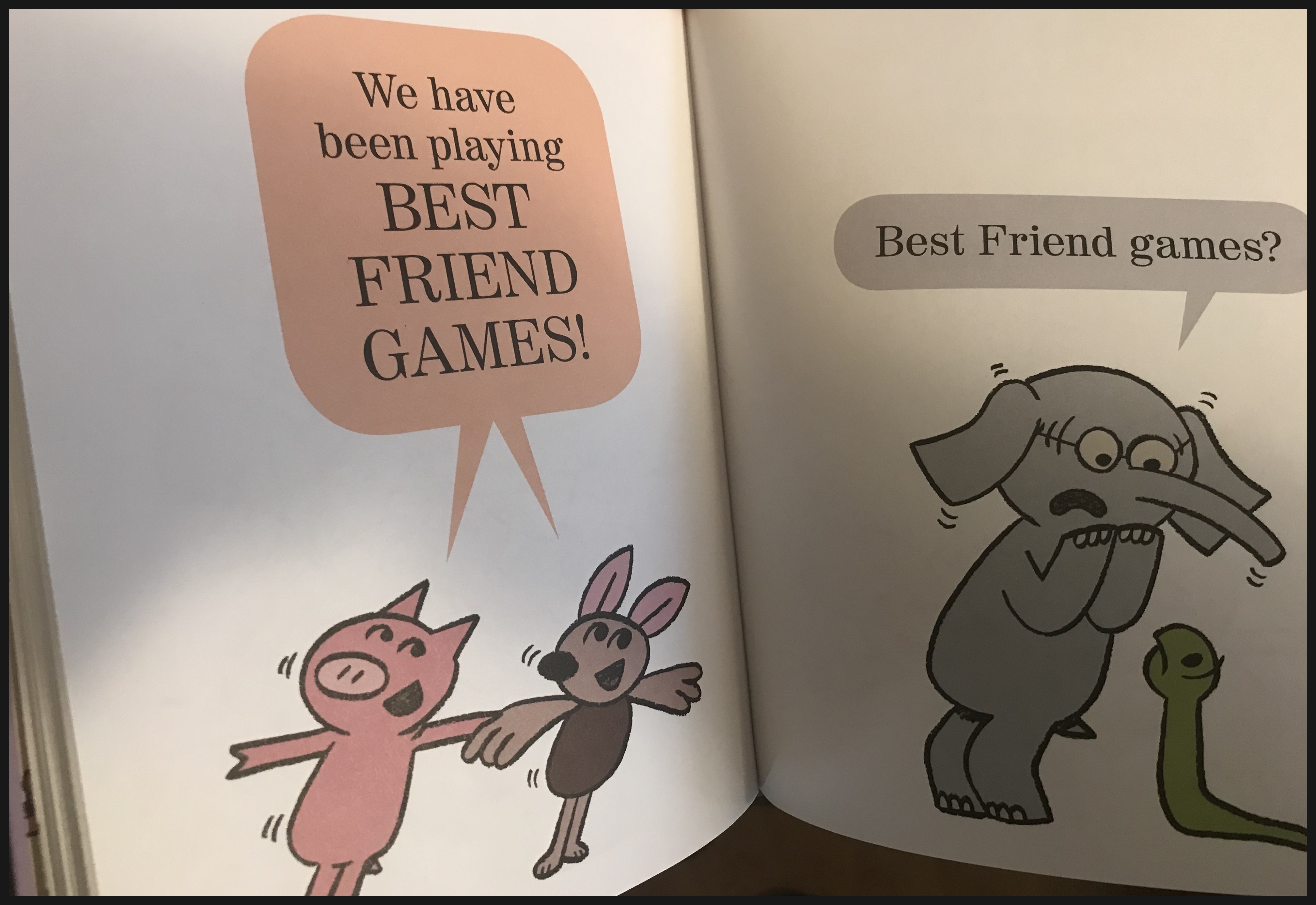
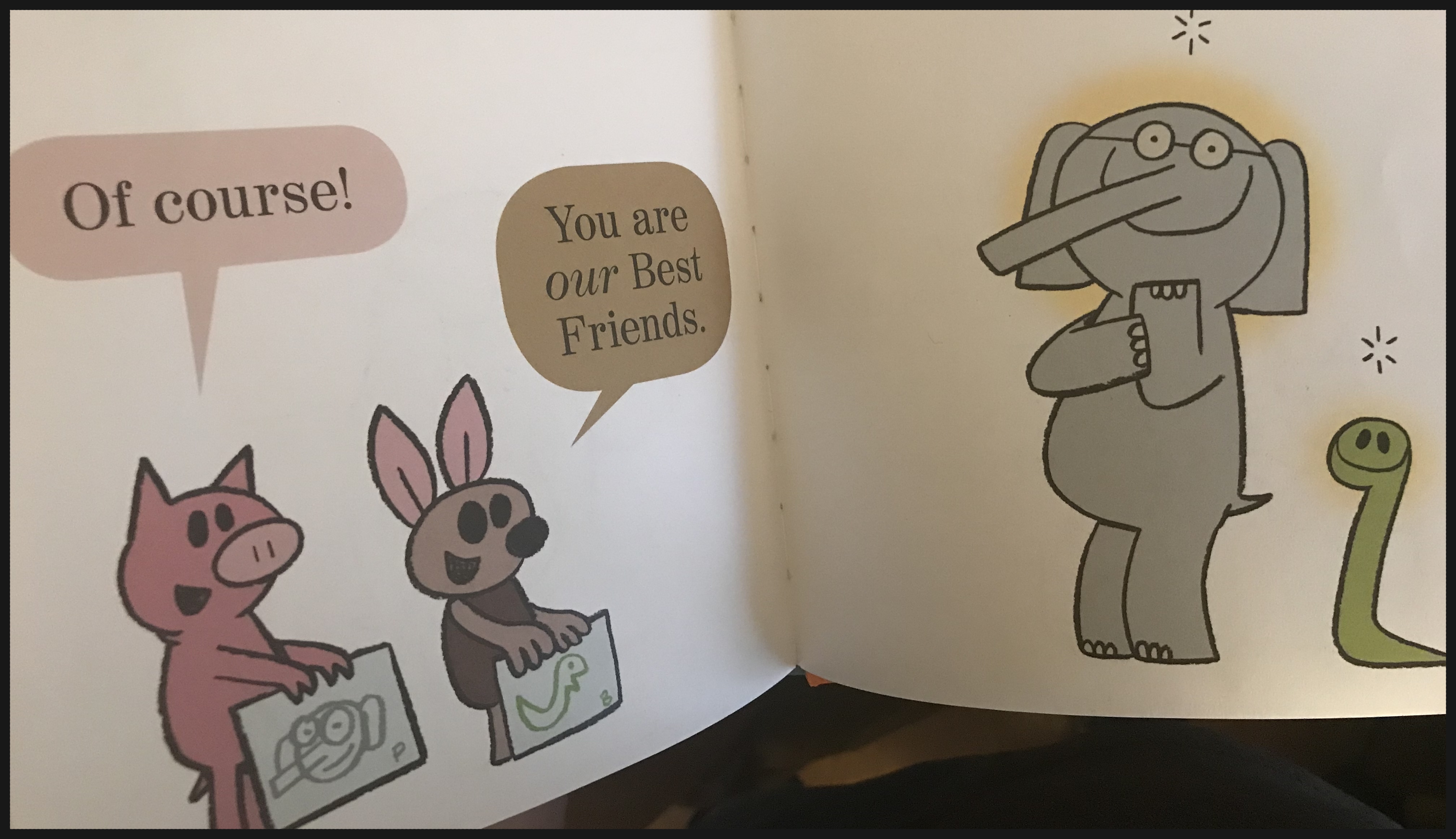
All of which is why my favorite book about polyamory is actually a early-reader children’s book aimed at preschool- and elementary-aged children, the Elephant & Piggie book My New Friend Is So Fun by Mo Willems.
Willems lovingly walks readers through the full spectrum of big emotions associated with polyamory, ranging from jealousy and dread to compassion and joy. At the beginning of the book, Elephant Gerald greets another animal who lets him know that Piggie, Elephant’s best friend, has just met someone wonderful.
Elephant is thrilled:
Elephant is worried:
Elephant is terrified:
Elephant is finally secure:
Elephant is happy about his friend’s happiness (now that he knows he won’t be replaced):
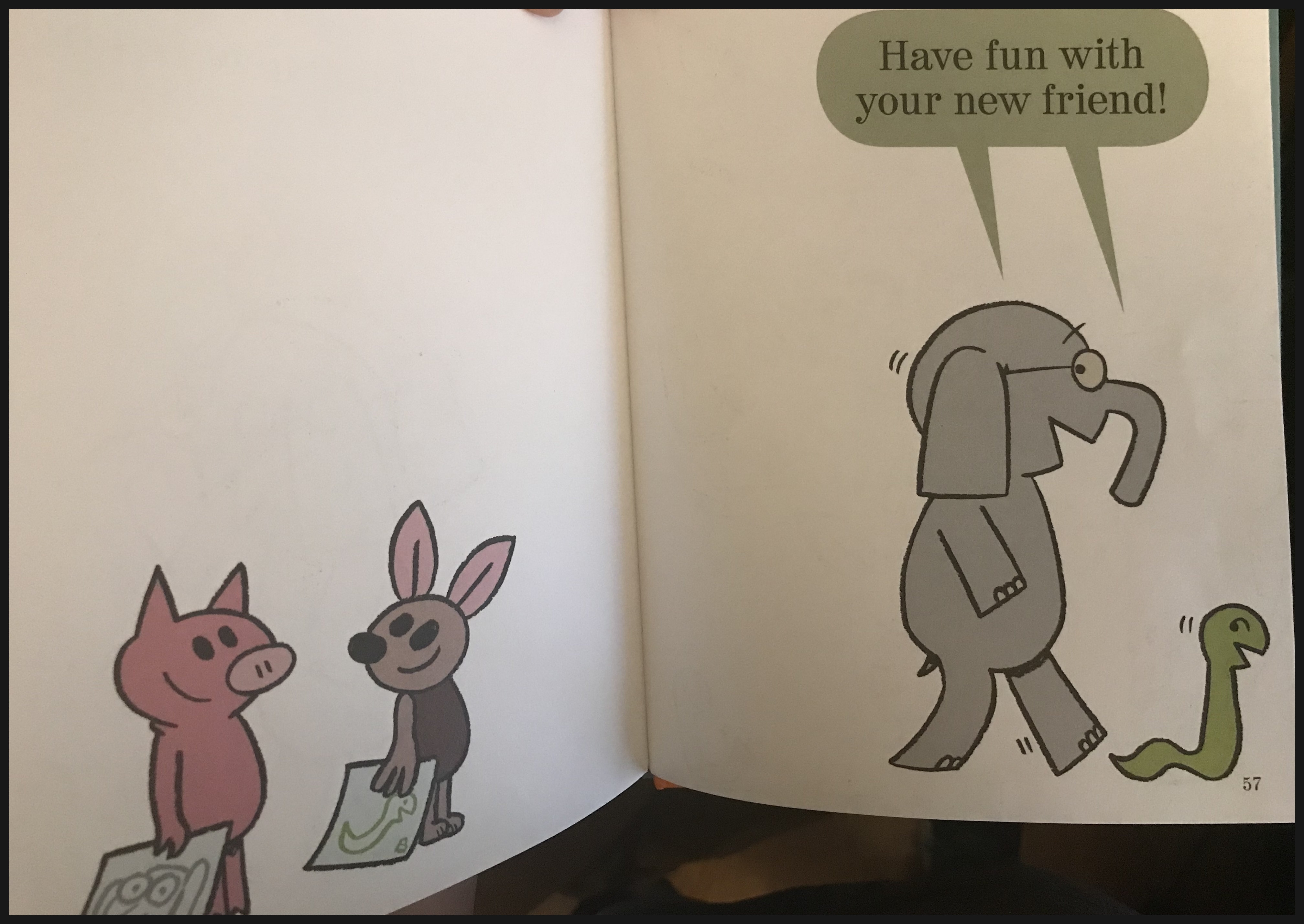
And isn’t that what we want? To have fun. And to know that the people we love are having fun.
With effort, perhaps we can reshape this world into a place where such fun is within reach of everyone. Jennifer Wilson is right: you can’t just spread the love, “you have to spread the wealth, too.” So much will need to change.
But it would be worth it. In that world – a place where we valued everyone’s independence, autonomy, and joy – you would probably be happier, too.
 Frank Brown Cloud