Of all my children’s toys, I imagine that the rainbow unicorn appears most unlovable. Its fur is tattered, some patches nearly bare and others clumped or crusty with goo. Its horn is a broken nub flaking bits of plastic. The eyes are scratched. The wings are pocked. The once-bright colors have faded.
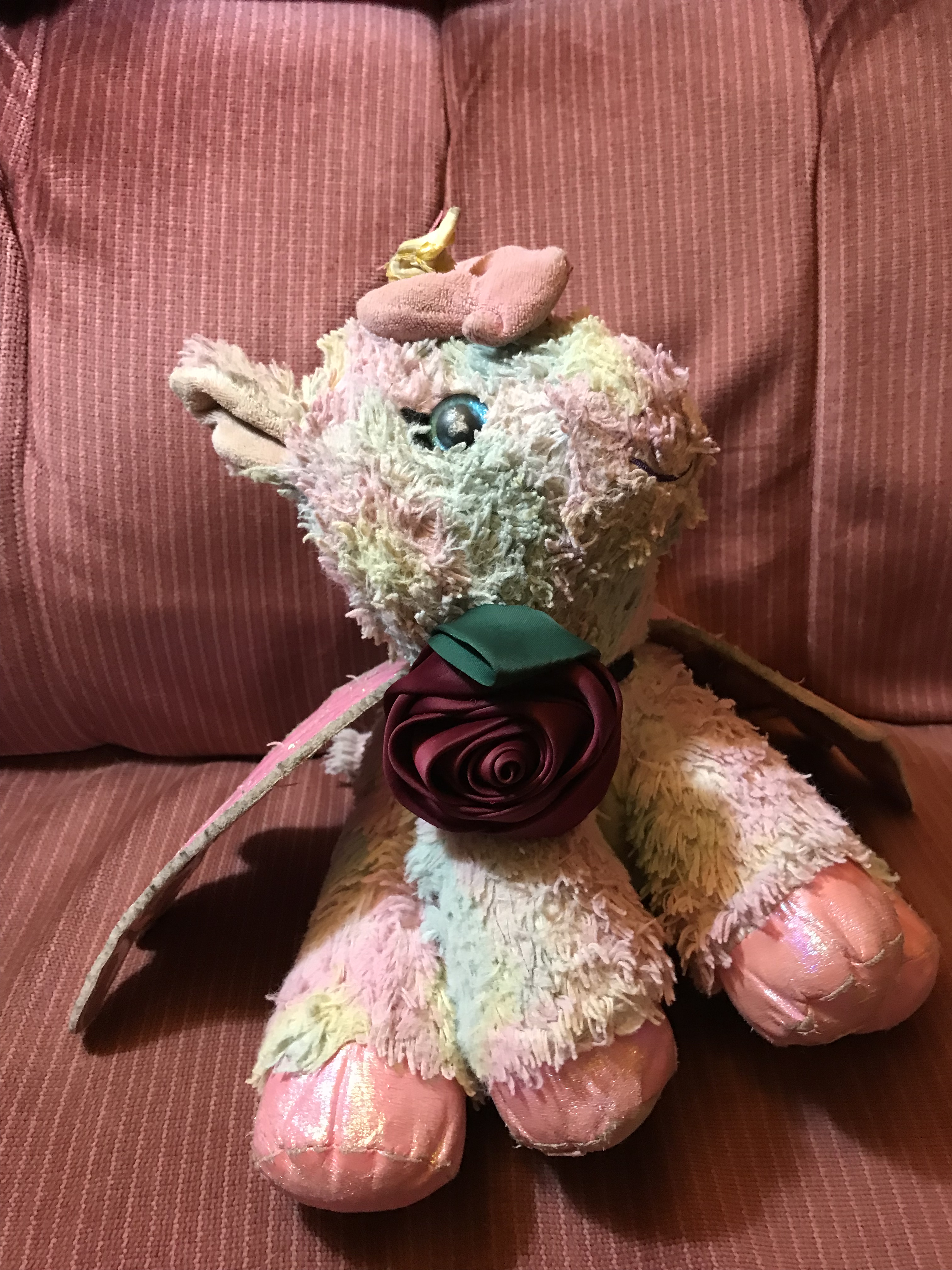
This unicorn is the rattiest-looking stuffed animal in my house, which is evidence of how dearly it is loved.
#
Unlike stuffed animals, our bodies are in a constant state of renewal. We grow new skin cells. Our bruises heal. Summer tans fade. Physical evidence of our past is steadily obscured. And so, luckily, having been loved won’t tarnish our exteriors the way it would a child’s toy.
But love is a process of history. This is why romance novels require charming plots, rather than mere descriptions of two characters who seem like they’d be suitably matched to meet and fall in love. Any lasting relationship between people is a testament to the process of having built that relationship: each interaction adds to the story that those people share, expanding their private language with new allusions that only they will understand.
Among the (many!) ways in which Ayn Rand was wrong about the world, I think she was most wrong about love. Rand believed that love should be based only on the present state of the world. To Rand, your emotions shouldn’t depend on the path you’ve taken, but only on your current circumstances. To Rand, someone ought to be able to look around, identify the nearby person who is objectively the best, then decide to love that person. (Because only a single pair of people could possibly be the objective best, those two ought to have a relationship, and everyone else should wistfully pine for them.) “Show me the woman a man sleeps with,” Rand writes, “and I will tell you his valuation of himself.”
Within the world Ayn Rand envisions, each night at bedtime a child would identify the softest, most beautiful toy, then cuddle up with that objectively best toy to go to sleep.
But our perceptions aren’t objective. We live within mental reconstructions of the world. Moment by moment, photons bounce off my writing desk to plonk against cone cells in my eye, exciting some fraction of them, creating signals that will pass through my visual cortex and then on to my conscious mind. The signals are discrete, caused by individual proteins absorbing incoming photons of light. The desk itself is mostly empty space, a lattice of atoms held in place by attractions and repulsions between their electrons. And yet, from these discrete signals, my mind concocts a solid desk. My mind retains an understanding of the desk’s presence even when I’m not looking at it. This partitioning of the world – interpreting some of the photons that reach my eye each second as representing a desk among a roomful of other discrete objects – occurs entirely within my mind.
Our minds also ignore vast quantities of sensory information. Presumably, you have a nose at the front of your face; presumably, your eyes can see that nose; presumably, because your eyes always see your nose, your mind removes its image from your visual field. In order to function in the world, our minds subconsciously unlearn any notion of objective reality – our brains ignore as much as possible, to retain attention for the changing circumstances that might require us to take action. Babies, young children, and people with autism tend to be more easily overwhelmed because their minds ignore less information about their surroundings.
And the personal history we share with elements of the world around us – places, objects, and other people – will cause us to see more than what is there. My spouse, perceived by my mind, is a person, much the same as the person you might see if you were to look at her. But also, my spouse, as perceived by my mind, is a story, a manifestation of the two decades of memories we share.
The objective version of my spouse is great! If you met her, I assume that you would like her, too. But the person I love is someone with whom I share history. A person whom only my mind can perceive.
#
At times, the protagonists of romance novels act bravely; at times they seem small. They might hide their emotions for fear of being hurt. In many of my favorites – Mistakes Were Made, She Gets the Girl, Not My Problem, Delilah Green Doesn’t Care, The Charm Offensive, Behind the Scenes – the characters actively repress their feelings for people whom they’ve been spending time with. These characters’ decisions might be frustrating, but who among us isn’t frustrating sometimes?
That’s the point: the protagonists of most romance novels tend to be ordinary people. None of us has to be the objectively best person alive in order to share kindness with the world or to create memories with the people around us. And that act – loving the world around us – will, over time, make us lovable in turn.
I was reminded of this after my child lost her beloved unicorn stuffed animal. The unicorn was accidentally left at the library on the Sunday before Labor Day. That night, my kid was nearly inconsolable, crying because she wouldn’t be able to cuddle with her special bedtime friend until Tuesday night, even if we ever found it!
Of course, I visited the library as soon as it opened on Tuesday morning.
And there, in a lost-and-found box behind the desk in the children’s room, was the unicorn. I must admit that, sitting in the box, the toy looked terrible. At a store, I can’t imagine that anyone would pick that unicorn as being objectively best.
But when I met my child after school, I was able to perceive the unicorn correctly again. Because there was my joyous child, clutching her favorite toy.


 Frank Brown Cloud