Yesterday, New York Times columnist Bret Stephens published an editorial condemning Oregon’s “Drug Addiction Treatment and Recovery Act.” This policy reduced the criminal penalty for possession of small quantities of many chemical substances, including cocaine, heroin, and methamphetamine; instead of incarceration, people caught with these substances are given fines.
Stephens condemns the policy because Oregon has recently been the site of more overdoses, more gun violence, and more unhoused people. Anecdotally, it has been very unpleasant for people who don’t use drugs to spend time in certain parts of the city, as they’ve been exposed to a much higher concentration of disorderly, uncivil, or antisocial conduct.
Stephens suggests that decriminalization is a disastrous mistake.
I’d posit instead that we need more cooperation for these policies to work. Unfortunately, the high concentration of disorderly, uncivil, and antisocial conduct from legislatures across the nation has stymied the efforts of local polities to fix things on their own.
#
My home town of Bloomington, Indiana has a population of eighty thousand (80,000) people, in a state with a total population of about seven million (7,000,000).
Indiana tends to be a “politically conservative” state, in the sense that we have relatively low funding for public schools; we further reduce school funding whenever a family chooses to transfer to a private school; we have relatively lax regulations on the possession of firearms; we have relatively strict regulations on the possession of marijuana; we provide relatively generous financial support for corporations and wealthy individuals; and we provide relatively minimal financial support for children and people in poverty. This set of policies roughly aligns with the platform of one of our country’s major political parties.
But Bloomington tends to be a “politically liberal” city, devoting a lot of tax money to local libraries, public transportation, free and subsidized housing for people in poverty, free meals for anyone who needs them, and a judicial system that often recognizes that chaotic drug use is a reflection of underlying trauma or disease and tries to direct people toward mental health care or rehabilitation.
Which means that people with exceptional mental health needs from across the entire state are shunted toward Bloomington. If, for example, a certain subtype of schizophrenia affected about one in ten thousand people, we might expect for a city this size to provide services for about ten such people; instead, because other cities in Indiana refuse to provide any services other than a free bus ticket to Bloomington, our city supports hundreds.
With only local resources, our city is attempting to address regional problems. As you might expect, this is incredibly difficult.
It would be foolish to look at the data and declare that the money Bloomington spends on subsidized housing is misguided, though. Even as Bloomington has devoted more money to subsidized housing, the number of unhoused people living here has increased. But only because the rest of our state has declined to help, which has led people in need to travel here.
#
Many of the best political policies can be undermined by uncooperative neighbors. For instance, the best financial policy – especially as we enter an era when more and more work can be done by artificial intelligence algorithms – would be to tax wealth and use the proceeds to fund a guaranteed basic income.
But a wealth tax cannot be enacted locally. (There are local property taxes, but real estate holdings typically account for only a fraction of extreme wealth.) Even with corporate income taxes, we’ve seen how easily a corporation can pretend to exist elsewhere – the Apple computer corporation has long pretended to exist in Ireland in order to avoid paying taxes in the places where the corporation actually operates.
If wealth taxes were enacted only in Oregon, or only in the United States, it would be relatively easy for people who obtained their wealth by doing business in the communities that these local governments maintained to then relocate elsewhere and avoid contributing to the society that made their wealth possible.
#
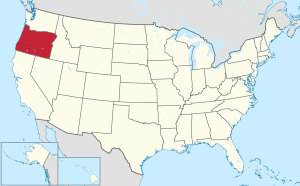
In a 2021 article by Eric Westervelt for National Public Radio, a local police officer was quoted saying “We’re already hearing of people coming into Oregon to use because they know they can do drugs and sleep outside.”
Obviously, a small island of care will attract people in need of care. A local policy enacted in Oregon – and only Oregon – cannot fix the nationwide problems caused by a half century of the federal “War on Drugs.”
 Frank Brown Cloud