I went to the jail last Sunday afternoon to host our weekly poetry class. A corrections officer escorted me to the fourth floor and then down a hallway toward the room that they let me use for classes. The officer and I had briefly chatted in the elevator, but after we reached the fourth floor, it was too loud to easily communicate. Somebody was screaming, and in between the bouts of screaming this person was kicking a metal cell door, a machine-gun clang-clang-clang-clang reverberating through the hall.
Inside the classroom, the screaming was muffled, but the clang-clang-clang-clang sounds still punctuated our discussion every ten or twenty minutes. In jail, people are issued floppy orange crocs, which aren’t designed for repeatedly slamming into steel. I’ve heard that kicking a metal door while wearing crocs often results in broken toes.
When our poetry class was finished, about two hours later, a pair of corrections officers escorted me back to the elevator. As we walked down the fourth floor hallway, we didn’t talk. The person was still screaming.
Presumably, this person had been screaming all day.
Presumably, this person would go on screaming long after I left.
#
Nana Kwame Adjel-Brenyah’s Chain-Gang All-Stars is set in a dystopian future very similar to present-day America, with a crucial difference. People who are incarcerated are given a choice: they can either remain in prison for the entirety of their sentence, or they can become reality-television gladiators and go free after “only” three years … if they survive.
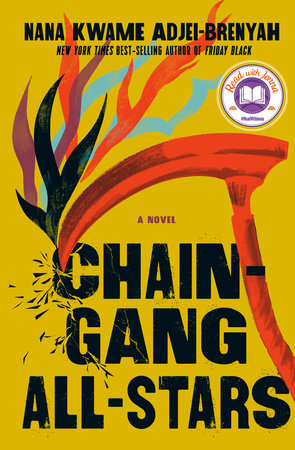
Almost no one survives. For each lethal contest, gladiators with similar records are paired, offering the viewing public the most exciting feats of murderous athleticism. The participants have to engage in another contest every week or two for the entirety of their three years, which means that, mathematically, we’d expect for only one out of every billion billion billion people to maintain a winning record long enough to be set free.
Even the United States – the incarceration capital of the world – doesn’t yet have a billion billion billion (roughly ten to the thirtieth power) people kept in cages.
As you might expect, no prisoners in Adiel-Brenyah’s dystopian world have actually been set free after participating as gladiators (unless you count the corporate shill who posed as a contestant). During the contests, the prisoners’ bodies deteriorate, making each victory more difficult to come by. And the need to constantly dehumanize everyone around them – how else could they willingly swing a weapon at another luckless person’s head? – makes many of them question the value of continued living. Even the few participants who are nearly set free often choose suicide rather than emerging into the world that designed and abetted such traumatizing games.
But Chain-Gang All-Stars opens with the story of one incarcerated person whose luck might be changing. After nearly three years or murdering other contestants for the American entertainment industry, a woman named Thurwar is about to be set free. She only has to endure two more weeks of trauma.
#
A few weeks ago, during a class in jail, someone who attended was lamenting that he was still inside.
“They’re going to set me loose on Thursday. So on Thursday, I’ll no longer be a menace to society? But how is that different from today? I’m not going to be different. If it’s okay for me to be out there Thursday, just let me go today!”
He didn’t feel as though his time with the Department of Corrections was “correcting” him.
Indeed, when we send our neighbors away to jails and prisons, we’re typically making ourselves less safe.
In Texas, a bevy of judges accidentally conducted something akin to a clinical trial in medicine: take an equivalent cohort of people, randomly assign them different treatments, then see what happens. People were randomly assigned a judge; the judges had significant leeway in sentencing; some judges were sympathetic to people who committed poverty crimes but were hard on drugs, other judges believed (correctly) that drug addiction isn’t a matter for the courts but came down hard on poor people caught stealing.
Which resulted in people with essentially identical cases being either set free or sent to prison, all depending on which judge they’d randomly received.
The people who were set free went on to commit fewer future crimes. The people who were sent to prison – who would’ve gone free if they’d been assigned a different judge – were often made more dangerous.
My mother-in-law was murdered by a man who’d been traumatized by his ten years of incarceration, a punishment levied onto him because he was caught selling small amounts of cocaine. If the judges overseeing this man’s initial case had helped him instead of sending him to prison, my mother-in-law would still be alive. If we as a people had spent our money to alleviate poverty instead of devoting our budget to militarized policing and prisons, this man would never been charged with a crime, and my mother-in-law would still be alive.
In the world of Adjei-Brenyah’s Chain-Gang All-Stars, protesters hold up signs: “Where life is precious, life is precious.”
Our willingness to throw away ten years of a person’s life because he was selling cocaine – the exact same product that wrought Merck pharmaceutical company’s initial fortune – reveals the scant value that we Americans currently place on life. A ten-year prison sentence is already something like fifteen percent of a murder. We’ve been stealing time, taking away so much of people’s lives.
#
In Chain-Gang All-Stars, the gladiators know that they probably won’t survive. But they enroll in the program anyway. Most have been tortured during their time in prison. The purpose of torture is to compel people to do anything – even violate their most deep-set ethical beliefs, like the belief that they will not betray their friends – in order to make the torture stop.
During our poetry class, when the clang-clang-clang-clang of kicking started up again, people used a lot of phrases to refer to what was happening: “twenty-three and one,” “the hole,” “seg block.” These phrases all mean the same thing: isolation. Solitary confinement.
Someone was in a cell alone, and screaming.
#
A few weeks ago, someone in class was talking about his time in solitary:
“You know what’s fucked up? You’d think, if you go to prison or something, the worst thing they could do to you is to put you in a room full of murderers and rapists. That’s horrible, right?”
“But that’s not the worst. Let me tell you, it’s not. Because they might put you in the hole, and you’re just by yourself for days and days, and you can feel your mind fading, and you’ll be screaming, like, ‘Let me out! Put me back with all them murderers and rapists! Please!’ “
#
Juan Mendez, the United Nations Special Rapporteur on Torture, has argued that prisoners should not be extradited to any country that routinely tortures inmates. Several countries are listed, including the United States. Solitary confinement is a form of torture.
After 15 days in solitary, Mendez argues, the psychological damage caused by solitary confinement is irreversible.
No one should be in the hole for over two weeks.
In the United States, attempts to change prison policy such that solitary confinement not be used for more than 90 days have failed. Here, there is no limit. Many people have been held in solitary confinement for years at a time. For some, decades.
#
Chain-Gang All-Stars is a difficult book to read – an early scene was so gruesome that I nearly gave up. Worse, there are moments when the action scenes might feel riveting, even pleasurable, to read. And then you might wonder whether your enjoyment makes you complicit in an unethical system. If we know about the trauma and suffering that underlies a system – be it our judicial system, or even a concussion-causing sport like football – can we placidly go on as we did before?
Footnotes are spread throughout Adjei-Brenyah’s dystopian fiction, offering readers painful truths about the real world we’re living in. Adjei-Brenyah presents facts, statistics, legal analysis. And, throughout the story, Adjei-Brenyah attempts to convey how routine torture and trauma feels.
By the end of the book, readers will know.
And then: a choice. Will that knowledge change what we do?

 Frank Brown Cloud